Эта статья пока доступна только на английском — перевод на русский в процессе.
Golf Fitness Training in the UAE: Improve Your Game with Science-Based Conditioning
Golf Fitness Training in the UAE: Improve Your Game with Science-Based Conditioning
Golf is among the most physically demanding sports to master, yet it remains one of the least-trained for in the fitness sense. The explosive rotational demands of the golf swing — generating club head speeds of 90–130 mph in professionals — require exceptional hip mobility, thoracic rotation, core stability, and lower body power. Without golf-specific physical preparation, technique limitations imposed by the body become the ceiling of performance improvement, regardless of how much time is spent on the range.
The UAE has a thriving golf culture. Courses at Yas Links, Abu Dhabi Golf Club, Emirates Golf Club, and Jumeirah Golf Estates attract players from around the world. Golf fitness training — once the exclusive domain of tour professionals — is now accessible to any UAE golfer willing to invest in it.
The Physical Demands of Golf: What Research Shows
A 2006 biomechanical analysis by Hume, Keogh & Reid (Sports Medicine) identified the following physical capacities as most determinant of golf performance:
- Hip internal rotation: Critical for the weight transfer and hip clearing phase of the downswing. Limited hip mobility is associated with lower swing speed and a compensatory "over the top" swing path.
- Thoracic rotation: The thoracic spine (mid-back) is the primary rotation segment in the backswing. Stiffness here — common in office workers and older players — forces compensation at the lumbar spine, increasing injury risk.
- Core stability: The "proximal-to-distal" sequencing of the swing requires the core to transfer force from the legs and hips through to the arms. A weak core acts as an energy leak in this chain.
- Lower body power: Leg drive in the downswing contributes up to 40% of total club head speed (Wattier et al., 2011 — Journal of Sports Sciences).
- Grip strength and wrist stability: Particularly relevant for impact shock absorption and club control in rough and bunker shots.
Golf Injuries: Why Fitness Prevents Them
The lumbar spine, shoulder, elbow (medial epicondyle), and wrist account for approximately 80% of all golf injuries (Gosheger et al., 2003 — American Journal of Sports Medicine). Virtually all chronic golf injuries are attributable to:
- Swing mechanics compensation for limited mobility
- Repetitive loading without adequate physical preparation
- Inadequate warm-up before rounds (particularly common in UAE summer heat where players rush to beat the heat)
Golf fitness training directly addresses all three causes — making injury prevention one of its most compelling justifications beyond performance improvement.
The TPI (Titleist Performance Institute) Model
The most evidence-based framework for golf fitness is the TPI (Titleist Performance Institute) model, which connects physical screening deficits directly to swing characteristics. The principle: the body performs the most efficient swing it can given its physical limitations. Change the body — change the swing.
TPI-certified coaches screen for 16 physical benchmarks including: overhead squat, single-leg balance, hip rotation range, thoracic rotation, and shoulder mobility. Deficits in specific tests correlate with specific swing faults (e.g., limited hip internal rotation → "early extension"; poor thoracic rotation → "reverse spine angle").
While a full TPI assessment requires a certified practitioner, awareness of these principles guides effective golf fitness programming.
Golf-Specific Fitness Program: Key Exercises
Mobility: The Foundation
- 90/90 hip stretch: Both hips at 90° on the floor, rotate the torso toward the front knee. Directly addresses hip internal and external rotation — the most common golf fitness deficit.
- Thoracic rotation on foam roller: Foam roller placed under mid-back, hands behind head, rotate the thoracic spine from side to side. Non-negotiable for UAE office workers playing golf.
- World's greatest stretch: Lunge with thoracic rotation and reach. Multi-joint mobility that mimics the full range of the golf swing.
- Glute bridge with rotation: From a glute bridge position, rotate the pelvis while keeping the ribcage stable — directly trains hip-trunk dissociation essential for the downswing.
Stability and Core Control
- Pallof press: Cable or band anchored at chest height, press straight out from the chest while resisting rotation. Trains anti-rotation core stability — the primary core demand in golf.
- Single-leg Romanian deadlift: Balance on one leg, hinge at the hip. Develops the hip stability required for the impact position and follow-through.
- Dead bug: Supine, opposite arm and leg extended while maintaining lumbar contact with floor. Core stability without lumbar compression.
Power Development
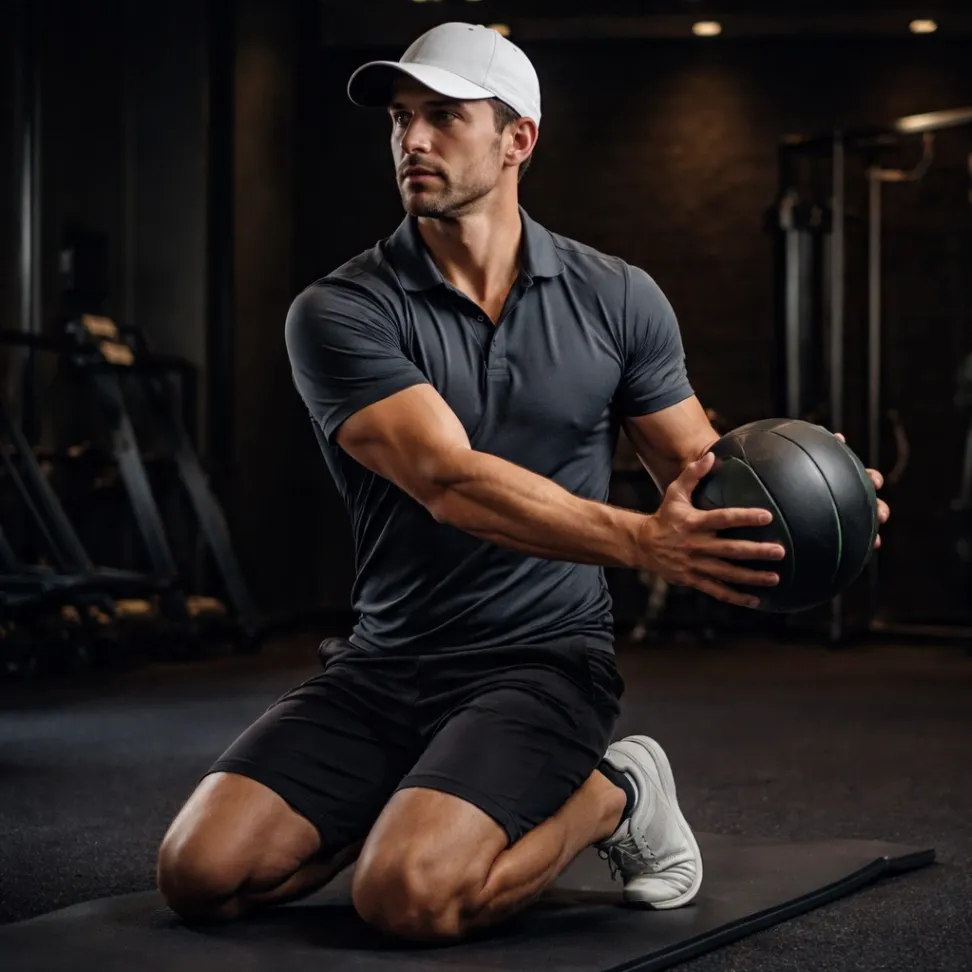
- Medicine ball rotational throw: Standing perpendicular to a wall, rotate explosively and throw a 3–5 kg medicine ball against the wall, catching on the rebound. Directly trains the rotational power of the golf swing.
- Jump squats and broad jumps: Lower body explosive power translates directly to downswing ground reaction force and club head speed.
- Cable pull-through: Hip hinge with explosive extension — builds the posterior chain power central to the hip thrust phase of the downswing.
Golf Warm-Up Routine for UAE Conditions
UAE golfers often skip warm-up due to heat — ironically, heat actually reduces muscle viscosity and can create a false sense of flexibility without adequate neuromuscular activation. A 10-minute pre-round routine:
- 5 minutes of brisk walking (temperature acclimatisation)
- 90/90 hip stretch × 10 each side
- Thoracic rotation × 15 each side
- Lunge with reach × 8 each side
- Club behind-the-back rotations × 20 (slow, controlled, gradual speed increase)
- 10 chip shots → 10 half swings → 10 full irons → 5 driver swings (progressive activation)
Frequently Asked Questions
Q: Will golf fitness training add distance to my drives?
A: Yes — for players with physical limitations contributing to their swing faults. A 2017 study (Wren et al. — Journal of Strength & Conditioning Research) found an average 8% increase in club head speed after 8 weeks of rotational power training. The caveat: physical improvement must be matched by technique practice on the range for the increased power to translate to distance.
Q: How many times per week should a UAE golfer train?
A: 2–3 dedicated golf fitness sessions per week of 45–60 minutes is optimal. More frequent training may create fatigue that impairs on-course technique work. The golf fitness programme should complement, not compete with, time on the course and range.
Q: Can I do golf fitness training at home in Abu Dhabi?
A: Yes — mobility and stability work requires no equipment. A foam roller, resistance band, and medicine ball cover most power development needs. A TRX or cable machine adds significant value for rotational exercises if available.
Q: Is golf fitness training different for seniors?
A: Yes — mobility becomes more critical as a limiting factor with age, and power development should use lighter loads with higher velocity emphasis. Senior golfers typically benefit enormously from thoracic mobility work and hip rotation restoration, which can reverse 5–10 years of swing deterioration.
Q: What is the best golf course for fitness-conscious golfers in Abu Dhabi?
A: Abu Dhabi Golf Club and Yas Links both have fitness facilities alongside the course. Several Abu Dhabi personal trainers specialise in golf fitness and offer court-side or gym-based programmes.
Improve Your Golf Game With a Certified UAE Fitness Coach
Our sports performance coaches build golf-specific fitness programs for Abu Dhabi and Dubai golfers — mobility, power, injury prevention, and on-course conditioning.
Find Your Coach →Готовы применить это на практике?
Подберём вам сертифицированного тренера 369MMAFIT в Дубае — персональные тренировки, ММА и питание, очно или онлайн.