هذه المقالة متاحة باللغة الإنجليزية فقط حالياً — الترجمة العربية قيد الإعداد.
Online vs In-Person Personal Training UK: Which Is Right for You?
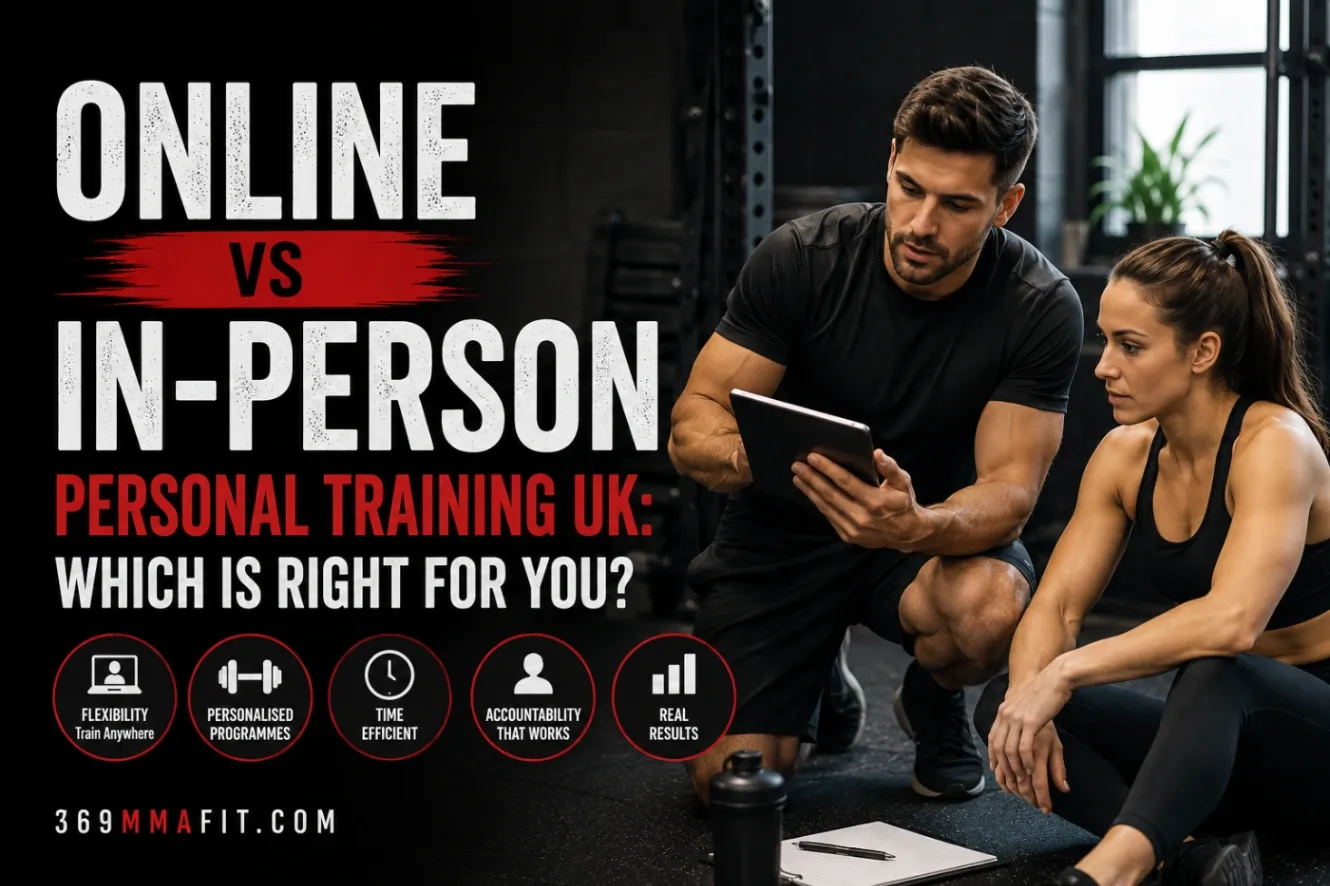
If you are a UK adult weighing up whether to hire an online or in-person personal trainer, this guide gives you a straight, evidence-based comparison so you can choose the format that fits your budget, schedule and goals. We will cover cost, accountability, flexibility, equipment, technique feedback and likely results, then finish with a decision checklist you can run through in five minutes.
Why the format matters more than people think
The biggest predictor of results from any training plan is not whether your coach is in the room, it is whether you actually do the work, consistently, for months. The NHS recommends that adults aim for at least 150 minutes of moderate-intensity activity, or 75 minutes of vigorous activity, each week, plus muscle-strengthening work on two or more days. Most people already know this. The hard part is adherence, and a good coach's main job is to keep you adherent.
Both online and in-person coaching can deliver excellent adherence, but they do it differently, and they suit different people. The American College of Sports Medicine (ACSM) and the National Strength and Conditioning Association (NSCA) both stress that effective programming rests on the same principles regardless of delivery: progressive overload, specificity, individualisation and recovery. The science of training does not change online; what changes is how the coaching is delivered, supervised and paid for.
The honest headline
- In-person wins on real-time hands-on correction, spotting heavy lifts, and the social ritual of showing up to a venue.
- Online wins on cost, scheduling flexibility, choice of coach, and structured app-based accountability between sessions.
- For most general-population goals, fat loss, getting stronger, building a habit, training for a 10k, a well-run online programme can produce comparable results to in-person at a fraction of the price.
Cost: where the gap is largest
Cost is the clearest difference. In-person personal training in the UK is typically priced per hour, and rates vary widely by region; central London commands far more than a regional town. As a rough national picture, single in-person sessions commonly sit in the region of thirty to seventy pounds or more per hour, with premium city studios higher still. Training two to three times a week with a face-to-face coach can therefore run into several hundred pounds a month.
Online coaching restructures that maths. Instead of paying for the coach's physical hour, you usually pay a monthly fee for programming, app-based tracking, regular video check-ins and ongoing messaging support. Because the coach is not tied to a single venue or a one-client-per-hour model, the monthly cost is often a fraction of an equivalent in-person package, while still giving you structured, individualised coaching every week.
What you are actually paying for
- In-person: the coach's time in the room, hands-on supervision, and sometimes gym access bundled in.
- Online: a bespoke programme, technique review of your filmed sets, habit and nutrition coaching, data tracking and accountability, spread across the week rather than concentrated into one hour.
If budget is your main constraint, online coaching usually offers more coaching contact per pound. You can compare what a structured online package includes on our pricing page before committing to anything.
Accountability: the deciding factor for most people
Accountability is where people assume in-person automatically wins, but it is more nuanced. A face-to-face session is a fixed appointment you are unlikely to skip, which is genuinely powerful for people who need an external commitment device. However, that accountability often evaporates the moment the hour ends; the other 167 hours of your week are unsupervised.
Good online coaching is designed to cover those 167 hours. Through an app, your coach can see whether you logged your sessions, hit your step target, tracked your meals and turned up to your scheduled workouts, and nudge you when you drift. Behavioural science supports this: structured self-monitoring and regular feedback are consistently associated with better adherence and weight-management outcomes in evidence reviews indexed on the Cochrane Library and PubMed.
Which accountability style suits you?
- You need the fixed appointment or you will not go: in-person, or live online video sessions, will serve you best.
- You are reasonably self-directed but lose momentum alone: online check-ins plus app tracking are usually enough, and cheaper.
- You want both supervision and daily structure: hybrid online coaching with scheduled video calls gives you the appointment and the between-session follow-up.
Flexibility and access: online's biggest practical edge
Online coaching removes geography and most scheduling friction. You are not limited to trainers within commuting distance, so you can match with a coach who genuinely specialises in your goal, whether that is postnatal strength, marathon prep, or training around a desk job. Sessions and check-ins can happen early morning, late evening, or while travelling for work.
This matters in the UK context. Office for National Statistics data shows a substantial share of the UK workforce now does some or all of their work from home, and long or irregular commutes remain common. For shift workers, parents, frequent travellers and anyone in a rural area without a nearby quality studio, the ability to train at home or in any gym on your own timetable is decisive.
Where in-person flexibility still helps
- If you genuinely dislike training at home and need the environment of a staffed gym to focus.
- If you want to use specialist kit, such as heavy barbells, machines or sleds, that you cannot replicate at home, though many gyms allow you to bring an online programme and train it independently.
If you are leaning towards remote coaching, our online training overview explains how video sessions and app-based programming work in practice.
Equipment and technique feedback: the real trade-off
This is the category where in-person has a legitimate, hard-to-replicate advantage, but it is narrower than most people assume.
Hands-on coaching and spotting
An in-person coach can physically adjust your position, provide tactile cues, and spot you under a heavy barbell. For maximal-load powerlifting, Olympic weightlifting technique, or clients who are very deconditioned and anxious, that real-time supervision genuinely reduces risk and speeds learning.
How online closes the gap
Modern online coaching handles technique through filmed sets. You record a lift from a prescribed angle, your coach reviews it and sends back specific corrections, often with frame-by-frame annotation. Because the coach can rewatch the clip, the feedback can be more detailed than a glance in a busy gym. The NSCA and ACSM both emphasise that movement quality is taught through clear cueing and progressive load, both of which transfer well to a structured, video-reviewed format for the vast majority of general-population exercises.
Equipment realities
- Bodyweight, dumbbells, bands and a bench are enough for most fat-loss and general-strength goals, and any competent online coach will programme around what you own.
- Train at a commercial gym and follow your online programme there if you want full equipment without the per-hour cost.
- Highly technical barbell sport at heavy loads is the one area where in-person supervision is hard to beat early on.
Results and safety: what the evidence suggests
For health and body-composition outcomes, the format is far less important than the programme quality and your consistency. The World Health Organization and NHS guidance both centre on accumulating regular activity and strength work; neither requires a coach in the room. Reviews on the Cochrane Library and studies indexed on PubMed support digitally delivered exercise and behaviour-change interventions as effective tools for improving activity levels and supporting weight management, particularly when they include personalised feedback and self-monitoring.
The British Heart Foundation and the British Journal of Sports Medicine consistently highlight that the most beneficial exercise is the exercise you sustain, making adherence, not delivery method, the true driver of long-term results. From a safety standpoint, the main risk for general-population training is not lack of supervision but progressing too fast or with poor technique; a good online coach manages both through sensible load progression and video review. If you have a medical condition or are returning from injury, follow NHS or NICE advice and check with your GP before starting any new programme.
Who each format suits best
- Choose in-person if: you lift near-maximal loads in technical barbell sports, you are highly anxious about training alone, or the fixed in-room appointment is the only thing that gets you moving, and your budget comfortably covers it.
- Choose online if: you want flexibility, value for money, a wider choice of specialist coaches, and structured accountability across the whole week, which describes most people pursuing general fitness or fat loss.
- Choose hybrid online if: you want live video supervision plus daily app-based follow-up without paying full in-person rates.
Your decision checklist
Run through these questions honestly. The more you tick on one side, the clearer your answer.
- Budget: Can you comfortably afford several hundred pounds a month? If not, online almost certainly gives you more coaching per pound.
- Self-direction: Will you train without someone watching, if you have a clear plan and weekly check-ins? If yes, online fits.
- Schedule: Do you have unpredictable hours, travel, shift work or caring responsibilities? Online flexibility wins.
- Goal type: Is your goal general fitness, fat loss, habit-building or endurance? Online covers these fully. Heavy technical barbell sport leans in-person early on.
- Equipment: Do you have or can you access a gym or home kit and follow a plan there? If yes, you do not need to pay for an in-room coach.
- Accountability need: Do you need a fixed appointment or you simply will not show? Choose in-person, or online live video sessions.
- Coach fit: Is the right specialist coach for your goal nearby? If not, online removes the geography problem entirely.
Most UK clients with general health and physique goals will find online coaching ticks the practical boxes. To see how the format works day to day, our how it works guide walks through onboarding, programming and check-ins, while our services overview sets out the coaching options available.
How to choose a qualified coach, either way
Whatever format you pick, vet the coach properly. The Chartered Institute for the Management of Sport and Physical Activity (CIMSPA) is the UK's professional body for the sector, and the National Careers Service outlines the recognised qualification routes for personal trainers. Look for:
- A recognised UK qualification, typically a Level 3 Personal Trainer certificate or higher, and CIMSPA recognition.
- Appropriate insurance and a clear, written coaching agreement.
- Genuine experience with clients like you, and references or reviews you can check.
- A structured onboarding: a proper intake of your history, goals, injuries and equipment before any programme is written.
Ready to try online coaching? Here is your next step
If the checklist pointed you towards online, or hybrid, coaching, the simplest way to start is to see who is available and find a coach whose specialism matches your goal. 369MMAFIT is an online coaching platform that connects UK clients with certified coaches for online personal training: live video sessions plus app-based programming, technique review and weekly accountability, which works wherever you are in the UK.
- Browse certified coaches: Find an online personal trainer and compare specialisms, reviews and pricing.
- Prefer to be matched? Request a trainer, tell us your goal, schedule and budget, and we will connect you with suitable coaches.
If you would rather talk it through first, you can get in touch with any questions before you commit.
Frequently Asked Questions
Q: Is online personal training as effective as in-person in the UK?
A: For general fitness, fat loss, strength and endurance goals, a well-run online programme typically produces comparable results to in-person, because outcomes are driven mainly by consistency and programme quality rather than supervision in the room. The main exception is heavy, highly technical barbell sport, where in-person spotting and hands-on cueing have a real early advantage. For most UK adults, online coaching is genuinely effective.
Q: How much does online personal training cost compared with in-person in the UK?
A: In-person training is usually charged per hour, commonly around thirty to seventy pounds or more in many areas and higher in central London, so multiple weekly sessions can run to several hundred pounds a month. Online coaching is typically a monthly fee covering programming, app tracking and check-ins, and usually costs a fraction of an equivalent in-person package while still delivering weekly coaching contact.
Q: How does an online coach check my technique without being there?
A: You film your sets from a prescribed angle and upload them; your coach reviews the footage and sends specific corrections, often with annotations. Because they can rewatch the clip, the feedback can be more detailed than a quick look in a busy gym. This works well for the vast majority of general-population exercises.
Q: What equipment do I need for online personal training at home?
A: Many fat-loss and general-strength goals can be met with just bodyweight, a set of dumbbells, resistance bands and a bench. A good online coach will design your programme around exactly what you own. If you want full equipment, you can train your online plan at a commercial gym without paying per-hour rates.
Q: Is online coaching safe if I am a complete beginner?
A: Yes, when the coach is qualified and progresses you sensibly. Reputable coaches start with a thorough intake, teach foundational movements with clear cueing, review your videos and increase load gradually. Follow NHS and NICE guidance and check with your GP first if you have a medical condition or are returning from injury.
Q: How do I know if an online trainer is properly qualified in the UK?
A: Look for a recognised UK qualification, typically a Level 3 Personal Trainer certificate or higher, and CIMSPA recognition, plus appropriate insurance and a written coaching agreement. The National Careers Service describes the recognised routes into the profession. Always check reviews or references and confirm experience with clients who share your goal.
References
- NHS — Physical activity guidelines for adults
- American College of Sports Medicine (ACSM) — exercise programming and position stands
- National Strength and Conditioning Association (NSCA) — strength and conditioning principles
- Cochrane Library — reviews on exercise and behaviour-change interventions
- CIMSPA — UK professional standards for personal trainers
- British Journal of Sports Medicine — research on physical activity and health
جاهز لتطبيق ذلك؟
احصل على مدرب 369MMAFIT معتمد في دبي — تدريب شخصي وMMA وتغذية، حضوريًا أو عبر الإنترنت.