هذه المقالة متاحة باللغة الإنجليزية فقط حالياً — الترجمة العربية قيد الإعداد.
Online Coaching for Weight Loss: What the Science Actually Shows
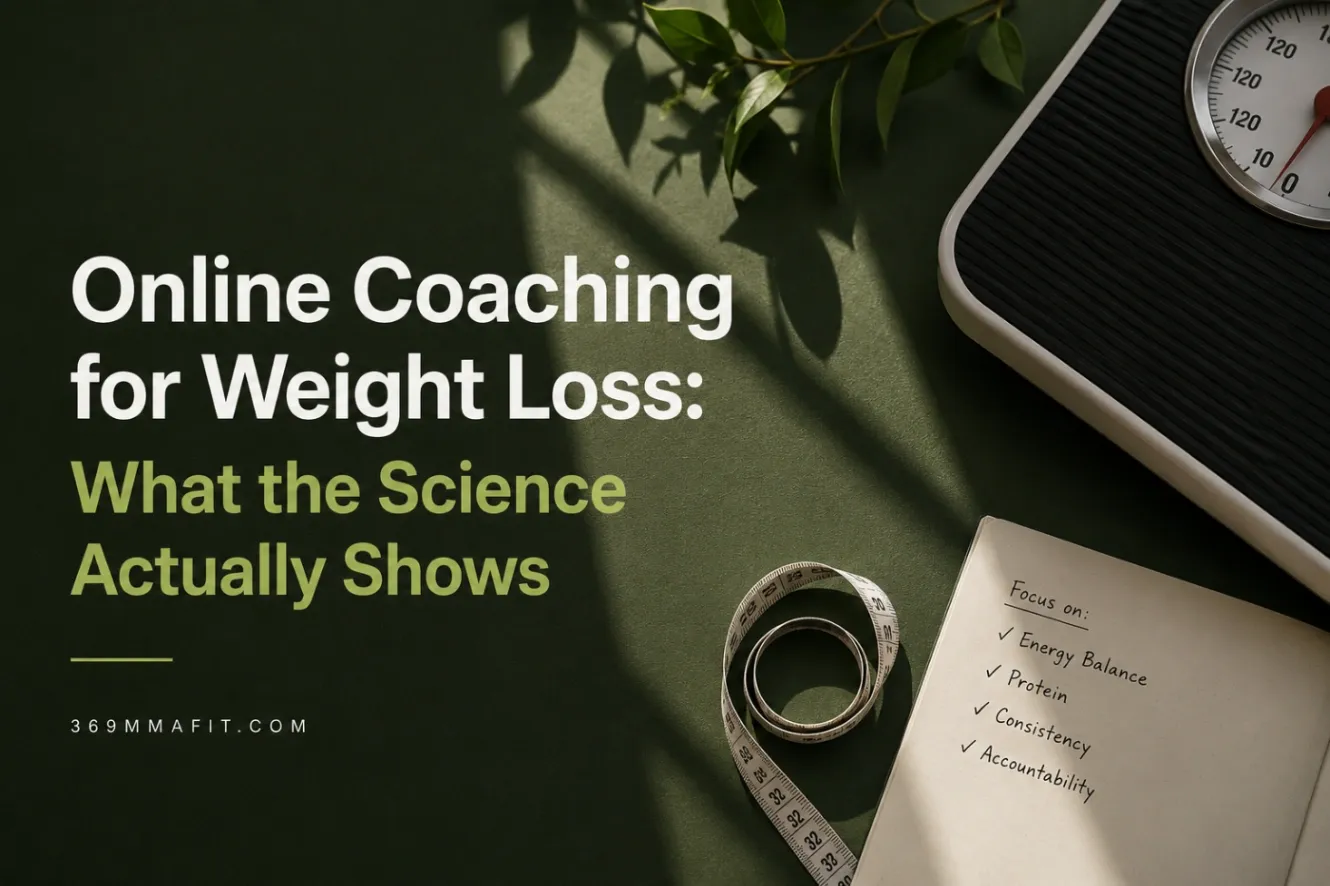
This guide is for US adults who want to lose body fat for good and are wondering whether an online coach is worth it. The short version: weight loss is governed by a handful of well-established principles, and the hard part is not knowing them but doing them consistently for months. That is exactly where remote coaching, daily tracking, and human accountability outperform raw willpower. Below is what the science actually shows and how to put it to work with an online coach.
The non-negotiable foundation: energy balance
Every credible weight-management body agrees that fat loss requires a sustained energy deficit, meaning you burn more calories than you consume over time. The Mayo Clinic frames it plainly: to lose weight you must take in fewer calories than you use, whether by eating less, moving more, or both. Calories are not a fad. They are the accounting layer underneath every diet that has ever worked, from low-carb to Mediterranean to plate-control plans.
What changes between approaches is how you create that deficit in a way you can tolerate. A few practical anchors:
- One pound of body fat stores roughly 3,500 calories. A deficit of about 500 calories per day tends to produce close to a pound of loss per week for many people, though real-world results vary with metabolism, water shifts, and adherence.
- Deficits that are too aggressive backfire. Very low intakes increase hunger, fatigue, and muscle loss, and they are harder to sustain, which is why crash diets so often rebound.
- You cannot out-exercise a poorly tracked diet. Exercise matters enormously for health and muscle, but intake is usually the larger lever for the scale.
What a sustainable rate of loss looks like
The CDC notes that people who lose weight gradually and steadily, often described as about 1 to 2 pounds per week, are more likely to keep it off than those who lose quickly. For someone carrying significant excess weight, the upper end may be appropriate early on; for someone closer to their goal, slower is smarter. A good online coach sets your target rate to your starting point, not to a one-size-fits-all promise.
Why a coach beats willpower: the adherence problem
Here is the uncomfortable truth the research keeps surfacing: most diets can work, but most people struggle to stick with them at home. The differentiator is rarely the macro split. It is adherence, the ability to keep doing the plan week after week. Behavioral weight-loss programs that include regular check-ins, self-monitoring, and accountability consistently outperform go-it-alone attempts in the peer-reviewed literature indexed on PubMed.
Accountability is not about a coach shaming you. It is about structure that reduces the number of decisions you have to win on your own:
- Self-monitoring works. People who log food, weight, and activity tend to lose more than those who do not, and remote tools make logging frictionless.
- Regular contact predicts results. Frequent check-ins, even brief asynchronous ones, are associated with better outcomes than infrequent contact.
- Course-correction beats perfection. A coach reads your weekly data, adjusts calories or steps when the scale stalls, and keeps a bad day from becoming a lost month.
This is precisely what online training is built to deliver: a real human looking at your numbers and your life, then telling you the one or two things to change next week. Willpower is a finite daily resource; a system is not. A coach also removes guesswork, so you can spend your energy executing rather than second-guessing whether the plan is even right.
Protect your muscle: resistance training during a deficit
When you lose weight, some of the loss can come from lean muscle, not just fat. That is a problem, because muscle drives strength, function, and a healthier resting metabolism. The fix is well established. The American College of Sports Medicine and the World Health Organization both recommend that adults perform muscle-strengthening activity on two or more days per week, and during a calorie deficit this becomes even more important to preserve lean mass.
Resistance training plus adequate protein sends your body a clear signal: keep the muscle, spend the fat. You do not need a commercial gym to do it. A remote coach can program effective sessions around dumbbells, bands, a bench, or even bodyweight at home, then check your form over video.
A simple weekly template a coach might build
- Day 1, full body strength: a squat pattern, a horizontal push, a horizontal pull, a hinge, and a core movement.
- Day 2, full body strength: a lunge pattern, an overhead push, a vertical pull, a hip hinge variation, and a loaded carry.
- Optional Day 3, strength or conditioning: repeat a session or add intervals based on recovery and schedule.
- Daily movement target: a step goal and a few minutes of mobility work.
Progression is the secret ingredient. Each week you add a little weight, a rep, or a set so the stimulus keeps challenging your muscles. The National Strength and Conditioning Association and NASM both emphasize progressive overload as the core driver of strength and body-composition change. If you want structured strength programming, browse general fitness coaching or a focused weight-loss program.
Protein: the most underrated fat-loss lever
If energy balance is the engine, protein is the lubricant that keeps the process humane. A position stand from the International Society of Sports Nutrition supports higher protein intakes than the basic RDA for active people and for those trying to lose fat while keeping muscle. Higher protein during a deficit does three useful things:
- Preserves lean mass alongside resistance training, so more of your loss comes from fat.
- Increases satiety, meaning you feel fuller on fewer calories, which directly supports adherence.
- Has a higher thermic effect, so a small slice of protein calories is spent just digesting it.
Practical targets used by many coaches land in the range of roughly 0.7 to 1.0 grams of protein per pound of goal body weight per day, distributed across meals. Whole-food sources such as chicken, fish, eggs, dairy, lean beef, tofu, and legumes do most of the work, and a shake can fill the gaps. Your coach personalizes the number to your weight, training, and preferences rather than copying a generic chart.
NEAT and steps: the deficit you barely notice
Structured workouts are valuable, but they are only a few hours a week. The other lever is NEAT, non-exercise activity thermogenesis, which is the energy you burn walking, fidgeting, doing chores, and generally living. NEAT can vary meaningfully between individuals, and it often quietly drops when people start dieting, which can stall progress before they realize what happened.
The most controllable slice of NEAT is your step count. The CDC and American Heart Association both promote regular moderate activity such as brisk walking for weight management and cardiovascular health, and steps are an easy, trackable proxy. A coach might:
- Set a personalized daily step target and nudge it up gradually instead of demanding a huge jump.
- Use your wearable or phone data to spot the days NEAT crashes and problem-solve around them.
- Pair steps with strength work so cardio supports, rather than replaces, muscle preservation.
Per the World Health Organization, adults should aim for at least 150 to 300 minutes of moderate-intensity aerobic activity per week, and walking is one of the most accessible ways to bank it without dreading your workouts.
How remote coaching turns the science into results
Online coaching is not a watered-down version of in-person training; for weight loss it is often better, because the work happens between sessions and remote tools live with you every day. A well-run program typically combines:
- Individualized programming for training and nutrition, delivered through an app you check daily.
- Video sessions for form, technique, and live coaching, available anywhere in the US.
- Daily tracking of weight trend, food, steps, and workouts, so decisions are based on data, not guesswork.
- Weekly review and adjustment, the feedback loop that keeps you progressing when biology fights back.
- Messaging access for the real-life curveballs: travel, holidays, injuries, plateaus, and motivation dips.
The labor market reflects how mainstream this has become. The U.S. Bureau of Labor Statistics reports that employment of fitness trainers and instructors is projected to grow faster than the average for all occupations, and online delivery is a major reason coaching has scaled beyond the gym floor. The Health and Fitness Association similarly tracks rising digital and hybrid fitness adoption in recent years.
A 12-week starter framework
- Weeks 1 to 2, baseline: estimate your maintenance calories, set a modest deficit, learn to log, and lock in two strength sessions and a step goal.
- Weeks 3 to 6, build the habit: hit protein daily, progress the lifts, and let the coach adjust calories from your weekly weight trend.
- Weeks 7 to 10, push through plateaus: tighten tracking, bump steps, and add a third session if recovery allows.
- Weeks 11 to 12, consolidate: review what worked, set the next block, and practice maintenance skills so the loss sticks.
Choosing the right online weight-loss coach
Not every coach is equal. Use this checklist when you evaluate options on a marketplace of certified coaches:
- Credentials: look for nationally recognized certifications such as NASM, NSCA, or ACSM, ideally with weight-loss or nutrition coaching experience.
- Method, not magic: a good coach talks about energy balance, protein, progressive strength, and steps, not detoxes or secret fat-burning tricks.
- Personalization: the plan should reflect your schedule, injuries, food preferences, and starting fitness, not a recycled template.
- Communication cadence: confirm how often you will check in and how fast they reply, because contact frequency predicts results.
- Transparent pricing: review clear plan options before you commit.
If you are not sure which coach fits, you can describe your goals once and let qualified coaches come to you through the request-a-trainer flow. That removes the pressure of guessing and lets you compare a few personalized offers side by side.
Start your online weight-loss coaching today
The science is settled enough to act on today: eat at a sustainable deficit, prioritize protein, lift to keep your muscle, move more through steps, and use accountability to stay consistent. The missing piece for most people is a coach who reads the data and adjusts the plan, week after week, from anywhere in the US.
Ready to begin? Browse certified online weight-loss coaches on 369MMAFIT and pick the one who fits your goals. Prefer to have coaches reach out to you instead? Request a trainer in a couple of minutes and get matched. If you have questions first, contact our team and we will point you in the right direction.
Frequently Asked Questions
Q: Does online coaching really work for weight loss, or do I need in-person training?
A: Online coaching works very well for weight loss because the results come from daily nutrition, steps, and consistency, not from being watched in a gym. Remote tracking, video form checks, and frequent check-ins give you the accountability that research links to better outcomes. For most clients, the convenience actually improves adherence.
Q: How fast should I expect to lose weight with a coach?
A: The CDC notes that gradual, steady loss of roughly 1 to 2 pounds per week is more likely to stay off. Your safe rate depends on your starting weight, so heavier individuals may lose faster early on while those near goal go slower. A good coach sets a target rate to your situation rather than promising dramatic results.
Q: Do I have to lift weights to lose fat?
A: You can lose weight through diet alone, but resistance training protects the muscle you would otherwise lose in a deficit, which keeps you stronger and supports your metabolism. ACSM and WHO both recommend muscle-strengthening activity at least twice a week. A coach can program effective strength work at home with minimal equipment.
Q: How much protein do I need when trying to lose fat?
A: The International Society of Sports Nutrition supports higher protein intakes for active people and for those losing fat while preserving muscle. Many coaches use a range of roughly 0.7 to 1.0 grams per pound of goal body weight daily, spread across meals. Your coach will personalize the exact number to your body and preferences.
Q: What equipment do I need for online weight-loss coaching at home?
A: Often very little. A coach can build progressive programs around dumbbells, resistance bands, a bench, or bodyweight, and use video to coach your form. Walking covers most of your cardio needs, so a phone or a basic step tracker is usually enough to start.
Q: How is online coaching priced, and is it worth it?
A: Pricing varies by coach, session frequency, and how much support you want, and you can compare options before committing. The value comes from personalization and accountability, the factors most strongly tied to sticking with a plan. For many people, paying for structure is what finally makes the science work.
References
- Mayo Clinic - Weight loss and calorie balance basics
- Centers for Disease Control and Prevention - Physical activity and healthy weight guidance
- World Health Organization - Physical activity recommendations for adults
- American College of Sports Medicine - Exercise guidelines and position stands
- International Society of Sports Nutrition - Protein and body composition research
- U.S. Bureau of Labor Statistics - Fitness Trainers and Instructors outlook
جاهز لتطبيق ذلك؟
احصل على مدرب 369MMAFIT معتمد في دبي — تدريب شخصي وMMA وتغذية، حضوريًا أو عبر الإنترنت.