این مقاله فعلاً فقط به انگلیسی موجود است — ترجمهی فارسی بهزودی اضافه میشود.
Online Personal Training UK: Does It Actually Work?
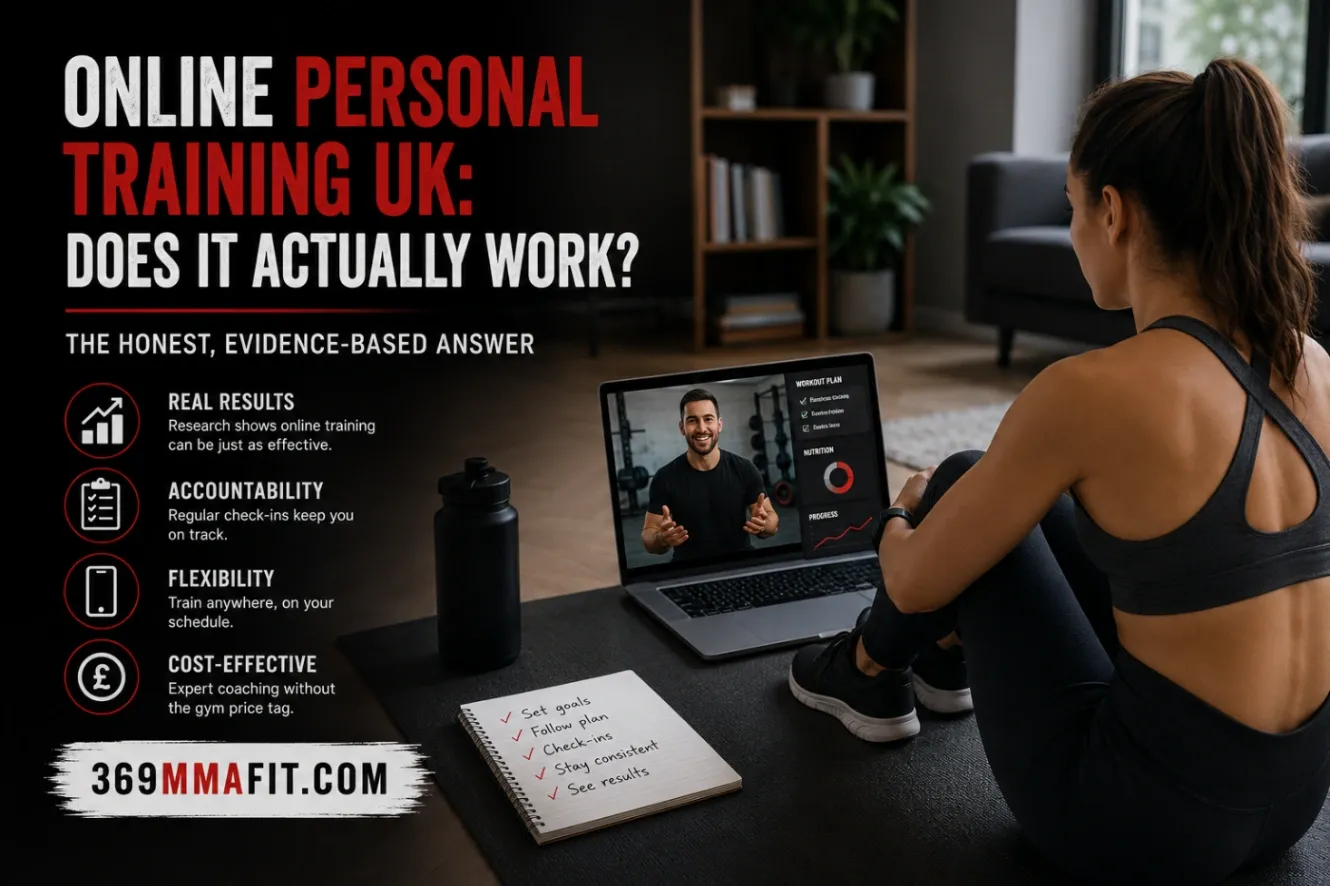
If you have ever wondered whether paying for a coach you only ever meet on a screen can really change your body and habits, this guide is for you. It is written for UK adults weighing up online personal training against a traditional gym-floor trainer, and it gives you an honest, evidence-based answer rather than a sales pitch. By the end you will know what online coaching actually involves, what the research says about results, why accountability matters more than location, and whether it fits your goals.
What "online personal training" actually means
Online personal training is not just a PDF workout emailed to you and a wave goodbye. A proper service combines three components that work together, and it is worth checking that any coach you consider offers all three.
- Individualised programming. Your coach builds a structured plan around your goals, training history, available equipment, schedule and any injuries, then updates it as you progress. This usually lives in a training app where you log every set, rep and weight.
- Live or video-reviewed coaching. Many coaches run real-time video sessions to teach technique and intensity, while others ask you to film key lifts so they can review form and send feedback. The best services blend both.
- Regular check-ins and accountability. Weekly or fortnightly reviews of your data, photos, measurements, sleep and adherence, plus messaging access between sessions. This is the engine of long-term change.
The practical difference from in-person training is location, not depth. A good online coach often spends more time analysing your data than a busy gym trainer who sees you for one hour and then moves to the next client. Because it is delivered remotely, it works for anyone in the UK with a phone, a little space and either a home setup or a gym membership. You can explore how this is structured on our online training page.
Online versus in-person: a quick comparison
- Convenience: Online wins — no commute, train at home or any gym, sessions fit around shifts and childcare.
- Cost: Online is typically lower per month because the coach is not paying for studio space or travel.
- Hands-on cueing: In-person wins for tactile correction and spotting heavy lifts.
- Data and programming depth: Online often wins because everything is logged and reviewed systematically.
- Access to specialists: Online wins — you are not limited to coaches within driving distance, so you can match with someone who genuinely specialises in your goal.
Does the research say remote coaching works?
The honest answer is yes, for the outcomes most people care about, with sensible caveats. The strongest evidence does not compare "online PT" by brand name, but it does test the underlying mechanisms: structured exercise prescription, remote and technology-delivered support, and behaviour-change coaching. These are exactly what online personal training delivers.
- Exercise itself is highly effective and the dose is well established. The NHS recommends adults do at least 150 minutes of moderate activity, or 75 minutes of vigorous activity, per week plus muscle-strengthening on two or more days. The World Health Organization echoes this globally. An online coach's job is to help you actually hit and progress that dose — and adherence is where most people fail on their own.
- Telehealth-delivered exercise can match supervised in-person exercise for many outcomes. Systematic reviews indexed on PubMed and in the Cochrane Library have examined remotely supervised and home-based exercise across fitness, rehabilitation and chronic-disease populations, generally finding meaningful improvements in strength, function and cardiovascular markers, often comparable to clinic-based delivery when programmes are well designed and supported.
- Digital and remote behaviour-change support improves outcomes. Research summarised by the National Institute for Health and Care Excellence (NICE) supports structured behaviour-change interventions — including remotely delivered ones — for increasing activity and supporting weight management. The British Journal of Sports Medicine regularly publishes work on digital and app-based interventions for physical activity.
- The training principles are identical regardless of delivery. Position stands from the American College of Sports Medicine (ACSM) and resources from the National Strength and Conditioning Association (NSCA) on progressive overload, training frequency and recovery apply whether your coach is standing next to you or reviewing your logs remotely. A barbell does not know where your trainer is sitting.
What the evidence does not show is a magic shortcut. Online coaching works because it makes good training and nutrition consistent over months — it is the consistency, not the medium, that produces results.
Accountability and adherence: the real reason coaching works
For most people, the limiting factor is not knowledge — it is doing the work week after week. This is where coaching of any kind earns its fee, and where online formats are surprisingly strong.
Why accountability changes outcomes
Behaviour-change science consistently highlights a handful of mechanisms that improve adherence: self-monitoring (logging workouts, food, weight and steps), specific goal-setting, regular feedback, and social accountability. Online platforms are built around exactly these features. When you know a coach will review your training log on Sunday night, you train on Friday. That gentle external accountability is often more reliable than motivation, which naturally fluctuates.
A simple weekly accountability loop
- Monday: Coach releases the week's programme in the app.
- Throughout the week: You log every session, plus steps, sleep and adherence to your nutrition targets.
- Mid-week: You film a key lift; the coach sends a short technique video back.
- Sunday: You submit a check-in — weight trend, measurements, photos, energy, how sessions felt.
- Start of next week: The coach adjusts load, volume or calories based on your data, and the loop repeats.
This closed feedback loop is hard to replicate alone with a generic app, and it is the core of what you are paying for. You can see how coaches structure ongoing support across goals on our fitness coaching page.
Who online personal training works best for
Online coaching is not equally suited to everyone. Be honest about which category you fall into.
- Busy professionals and parents who cannot reliably commit to fixed studio appointments but will train at home or at a local gym when it suits them.
- People who already have some training experience and mainly need structure, progression and accountability rather than constant hands-on correction.
- Anyone outside major cities or away from good in-person trainers, who can now access UK specialists remotely.
- Goal-driven individuals — fat loss, building muscle, running a first 10k, or general health — who respond well to data and check-ins. Our weight-loss coaching page covers how this is applied to body-composition goals.
- Shift workers and frequent travellers whose schedules make recurring in-person bookings impractical.
- People motivated by cost-efficiency, since online programmes are usually more affordable per month than one-to-one studio sessions.
Who should consider in-person instead
- Complete beginners who feel anxious or unsafe performing basic movements and want immediate hands-on guidance from day one.
- People returning from serious injury or surgery who need clinically supervised rehab — speak to your GP or an NHS physiotherapist first; the British Heart Foundation and NHS offer guidance for those with cardiac or chronic conditions.
- Those who genuinely cannot self-motivate without someone physically present and who know they will not log sessions or film lifts.
- Anyone training for maximal heavy lifts where in-person spotting is a safety necessity, though many lift safely online with conservative loading.
A hybrid approach also works well: occasional in-person sessions for technique, with online coaching for everything in between.
What results should you realistically expect?
Manage your expectations against the biology, not the marketing. The following ranges are typical and broadly consistent with guidance from the NHS, ACSM and the British Nutrition Foundation; individual results vary with adherence, starting point, sleep, stress and genetics.
- Fat loss: A sustainable, health-supporting rate is often cited as roughly 0.5–1 kg per week for many people, slowing as you get leaner. Slower, steadier loss is more likely to stick.
- Strength: Newer trainees commonly see rapid early strength gains in the first weeks to months as the nervous system adapts, before progress becomes more gradual.
- Muscle: Visible muscle gain is slower — typically realised over months of consistent progressive training and adequate protein, faster for beginners than for experienced lifters.
- Fitness and energy: Many people notice improved energy, sleep and cardiovascular fitness within the first few weeks, well before major changes in the mirror.
- Habits: The most valuable outcome is durable behaviour — consistent training and eating you can maintain after coaching ends.
Be wary of any coach promising fixed, dramatic numbers in short timeframes. Honest coaching sets process goals you control (sessions completed, steps, protein, sleep) and lets the outcomes follow.
How to choose a safe, qualified online coach
Because anyone can call themselves a "coach" online, due diligence matters. Use this checklist before you commit.
- Recognised qualifications. In the UK, look for coaches aligned with professional standards such as those set by CIMSPA, the chartered body for the sector. The National Careers Service describes the recognised entry routes for personal trainers.
- Insurance and clear policies. Professional indemnity insurance, a sensible health screening process, and transparent cancellation terms.
- A real check-in system. Ask exactly how often they review your data and how you contact them between sessions.
- Relevant specialism. Fat loss, strength, postnatal, sport-specific or rehab-adjacent goals each benefit from a coach who actually focuses there.
- Genuine reviews and a trial conversation. A good coach will happily explain their method before you pay.
You can compare verified coaches and their specialisms on the 369MMAFIT trainers directory, and review transparent pricing before deciding.
Get matched with an online coach
If you have decided online personal training fits your life, the fastest route to results is being matched with the right coach for your specific goal rather than guessing. 369MMAFIT connects UK clients with certified coaches who deliver fully online programming, video coaching and structured check-ins — wherever you live, whatever your schedule.
- Browse coaches now: Explore verified online personal trainers and view their specialisms, approach and reviews.
- Prefer to be matched? Request a trainer and tell us your goal, experience and schedule — we will connect you with suitable online coaches.
Still have questions? Our team is happy to help via the contact page.
Frequently Asked Questions
Q: Does online personal training really work as well as in-person?
A: For most common goals — fat loss, strength, general fitness and habit change — the evidence on remotely delivered and home-based exercise suggests outcomes can be comparable to in-person when the programme is well designed and supported. In-person retains an edge for hands-on cueing, heavy-lift spotting and very anxious beginners. The deciding factor is usually your consistency, not the location of your coach.
Q: How much does online personal training cost in the UK?
A: Online coaching is typically more affordable per month than one-to-one studio sessions because the coach has no studio or travel overheads. Exact prices vary by coach, support level and check-in frequency. You can compare transparent options on the 369MMAFIT pricing page before committing.
Q: What equipment do I need to start online training?
A: It depends on your plan. Many coaches design effective home programmes using minimal kit such as resistance bands, a pair of dumbbells or just bodyweight, while others build around a full gym membership. A good coach tailors the programme to whatever equipment you actually have.
Q: Is online personal training safe if I have a health condition?
A: Exercise is beneficial for most people, but if you have a heart condition, are pregnant, are recovering from injury or surgery, or have any concern, speak to your GP or an NHS professional first. Reputable coaches use a health-screening process and will adapt or refer you when in-person or clinical supervision is more appropriate.
Q: How quickly will I see results with an online coach?
A: Many people notice improved energy, sleep and fitness within a few weeks, while visible body changes such as fat loss or muscle gain build over months of consistent training and nutrition. Sustainable fat loss is often around 0.5–1 kg per week for many people. Results depend heavily on adherence, sleep, stress and your starting point.
Q: How do I know an online coach is properly qualified?
A: Look for recognised UK qualifications and alignment with professional standards such as those set by CIMSPA, plus appropriate insurance and a clear health-screening and check-in process. Ask how often they review your data and how you reach them between sessions. On 369MMAFIT you can review verified coaches and their specialisms before you choose.
References
- NHS — Physical activity guidelines for adults
- World Health Organization — Physical activity fact sheet
- Cochrane Library — systematic reviews on exercise and remote delivery
- NICE — guidance on physical activity and behaviour change
- British Journal of Sports Medicine — research on digital and app-based interventions
- CIMSPA — UK professional standards for fitness coaches
آمادهاید این را عملی کنید؟
با یک مربی معتبر 369MMAFIT در دبی مچ شوید — تمرین شخصی، MMA و تغذیه، حضوری یا آنلاین.