این مقاله فعلاً فقط به انگلیسی موجود است — ترجمهی فارسی بهزودی اضافه میشود.
Muay Thai Conditioning for MMA: Build Striking Endurance and Power
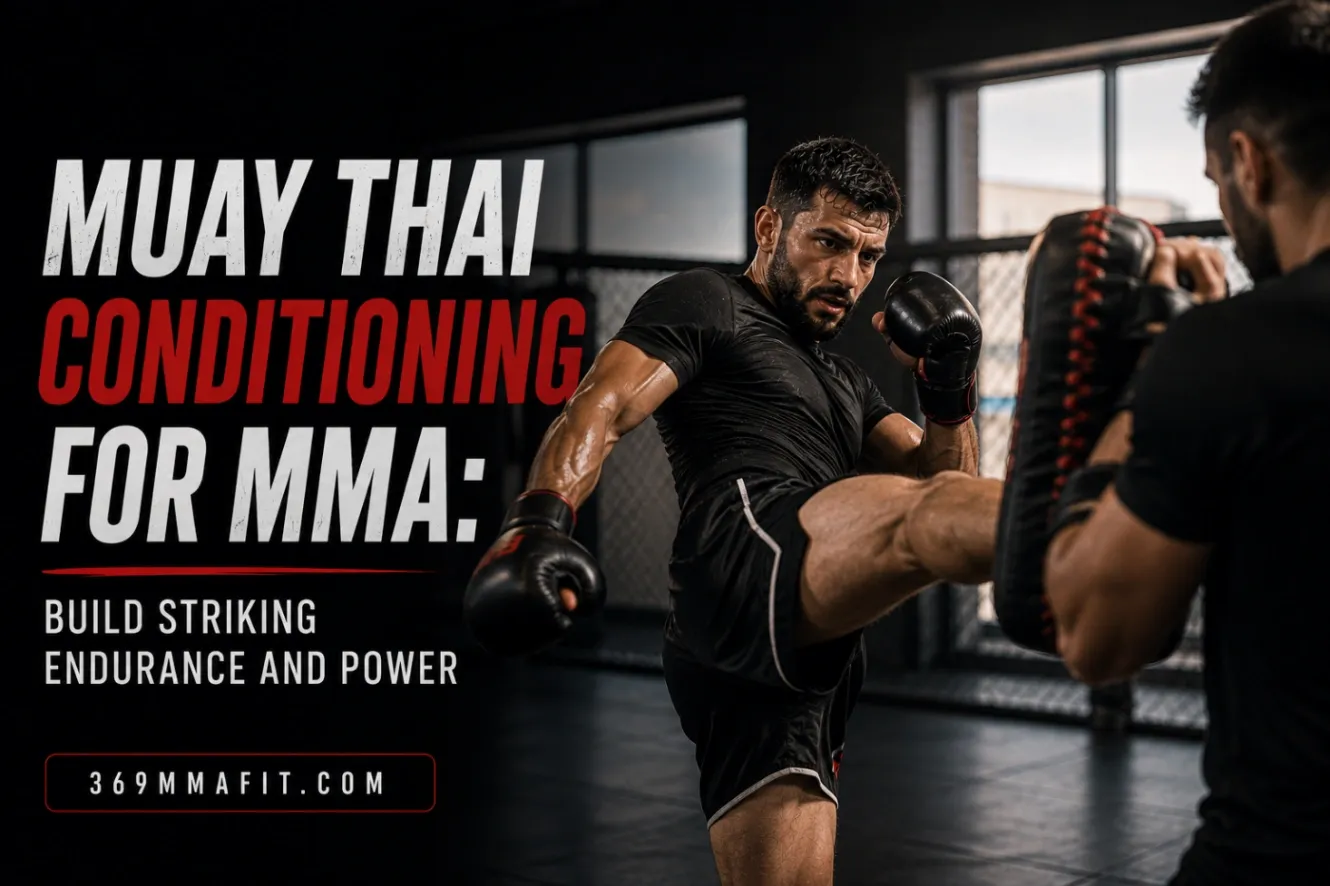
Muay Thai Conditioning for MMA: Build Striking Endurance and Power
Muay Thai — the art of eight limbs — demands a conditioning profile unlike any other combat discipline. A single round of hard pad work with a skilled trainer can expend over 600 kcal and sustain heart rates above 90% of maximum for prolonged periods. Yet elite Muay Thai fighters can maintain precise technical output for 5 rounds of 3 minutes at championship pace. This is not accident: it is the product of systematic, science-informed conditioning work.
The Physiology of Striking
Research by Ouergui et al. (2014, Journal of Human Kinetics) found that kickboxing competition involves a work-to-rest ratio close to 2:1, with explosive striking clusters (3–8 seconds) punctuated by brief recovery intervals. The dominant energy systems are alactic (explosive strikes) and aerobic (recovery and sustained pace) — glycolytic contribution is high during prolonged exchanges and clinch battles.
The clinch — central to Muay Thai and increasingly important in MMA — is a unique physiological demand: sustained isometric effort (gripping the neck, maintaining posture) combined with explosive knee strikes. This requires both upper-body muscular endurance and hip flexor power simultaneously.
Rotational Power: The Foundation of Strike Force
Strike force in Muay Thai originates from ground reaction force transmitted through hip rotation. Studies using force plates confirm that elite Thai boxers generate kick forces exceeding 1,000 N — comparable to sport karate kicks. Training this requires:
Rotational Power Exercises
- Landmine rotational press: 4×8 per side — builds hip-to-shoulder transfer chain
- Cable woodchops: 3×12 per side — rotational core strength
- Rotational med-ball throws: 4×6 per side against a wall — power expression
- Single-leg hip hinge: 3×10 per side — trains the kicking-leg hip extension
- Cossack squats: 3×8 per side — hip mobility for high kicks and teeps
Clinch Conditioning
The Thai clinch demands grip endurance, neck strength, and the ability to generate repeated knee strikes from close range. Training approaches:
- Neck harness work: Flexion, extension, lateral — 3 sets each direction, moderate resistance
- Plumb position band work: Resistance band around partner's head; maintain posture for 60s — 3 sets
- Knee strike intervals: 10×10 knees to heavy bag with 20s rest — mimics clinch exchanges
- Isometric row holds: 3×30s at 70% 1RM — upper-back endurance for clinch control
Striking Endurance: The Pad-Work Protocol
Heavy bag and pad work are the primary conditioning tools for Muay Thai — but they must be structured. Random volume doesn't build specific endurance. Use these protocols:
Aerobic Striking (Weeks 1–3)
3×5 min continuous pad rounds at 60–70% intensity, 90s rest. Focus: maintain technique under mild fatigue. Heart rate target: 65–75% HRmax.
Lactate Threshold Rounds (Weeks 4–5)
5×3 min hard pad work, 60s rest. Push output to 80–85% max effort — sustainable hard pace, not sprint. This trains the threshold between aerobic and anaerobic work.
Fight-Simulation Rounds (Weeks 6–8)
5×3 min with variable intensity: 30s moderate → 10s sprint → 30s moderate → 10s sprint → 30s moderate → 10s sprint. 60s rest. This mirrors the rhythm of actual competition.
Shadow Boxing: Underrated Conditioning Tool
Shadow boxing performed at high intensity for 3×3 min continuous rounds develops footwork patterns, combination flow, and cardiovascular efficiency simultaneously. Research in combat sports confirms that technical drilling at moderate-to-high intensity produces measurable VO₂max improvements alongside technical improvement — dual-purpose training with no contact injury risk.
Integrating Muay Thai Conditioning into MMA
Balance striking and grappling conditioning demands carefully. During fight camp, allocate conditioning work by game-plan priority: if a fight is likely to go to the ground, emphasize BJJ conditioning (see BJJ guide); if standing striking is the game plan, emphasize striking endurance. Your S&C program should reduce volume in fight camp weeks to allow striking work to dominate. See also: Complete MMA Beginner Guide.
Frequently Asked Questions
Q: How many rounds of sparring per week is optimal for MMA strikers?
A: For most athletes, 3–4 rounds of technical sparring (60–70% intensity) per session, 2–3 sessions per week, provides sufficient stimulus without excessive injury risk or CNS fatigue. Save near-competition intensity for fight camp only.
Q: Does roadwork (running) help Muay Thai conditioning?
A: Yes — Zone 2 running builds the aerobic base that supports recovery between striking exchanges. Traditional Thai fighters run 6–10 km daily at moderate pace. For modern MMA, 3–4 Zone 2 sessions per week of 30–45 min is sufficient alongside technical training.
Q: How do I build power in leg kicks?
A: Leg kick power comes from hip internal rotation velocity, not just strength. Develop this with rotational medicine ball throws, single-leg hip hinge strength, and hip flexor power work. Heavy bag drilling at full power is essential for motor pattern specificity.
Q: Should I use ankle weights for shadow boxing?
A: No — ankle weights alter kick mechanics and increase injury risk at the hip and knee. For resistance-based shadow boxing, use light resistance bands around the wrists or add weighted vest for bodyweight load. Technique must remain identical to competition movement.
Q: What's the single biggest conditioning mistake Muay Thai fighters make?
A: Training at medium intensity all the time — never going truly easy or truly hard. This "grey zone" training produces mediocre adaptation. Adopt a polarized approach: 80% of work at low intensity (Zone 2), 20% at high intensity (above threshold). Eliminate the middle.
References
- Ouergui et al. (2014). Time-motion analysis and physiological responses to Muay Thai fighting. Journal of Human Kinetics, 44, 263–272.
- Turner, A. (2009). Strength and conditioning for Muay Thai athletes. Strength and Conditioning Journal, 31(6), 78–92.
- Seiler, S. (2010). What is best practice for training intensity and duration distribution? International Journal of Sports Physiology and Performance, 5(3), 276–291.
- Lenetsky, S. & Harris, N. (2012). The mixed martial arts athlete: A physiological profile. Strength and Conditioning Journal, 34(1), 32–47.
Ready to Train with a Certified Coach?
Get a free consultation and a training plan built specifically for your goals, level, and schedule.
Find Your Coach →آمادهاید این را عملی کنید؟
با یک مربی معتبر 369MMAFIT در دبی مچ شوید — تمرین شخصی، MMA و تغذیه، حضوری یا آنلاین.