این مقاله فعلاً فقط به انگلیسی موجود است — ترجمهی فارسی بهزودی اضافه میشود.
What Is Low Pressure Fitness? The Complete Guide for Women in the UAE
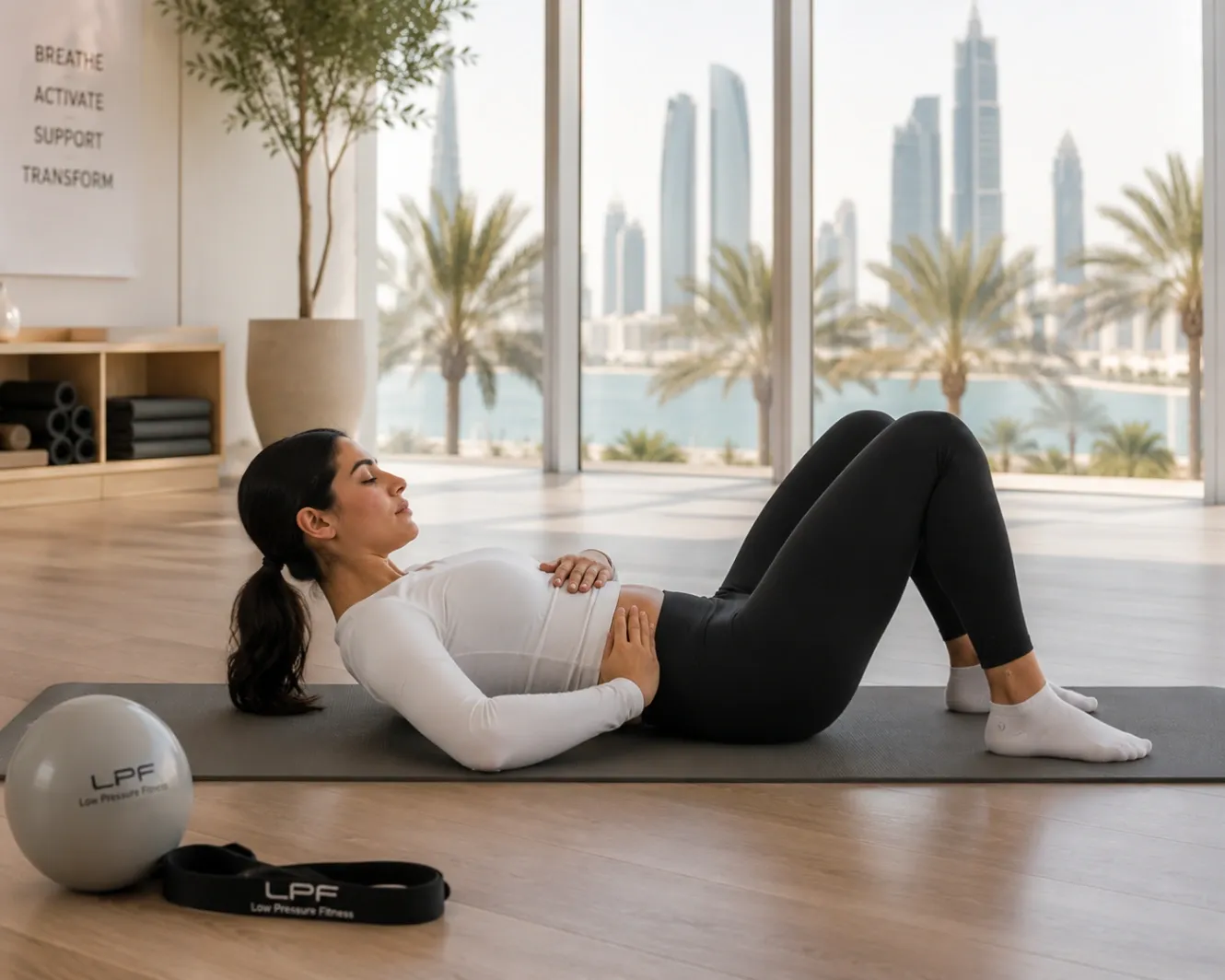
What Is Low Pressure Fitness? The Complete Guide for Women in the UAE
Low Pressure Fitness (LPF), also known as hypopressives, is a postural, breathing, and movement methodology developed by Belgian physiotherapist Marcel Caufriez in the 1980s and formally systematised as Low Pressure Fitness by Spanish physiotherapist Tamara Rial. It is gaining significant traction among women in Abu Dhabi and Dubai — particularly those who have experienced pelvic floor dysfunction, abdominal separation (diastasis recti), or want a core training approach that is fundamentally different from conventional high-pressure abdominal work.
The Problem with Conventional Core Training
Traditional core exercises — crunches, sit-ups, heavy planks, Valsalva-heavy compound lifting — all increase intra-abdominal pressure (IAP). For most healthy people, this is fine. However, for women with:
- Pelvic floor dysfunction (stress urinary incontinence, pelvic organ prolapse)
- Diastasis recti (abdominal separation) post-pregnancy
- Post-surgical abdominal weakness
- Pelvic girdle pain
...high-pressure core training can worsen these conditions by repeatedly increasing downward force on an already compromised pelvic floor and connective tissue system. Low Pressure Fitness addresses the core from the opposite direction — by reducing intra-abdominal pressure through specific breathing and postural techniques.
How Low Pressure Fitness Works: The Physiology
The foundation of LPF is the hypopressive technique — a combination of specific spinal elongation posture, respiratory apnoea (breath hold after full exhalation), and rib cage expansion. This creates a temporary thoracic vacuum effect that:
- Reduces intra-abdominal pressure (versus increasing it in conventional core work)
- Creates a reflex activation of the deep core muscles including the transversus abdominis and pelvic floor without voluntary contraction
- Gradually retrains the autonomic activation patterns of the deep stabilising system
Over repeated practice, this recalibrates the resting tone and functional responsiveness of the pelvic floor — the muscles become better at reflexively contracting before and during increased loading (coughing, jumping, lifting) rather than chronically under-activating.
What Does the Research Say?
LPF is a relatively recent systematised methodology, and research is growing but still limited compared to conventional physiotherapy:
- Rial & Pinsach (2015, Journal of Physical Therapy Science) found hypopressive exercises produced significant improvements in pelvic floor muscle tone and function in postpartum women
- Navarro Brazález et al. (2020, Neurourology and Urodynamics) compared hypopressives vs. pelvic floor muscle training for stress urinary incontinence — both produced significant improvement, with hypopressives showing advantage in certain postural outcome measures
- Multiple studies show reductions in waist circumference (average 2–4cm reduction after 8–12 weeks) — attributed to increased deep core muscle tone rather than fat loss per se
LPF should be considered a complement to, not a replacement for, conventional pelvic floor physiotherapy for clinical conditions. A women's health physiotherapist in Abu Dhabi or Dubai remains the primary professional for pelvic floor rehabilitation.
Who Benefits Most from Low Pressure Fitness in the UAE?
- Postpartum women: Particularly effective for restoring pelvic floor function and managing diastasis recti in the months following birth
- Women with stress urinary incontinence: Leaking with coughing, sneezing, jumping — extremely common in UAE women post-childbirth and rarely discussed
- Perimenopausal and menopausal women: Declining oestrogen reduces pelvic floor tissue quality — LPF helps maintain function
- Women who want to train their core without high-impact or high-pressure exercise: Those with disc conditions, prolapse, or chronic pelvic pain who cannot tolerate conventional core training
- Athletes who want to complement conventional training: LPF is increasingly used by runners, swimmers, and gym-goers in Dubai and Abu Dhabi as a pelvic floor maintenance and core supplementation practice
A Beginner LPF Session: What It Looks Like
A standard Low Pressure Fitness session takes 20–30 minutes and consists of:
- Postural reset (5 min): Cervical and thoracic spinal elongation exercises to create the "stacked" posture required for effective technique
- Breathing coordination (5 min): Learning the apnoea technique — exhale fully, hold, expand the rib cage laterally without inhaling. This is the core of the method and takes several sessions to coordinate correctly
- Hypopressive postures (15–20 min): A series of standing, kneeling, lying, and seated postures combining the elongation and apnoea technique — each held for 8–10 seconds, performed 3–5 repetitions
- Relaxation and diaphragmatic breathing (5 min)
Learning LPF correctly requires guidance from a certified LPF instructor — the technique is specific enough that self-learning from video produces poor results. Certified instructors in Abu Dhabi and Dubai are increasingly available through women's physiotherapy clinics and boutique fitness studios.
Low Pressure Fitness vs. Pilates vs. Yoga for Core Health
| Method | Intra-abdominal pressure | Pelvic floor focus | Best for |
|---|---|---|---|
| LPF / Hypopressives | Decreases | Primary | Pelvic floor dysfunction, prolapse, diastasis recti |
| Pilates (clinical) | Variable, moderate | Secondary | Core stability, postnatal rehab, general strength |
| Yoga | Variable | Incidental | Flexibility, spinal health, relaxation |
| Conventional core training | Increases | Minimal | General core strength in healthy individuals |
Frequently Asked Questions
Q: Is Low Pressure Fitness the same as Pilates in Dubai?
A: No — they are distinct methodologies. Pilates focuses on core stabilisation through controlled movement and breathing coordination with exertion. LPF uses apnoea (breath holding after exhalation) and rib cage expansion to create a thoracic vacuum that reflexively activates deep core and pelvic floor muscles. Both are valuable; for pelvic floor dysfunction specifically, LPF has a more targeted mechanism. Many women in Dubai and Abu Dhabi benefit from combining both approaches.
Q: Can I do Low Pressure Fitness after a C-section in Abu Dhabi?
A: Yes, after adequate wound healing and with medical clearance (typically 8–12 weeks post-surgery). LPF is particularly beneficial post-caesarean because it does not place direct pressure on the abdominal scar while still training the deep core system. Start with an LPF-certified instructor or women's health physiotherapist in Abu Dhabi who can modify the programme for your healing stage.
Q: How long does it take to see results from LPF in the UAE?
A: Most women practicing LPF 3–4 times per week report improvements in pelvic floor symptoms (reduced leaking, improved pelvic pressure) within 6–8 weeks. Waist circumference changes are typically seen at 8–12 weeks. The neuromotor re-patterning of deep core activation takes 3–6 months of consistent practice to become automatic during daily activities and other exercise.
Q: Can LPF help with a mummy tummy or mum tum in Dubai?
A: For women whose abdominal protrusion is partly due to diastasis recti (abdominal separation) or poor deep core tone, LPF produces meaningful improvements. For protrusion primarily due to excess body fat, LPF alone will not produce significant visual change — fat loss through caloric deficit and metabolic training is needed. A combination of LPF (for deep core and pelvic floor function) and general fitness training (for fat loss) produces the best outcomes.
Q: Where can I find a Low Pressure Fitness instructor in Dubai or Abu Dhabi?
A: Certified LPF instructors are available through women's health physiotherapy clinics, specialist postnatal fitness studios, and some yoga and Pilates centres in Dubai (Jumeirah, Downtown, JBR) and Abu Dhabi (Khalidiyah, Saadiyat, Al Reem Island). Search specifically for "LPF certified" or "hypopressive" training — not all core fitness instructors have this specialised certification. A personal trainer in the UAE with LPF certification can deliver private sessions for maximum individual adaptation.
Ready to Train with a Certified Coach?
Get a free consultation and a training plan built specifically for your goals, level, and schedule.
Find Your Coach →References: Rial & Pinsach 2015, J Phys Ther Sci | Navarro Brazález et al. 2020, Neurourol Urodynam | Caufriez M — original hypopressive methodology | Bø et al. 2017, Br J Sports Med — postnatal exercise and pelvic floor
آمادهاید این را عملی کنید؟
با یک مربی معتبر 369MMAFIT در دبی مچ شوید — تمرین شخصی، MMA و تغذیه، حضوری یا آنلاین.