این مقاله فعلاً فقط به انگلیسی موجود است — ترجمهی فارسی بهزودی اضافه میشود.
How Much Do Online Personal Trainers Make in the US in 2026?
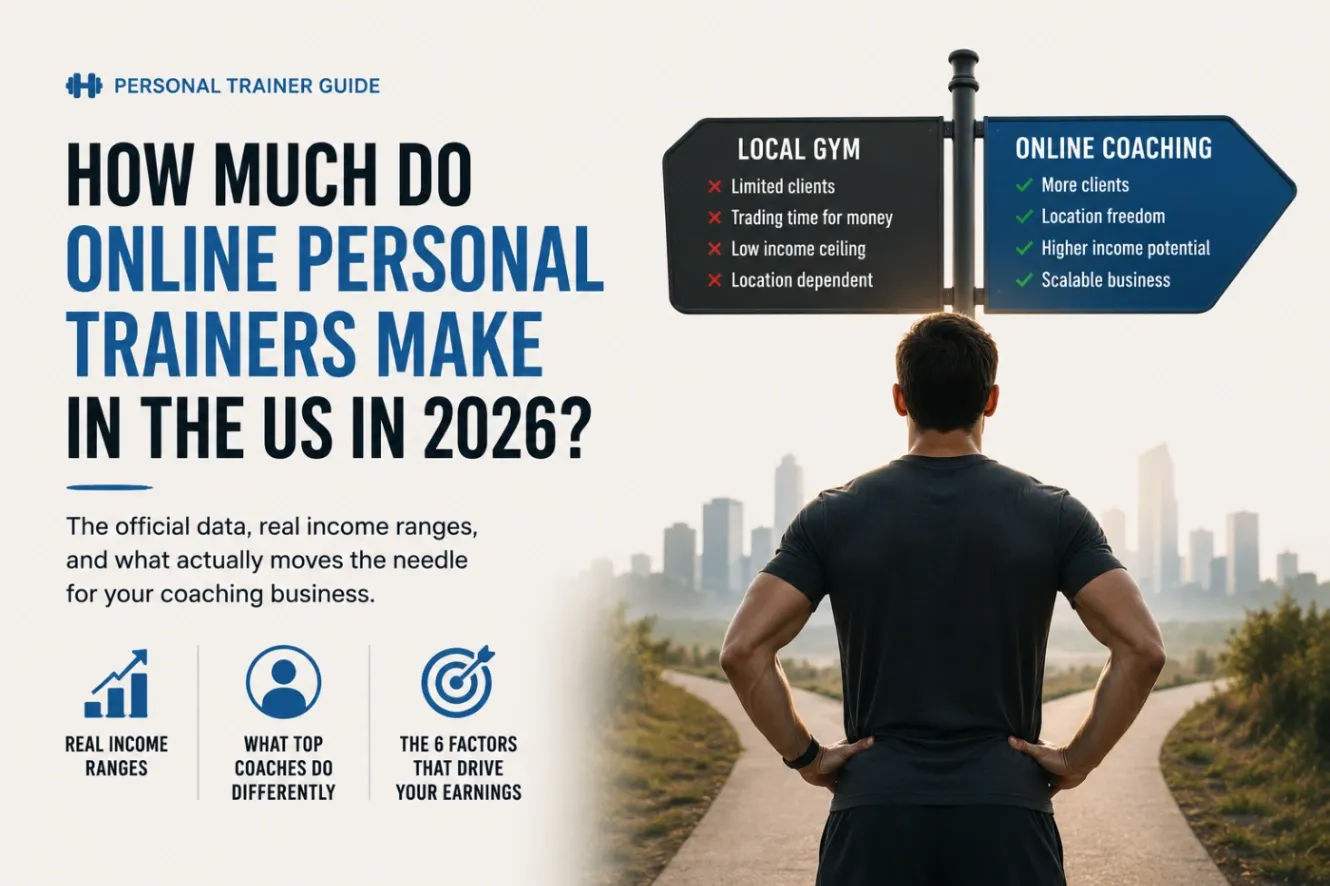
This guide is for personal trainers and aspiring online coaches who want a realistic, numbers-first answer to one question: how much can you actually make coaching clients online in the US in 2026? We'll start with official U.S. Bureau of Labor Statistics figures, show how independent and online work compares, break down the levers that move your income the most, and end with the uncomfortable truth most "make six figures" content skips: lead flow, not coaching skill, is usually the bottleneck.
What the official data says: BLS baseline for fitness trainers
Per the U.S. Bureau of Labor Statistics, "fitness trainers and instructors" is the occupational category that covers personal trainers. The BLS Occupational Outlook Handbook reports median annual pay for this group in the low-to-mid $40,000s, with the lowest-paid roughly 10% earning under about $30,000 and the highest-paid roughly 10% earning above $70,000 to $80,000. Treat these as ranges, not promises, because they blend full-time gym staff, part-timers, and specialists across very different markets.
Two BLS details matter for online coaches specifically:
- Employment is growing faster than average. The BLS projects employment of fitness trainers and instructors to grow well above the all-occupation average over the current decade, citing sustained consumer interest in health and the rise of virtual and app-based fitness.
- The median is an employee figure. The handbook describes typical wage-and-salary work. Self-employed and online coaches sit outside that average and can land well below it (slow ramp, few clients) or well above it (strong retention, premium packaging). The data sets a floor for context, not a ceiling for your business.
The Health & Fitness Association (formerly IHRSA) similarly tracks a US fitness industry that has rebounded past pre-2020 levels in membership and spending, with digital and hybrid delivery now a permanent channel rather than a stopgap. That tailwind is real, but it rewards trainers who can find and keep clients, not just those who can program a workout.
Employee vs. independent vs. online: how the models compare
Your business model changes your economics more than your certification does. Here's how the three common paths stack up.
Gym-employed trainer
You're paid a session rate or hourly wage, the gym supplies the clients and the room, and the gym keeps a large cut of what the client actually pays. Predictable, low-risk, low-ceiling. This is the cohort the BLS median best describes.
Independent in-person trainer
You keep most of the session fee but pay for space, insurance, travel, and your own marketing. Higher per-session take, but capped by the hours you can physically be in a room with people.
Online coach
You deliver via video sessions plus app-based programming, so geography stops limiting your client pool. Overhead drops (no rent, no commute), and you can serve clients on asynchronous check-ins alongside live calls, which breaks the strict one-hour-equals-one-paycheck ceiling. The trade-off: you own client acquisition end to end. No front desk feeds you walk-ins.
That last point is why online coaching has both the highest ceiling and the highest variance. A US-based coach can deliver coaching to a client in another time zone with zero added overhead, but only if a qualified client is in front of them in the first place. If you are weighing this path, it helps to study how established online coaches present their services before you build your own.
The income levers that actually move your number
Online personal trainer income is the product of a handful of variables. Pull on these in order of impact.
1. Active client count
The most direct lever. A simplified model: monthly revenue is roughly active clients multiplied by average monthly fee. Twelve clients at $250 per month is roughly $36,000 per year before tax and expenses, already near the BLS median, working remotely. Thirty clients at $300 per month is six figures. The math is not exotic; the constraint is filling and holding those slots.
2. Pricing and packaging
Hourly billing punishes you twice: it caps revenue at your available hours and trains clients to think in single sessions. Monthly packages and multi-month commitments stabilize cash flow and dramatically improve retention. A practical packaging ladder:
- App-only programming (lowest price): custom plan plus asynchronous check-ins, no live calls.
- Hybrid coaching (mid): programming plus a set number of live video sessions per month.
- Premium 1:1 (highest): weekly live calls, nutrition guidance, daily messaging access, faster response times.
See how a tiered structure can be presented on a coaching pricing page; the goal is to let clients self-select up, not to negotiate down.
3. Retention
Acquisition is expensive; retention is profit. A client who stays nine months is worth roughly three times one who churns at three months, for the same acquisition effort. The biggest retention drivers are early wins (program your first 30 days for visible progress and adherence, not maximal intensity), consistent check-ins, and outcome tracking. This is also where evidence-based programming pays off: clients who see results attributed to a real plan stay longer.
4. Specialization and outcomes
Generalists compete on price; specialists command premiums. Pick a population and a result: postpartum strength, weight loss for desk-bound professionals, return-to-lifting after injury, or beginner general fitness for people intimidated by gyms. You can see the range of focus areas that demand exists for by browsing common coaching service categories. Credentials from recognized US bodies, such as NASM, NSCA, and ACSM, back up premium positioning and reassure clients that your programming is grounded, not guesswork.
5. Group and one-to-many offers
Small-group video coaching and cohort-based challenges let you serve several clients per hour at a lower per-person price but higher hourly yield. Layered on top of 1:1 work, group offers raise your effective hourly rate without adding solo-call hours.
A realistic ramp: what the first 12 to 18 months look like
Most income disappointment comes from expecting a six-figure book in month two. Here is a more honest trajectory for a committed online coach starting from a small or zero client base.
- Months 1 to 3, Foundation. Lock your niche, package structure, and intake process. Land your first 2 to 5 clients (often warm contacts and referrals). Revenue is small and lumpy; this stage is about building proof, testimonials, and a repeatable delivery system.
- Months 4 to 9, Traction. With a working system and a few documented results, you reach roughly 8 to 15 active clients. Income approaches and may pass the BLS median range. Retention discipline matters most here; plugging leaks is cheaper than chasing new leads.
- Months 10 to 18, Scale. You introduce premium tiers and group offers, raise prices for new clients, and push for 20 to 30 or more active clients. This is the window where committed coaches with steady lead flow cross into high five figures and beyond.
The single variable that decides whether you move through these stages in 12 months or stall for three years is consistent lead flow.
The real bottleneck: lead flow, not coaching ability
Talk to coaches who plateaued and you'll rarely hear "I ran out of programming knowledge." You'll hear "I ran out of people to coach." Client acquisition is the hardest, least-taught part of the job, and it's where most online businesses break.
Why it's so hard solo:
- Marketing is a separate skill set. Funnels, ads, content, and SEO take months to compound, months when you also need to coach and earn.
- Inconsistent pipeline kills planning. Feast-or-famine months make it impossible to hire, invest, or set prices confidently.
- Cold outreach has brutal conversion. Strangers who don't know you convert far worse than people actively searching for a coach.
The fix isn't "post more." It's getting in front of clients who are already looking. A marketplace that routes ready-to-buy clients to qualified trainers collapses the acquisition problem: instead of manufacturing demand, you respond to it. That's the gap 369MMAFIT is built to close for US-based online coaches. If you would rather talk it through first, you can always contact the team with questions about how matching works.
Put the numbers to work
369MMAFIT is an online personal-training marketplace that connects US clients with certified coaches for video sessions and app-based programming, coaching that works anywhere in the country. For trainers, the value is the part you can't easily build alone: a steady stream of clients who are actively requesting coaching, so you spend your time delivering results instead of hunting for the next sign-up. Because delivery is fully remote, your earning potential is tied to how many clients you can serve well, not to the square footage of a room you can rent.
Start earning as an online coach
If you want predictable lead flow instead of feast-or-famine, get on the platform and let qualified US clients come to you.
- Trainers, apply to join and get matched with clients: Become a trainer on 369MMAFIT
- See the coaches already on the platform: Browse 369MMAFIT trainers
Frequently Asked Questions
Q: How much do online personal trainers make in the US in 2026?
A: Per the U.S. Bureau of Labor Statistics, median pay for fitness trainers sits in the low-to-mid $40,000s, with the top tier above roughly $70,000 to $80,000. Online and independent coaches fall outside that employee average and vary widely, from very little during a slow ramp to six figures with strong retention, premium packaging, and steady lead flow.
Q: Can online personal trainers earn more than gym-employed trainers?
A: Often yes, because online coaches keep more of each fee, carry low overhead, and aren't limited by a strict one-session-per-hour ceiling thanks to app-based programming and group offers. The catch is that they own client acquisition entirely, which makes income higher-ceiling but higher-variance than a salaried gym role.
Q: What's the fastest way to increase my income as an online coach?
A: Improve retention and packaging before chasing more leads. Move clients from hourly billing to monthly or multi-month packages, program early wins so people stay longer, and add a premium tier. These compound faster than acquisition because keeping a client is far cheaper than finding a new one.
Q: How long does it take to build a full-time online coaching income?
A: A realistic, committed timeline is roughly 12 to 18 months: foundation and first clients in months 1 to 3, traction toward 8 to 15 active clients by months 4 to 9, and scaling to 20 to 30 or more in months 10 to 18. Steady lead flow is the main factor that determines whether you hit those marks on schedule or stall.
Q: Do I need a certification to coach online in the US?
A: Most clients and platforms expect a recognized certification, and credentials from bodies like NASM, NSCA, or ACSM support premium pricing and client trust. Beyond credibility, evidence-based programming improves results and retention, which directly affects your income.
Q: Why is finding clients harder than coaching them?
A: Coaching is a skill you already trained for; marketing, funnels, and SEO are a separate discipline that takes months to compound and competes for the same hours you need to earn. That's why a marketplace that routes clients who are already searching for a coach removes the biggest bottleneck most online trainers face.
References
- U.S. Bureau of Labor Statistics, Fitness Trainers and Instructors pay and outlook
- Health & Fitness Association (IHRSA), US fitness industry and digital trends
- National Academy of Sports Medicine (NASM), certification and standards
- National Strength and Conditioning Association (NSCA), strength coaching credentials
- American College of Sports Medicine (ACSM), exercise science and guidelines
- Centers for Disease Control and Prevention, physical activity guidance
آمادهاید این را عملی کنید؟
با یک مربی معتبر 369MMAFIT در دبی مچ شوید — تمرین شخصی، MMA و تغذیه، حضوری یا آنلاین.