Back Pain Relief Through Exercise in Dubai and Abu Dhabi: Evidence-Based Solutions
Back Pain Relief Through Exercise in Dubai and Abu Dhabi: Evidence-Based Solutions
Lower back pain is the most common musculoskeletal complaint among Dubai and Abu Dhabi's professional population. With an estimated 60–80% of adults experiencing lower back pain at some point, and UAE's desk-work, car-centric culture creating ideal conditions for it, this is one of the most practically valuable guides in our library. The good news: exercise is the most evidence-based treatment for chronic lower back pain — and the right exercises can transform quality of life within weeks.
Why UAE Residents Get Back Pain
Lower back pain in Dubai and Abu Dhabi is overwhelmingly driven by lifestyle factors rather than structural pathology:
- Prolonged sitting: 8–10+ hours daily in office chairs creates anterior pelvic tilt, shortened hip flexors, inhibited glutes, and overactivated lumbar erectors — the classic "lower cross syndrome"
- Weak core: Sedentary UAE lifestyles mean the deep spinal stabilisers (multifidus, transversus abdominis) are chronically underactive
- Poor movement habits: Minimal daily walking, no bending or carrying in most UAE professional lives, and then sudden weekend gym sessions creates unpredictable loading
- Stress: Research consistently shows psychological stress is an independent predictor of back pain persistence and severity
The important reassurance: MRI findings of disc bulges, disc herniations, and degenerative changes are present in a significant percentage of completely pain-free adults (Brinjikji et al. 2015, AJNR). Structural findings often don't cause pain — and pain often resolves without structural change. This means exercise and lifestyle modification work for most UAE residents, even those with "scary-sounding" imaging findings.
What Research Says About Exercise for Back Pain
A 2021 Cochrane systematic review confirmed that exercise therapy is more effective than passive treatments (rest, massage, ultrasound) for chronic lower back pain in terms of both pain reduction and return to function. Specific exercise types with strongest evidence:
- Core stabilisation training: Targeting deep spinal stabilisers (Hayden et al. 2005 Cochrane review)
- Yoga: Multiple RCTs show yoga significantly reduces back pain in office workers (Cramer et al. 2017, Journal of Pain)
- General exercise: Any moderate-intensity physical activity provides benefit — sedentary behaviour is the enemy
- Walking: Consistent walking reduces back pain in multiple clinical trials
The Evidence-Based Back Pain Exercise Programme
Perform this programme daily (10–15 minutes) for 4 weeks. These exercises are safe for most non-acute lower back pain. If pain increases during any exercise, stop and consult a UAE physiotherapist.
Deep Core Activation (Foundation)
Diaphragmatic breathing with pelvic floor activation:
- Lie on your back, knees bent, feet flat on floor
- Breathe deeply into your belly (not chest) — feel abdomen rise
- On exhale, gently draw navel toward spine and lightly activate pelvic floor (as if stopping urination flow)
- Hold for 5 seconds, 10 repetitions — this activates transversus abdominis, the deep stabiliser most inhibited in back pain patients
Dead Bug
The most research-supported anti-extension core exercise for lower back pain:
- Lie on back, arms vertical, knees bent 90° (tabletop position)
- Slowly lower one arm above head while extending the opposite leg toward the floor — maintaining lower back contact with floor throughout
- Return and alternate sides. 3 × 8 reps each side (slow and controlled).
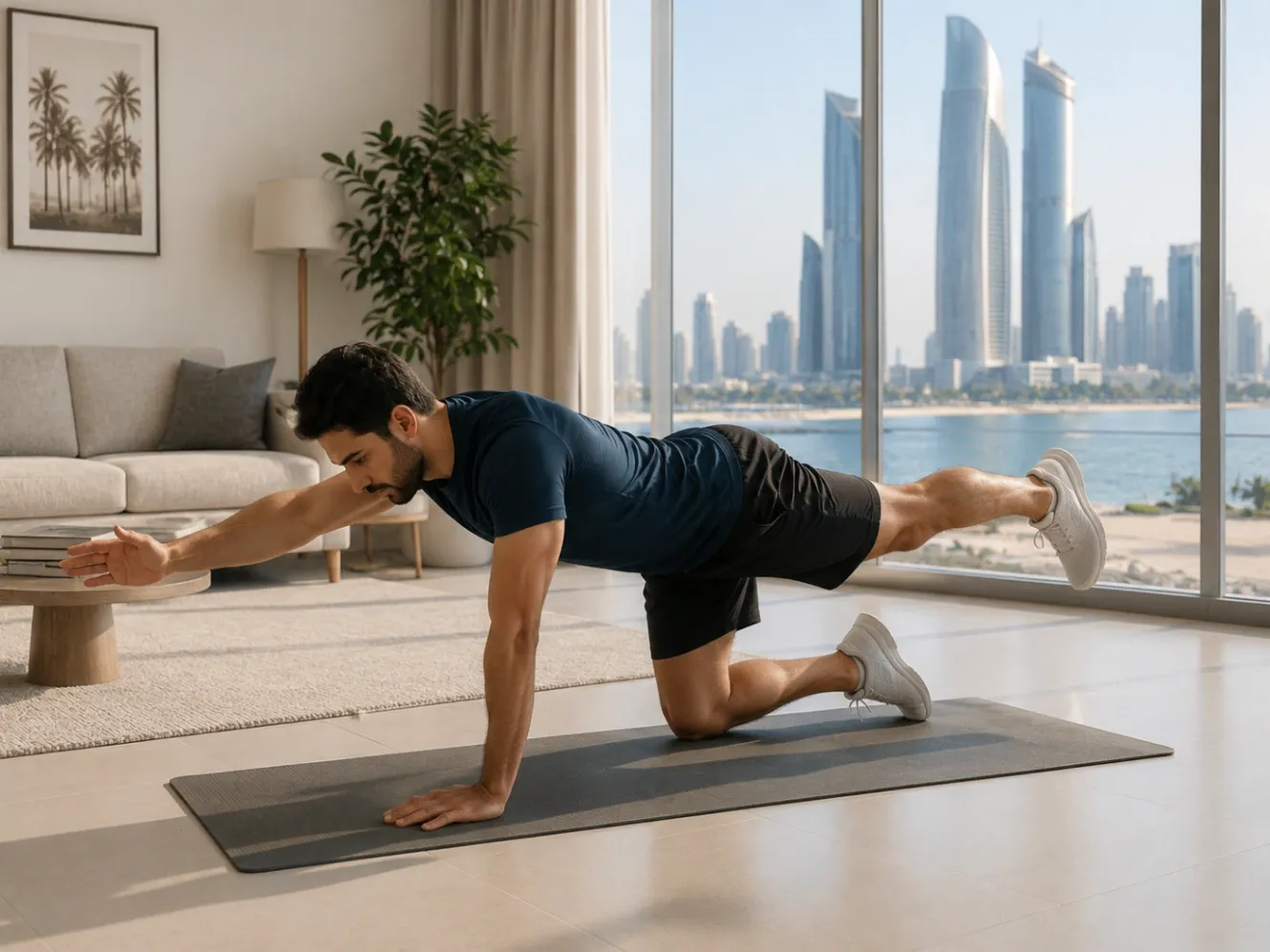
Bird Dog
- From all-fours position, maintain neutral spine (no sagging or arching)
- Slowly extend one arm forward and opposite leg back — pause 3 seconds at top
- Return without dropping the hip. 3 × 10 each side.
Glute Bridge
- Lie on back, knees bent, feet flat on floor hip-width apart
- Drive through heels, lift hips until body forms a straight line from knees to shoulders
- Squeeze glutes at top, hold 2 seconds, lower slowly. 3 × 15 reps.
- Progress to single-leg bridge as strength develops
Cat-Cow Mobility
- From all-fours, alternate between maximal lumbar flexion (cat — round the back) and extension (cow — arch the back)
- Move slowly through full range of motion, breathing rhythmically. 10 repetitions.
- Restores lumbar mobility and reduces stiffness — particularly helpful in UAE residents who have been sitting all day
Hip Flexor Stretch
- Half-kneeling position — one knee on floor, one foot forward
- Gently push hips forward until you feel a stretch in the front of the rear hip
- Hold 45 seconds each side. 2 repetitions per side.
- Addresses hip flexor shortening from UAE sitting culture directly
Returning to Exercise With Lower Back Pain in UAE
Many UAE gym-goers stop all training when back pain occurs — the wrong approach. Research shows active rehabilitation produces better outcomes than rest. Guidelines:
- Keep moving: Daily walking (even 15–20 minutes) maintains spinal nutrition via disc compression-decompression cycles
- Avoid exercises that increase pain: Stop any exercise that worsens pain — not all pain means stop (some therapeutic discomfort is normal), but sharp/shooting pain is a clear stop signal
- Modify, don't eliminate: Replace a barbell squat with a goblet squat if necessary; replace deadlifts with Romanian deadlifts or hip hinges to a box — don't stop training compound movements entirely
- Progressive loading is therapeutic: Gradually increasing loads on the spine under controlled conditions is how the spine strengthens and rehabilitates
When to See a UAE Physiotherapist or Doctor
- Pain persists beyond 6 weeks despite regular exercise and lifestyle modification
- Pain radiates into the leg with accompanying numbness, tingling, or weakness (possible nerve compression)
- Back pain associated with recent trauma or injury
- Night pain that doesn't change with position (requires medical evaluation)
- Loss of bladder or bowel control (emergency — seek immediate medical attention)
UAE resources: Mediclinic physiotherapy departments, Cleveland Clinic Abu Dhabi musculoskeletal services, Emirates Hospital physiotherapy, and multiple independent physiotherapy practices throughout Dubai and Abu Dhabi.
Ready to Train with a Certified Coach?
Get a free consultation and a training plan built specifically for your goals, level, and schedule.
Find Your Coach →Frequently Asked Questions
Q: What exercises should I avoid with lower back pain in Dubai?
A: Initially avoid: sit-ups and crunches (increase intradiscal pressure), heavy deadlifts before adequate core activation, high-impact jumping exercises, and any exercise that increases your pain. These aren't permanently off-limits — with appropriate rehabilitation and gradual progression, most exercises become accessible as back pain resolves.
Q: Is it safe to go to the gym with lower back pain in Abu Dhabi?
A: Generally yes, with appropriate modifications. Avoid exercises that worsen pain; focus on the rehabilitation exercises in this guide and swimming. Many UAE gym-goers find that targeted strengthening exercises resolve back pain that rest did not. Work with a personal trainer or physiotherapist in Abu Dhabi with experience in back rehabilitation for the most effective guidance.
Q: How long does lower back pain take to resolve with exercise in UAE?
A: Acute lower back pain (sudden onset, no nerve involvement) typically improves significantly within 2–6 weeks of consistent movement and core exercise. Chronic lower back pain (present for 3+ months) improves more gradually — expect 8–12 weeks of consistent exercise for meaningful improvement. The trajectory is typically gradual improvement with occasional setbacks rather than linear recovery.
Q: Can sitting at my Dubai office desk cause back pain?
A: Yes — prolonged sitting is one of the strongest lifestyle predictors of lower back pain. Research shows sitting increases intradiscal pressure more than standing. Solutions: set a timer to stand or walk briefly every 30–45 minutes, use a sit-stand desk if available (increasingly common in modern Dubai offices), ensure ergonomic chair setup (lumbar support, screen at eye level), and practise the hip flexor stretches in this guide daily.
Q: Should I see a chiropractor or physiotherapist for back pain in Dubai?
A: UAE physiotherapists (physical therapists) are the first-line recommended practitioners for lower back pain based on evidence. They assess, diagnose, and provide exercise-based rehabilitation — the most evidence-supported treatment. Chiropractors offer manual therapy which has modest short-term evidence for acute pain. A physiotherapist in Dubai will teach you how to manage and prevent future episodes through exercise — a more valuable long-term investment.
Ready to put this into action?
Get matched with a certified 369MMAFIT coach in Dubai — personal training, MMA, and nutrition, in-person or online.