Sports Injury Rehabilitation in Dubai: How a Personal Trainer Accelerates Recovery (Evidence-Based)
Sports Injury Rehabilitation in Dubai: How a Personal Trainer Accelerates Recovery (Evidence-Based)
Most Dubai residents who suffer a sports injury — torn ACL, rotator cuff impingement, hamstring strain, herniated disc, plantar fasciitis — follow a familiar trajectory: see a sports physician, then a physiotherapist, then attempt to return to training on their own. The transition between physiotherapy discharge and full return to sport is the moment most re-injuries occur. A 2017 systematic review in British Journal of Sports Medicine (Ardern et al.) documented that ACL re-injury rates within 24 months of return-to-sport approach 30% — and the majority occur in the first 6 months back.
The missing link is structured strength training under a coach who understands the injury, the rehab progression, and the specific demands of your sport. This is the role of a corrective-exercise specialist personal trainer in Dubai — bridging the gap between physiotherapy discharge and full athletic return.
The Three-Phase Recovery Model
Phase 1 — Clinical Rehabilitation (Weeks 0–4, sometimes longer)
Led by a DHA-licensed physiotherapist. Focus: pain management, swelling control, restoration of basic range of motion, neuromuscular re-education. This phase is non-negotiable and must not be skipped.
Phase 2 — Progressive Reconditioning (Weeks 4–12)
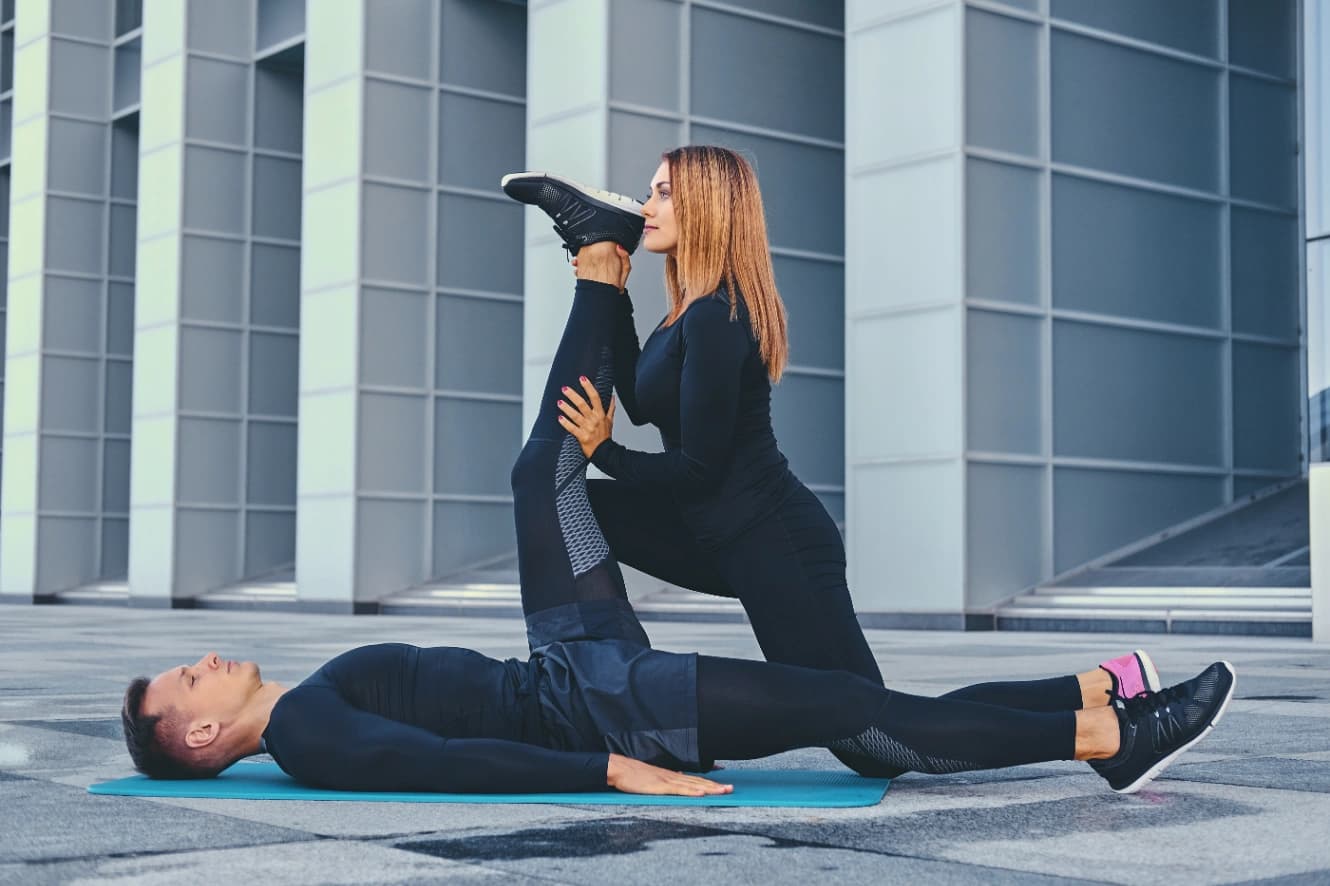
The phase where personal trainer + physio collaboration is most valuable. The physiotherapist continues clinical oversight; the personal trainer adds structured strength loading appropriate to the rehab phase.
- Building affected-side strength back toward baseline
- Restoring symmetry between sides
- Re-introducing complex movement patterns under load
- Maintaining cardiovascular and unaffected-side fitness
Phase 3 — Return to Sport (Weeks 12+)
Sport-specific reconditioning. The personal trainer leads; the physio is consulted as needed. Focus on movement-specific loading, deceleration training, change-of-direction work, and confidence rebuilding.
Why the PT-Physio Combination Works Better
Physiotherapy excels at clinical rehabilitation but is typically constrained by session frequency (1–2× per week) and case-load. Personal training, by contrast, can provide:
- 3–4× weekly training touch points
- Longer sessions for progressive overload (60–90 min vs PT's 30–45 min)
- Equipment and environment for serious strength work
- Real-time motor learning over hundreds of reps weekly
- Programmatic continuity beyond formal physio discharge
A 2020 randomised trial in American Journal of Sports Medicine (Grindem et al.) found that ACL-reconstruction patients who continued structured strength training under a coach for 6+ months post-physio had re-injury rates of 4% — compared to 18% in those who returned to sport without continued strength oversight.
Common Injuries and the Coach's Role
ACL Reconstruction Return-to-Sport
The single highest-stakes rehabilitation in adult sport. Coach role: quadriceps and hamstring symmetry development, controlled deceleration patterns, gradual reintroduction of cutting and pivoting. Minimum 9 months post-surgery before unrestricted sport return.
Rotator Cuff Rehabilitation
Coach role: scapular stability work, rotator cuff isolation under controlled load, progressive overhead pressing reintroduction. Critical to avoid premature heavy bench pressing.
Hamstring Strain Recurrence Prevention
Hamstrings have a notoriously high re-injury rate (12–34% within 2 months). Coach role: eccentric loading (Nordic curls), single-leg work, hip-hinge mechanics. See Training Around Injuries in Dubai.
Lumbar Disc Injuries
Coach role: McGill-style core stabilisation, anti-extension and anti-rotation work, gradual reintroduction of hip-hinge loading. See Lower Back Pain Exercises.
Achilles Tendinopathy
Coach role: heavy slow resistance protocol (Alfredson regimen), progressive calf raises under load, gradual running reintroduction. Particularly common in UAE runners increasing volume in cooler months.
What to Look for in a Rehab-Capable Dubai Coach
- NASM CES (Corrective Exercise Specialist) or equivalent post-graduate certification.
- FMS Level 2 (Functional Movement Screen) — useful for objective movement assessment.
- Documented experience with your specific injury type (ask for relevant case examples).
- Willingness to collaborate with your physiotherapist — the coach should welcome a 3-way call or written handover.
- REPS UAE registered.
- Realistic expectations: a coach who promises return-to-sport faster than your physio's timeline is to be avoided.
Common Mistakes
- Discharging from physio and returning to YouTube workouts: The leading predictor of re-injury.
- Hiring a coach who doesn't know your injury: Generic strength coaching can do real damage at this stage.
- Skipping objective testing: Strength asymmetry of >10% between sides predicts re-injury. Measure, don't guess.
- Racing back to sport: The cost of an extra 4–8 weeks of conservative loading is trivial compared to a re-injury.
- Ignoring nutrition and sleep: Tissue remodelling depends on both. See Sleep & Fitness in Dubai.
Costs for Combined Physio + PT in Dubai (2026)
- Physiotherapy: 250–600 AED per session (often covered by health insurance).
- Personal training: 280–600 AED per session.
- Total weekly investment during peak rehab: 1,400–2,800 AED.
Compared with the cost of a recurrent injury (often 6,000–25,000+ AED in medical, surgical, and lost-work costs), the structured investment is rational.
Frequently Asked Questions
Q: Can I work with a personal trainer while still in formal physiotherapy?
A: Yes — provided your physio approves the specific exercises. Coach and physio communication is critical here.
Q: How do I find a Dubai physio who collaborates well with personal trainers?
A: Sports-specific physios at facilities like Bodyworks, Up & Running Dubai, and Sports Medicine Department of major hospitals are typically open to this collaboration. Ask explicitly.
Q: Is online personal training appropriate for post-injury rehab?
A: Limited. Real-time form correction is critical at this stage. In-person sessions remain the gold standard. See Online Personal Training in Dubai.
Q: How long until I'm back to my pre-injury training level?
A: Depends entirely on injury type. Minor strain: 4–6 weeks. Surgery (ACL, rotator cuff): 6–12 months. Patience is the highest predictor of successful return.
Return to Sport Stronger Than Before
Our corrective-exercise specialist coaches in Dubai collaborate with your physiotherapist to bridge the gap between clinical discharge and full athletic return. Evidence-based, objective, individualised.
Request a Rehab Coach →Ready to put this into action?
Get matched with a certified 369MMAFIT coach in Dubai — personal training, MMA, and nutrition, in-person or online.