این مقاله فعلاً فقط به انگلیسی موجود است — ترجمهی فارسی بهزودی اضافه میشود.
Rest and Recovery for Athletes in Dubai and Abu Dhabi: The Science of Training Recovery
Rest and Recovery for Athletes in Dubai and Abu Dhabi: The Science of Training Recovery
In Dubai and Abu Dhabi's high-performance fitness culture, there's a pervasive belief that more training equals better results. It doesn't. Research in exercise science has established definitively that adaptation — the actual fitness improvement — happens during recovery, not during training. Training is the stimulus; recovery is where the change occurs. This guide gives UAE athletes and fitness enthusiasts a complete, science-based recovery framework.
The Physiology of Recovery
When you train, you create physiological stress: muscle protein is degraded, glycogen is depleted, the nervous system is taxed, connective tissue sustains microscopic damage. These are not problems — they're the essential signals that drive adaptation. But adaptation only happens if adequate recovery occurs between sessions.
The supercompensation model (Yakovlev 1955, refined by Stone et al. 2007 JSCR) shows that after a training stimulus, fitness temporarily decreases (fatigue phase) before rising above baseline (supercompensation peak). Train again at the right moment — during supercompensation — and you improve. Train too soon (while still in the fatigue phase) or too late (after supercompensation has dissipated) and you either accumulate fatigue or miss the adaptation window.
Sleep: The Most Powerful Recovery Tool
Sleep is the single most impactful recovery intervention available — and the most commonly compromised by Dubai and Abu Dhabi's lifestyle patterns.
What Research Shows About Sleep and Athletic Performance
Research by Mah et al. (2011) at Stanford found that extending basketball players' sleep to 10 hours per night improved sprint speed by 5%, reaction time by 9%, and shooting accuracy significantly. Conversely, sleep restriction studies (Fullagar et al. 2015, Sports Medicine) show:
- One night of partial sleep restriction (4 hours) impairs maximal strength by 3–8%
- Chronic partial sleep restriction (6 hours/night for 14 days) impairs performance as severely as 24 hours complete deprivation
- Sleep restriction increases perceived exertion at given work rates — exercise feels harder
- Growth hormone secretion (critical for recovery) occurs primarily in deep sleep stages 3–4
UAE Sleep Challenges and Solutions
Dubai and Abu Dhabi's lifestyle creates specific sleep obstacles:
- Late social culture: UAE social events, restaurant dining, and family gatherings routinely extend past midnight. Compress your morning training to evenings or accept that late social life costs performance.
- Light pollution and nighttime brightness: Dubai's neon cityscape disrupts melatonin production. Use blackout curtains and minimise blue light exposure after 9pm.
- Temperature: UAE AC-cooled bedrooms (often very cold) are actually conducive to sleep — the ideal sleep temperature is 16–19°C, which most UAE AC units achieve.
- Caffeine culture: Dubai's café culture means high caffeine consumption. Caffeine has a 5–7 hour half-life — your 4pm Arabic coffee is still 50% active at 10pm.
Target sleep quantity for UAE athletes: 7.5–9 hours, with consistent sleep/wake times (even on weekends). This consistency regulates circadian rhythm more effectively than any supplement.
Nutrition for Recovery
Post-Workout Nutrition Window
Research by Ivy & Portman (2004) established a "metabolic window" after training where nutrient uptake is enhanced. While the strict 30-minute window theory has been refined by more recent research, consuming protein and carbohydrates within 2 hours of training consistently improves recovery metrics:
- Protein: 20–40g within 2 hours post-training (whey, eggs, chicken, labneh)
- Carbohydrates: 1–1.2g per kg bodyweight within 2 hours to replenish muscle glycogen
- Practical UAE options: Dates + whey protein shake (excellent post-workout — dates provide fast glycogen restoration, whey provides leucine for muscle protein synthesis)
Anti-Inflammatory Nutrition
Chronic training inflammation can impede adaptation if not managed. Research supports omega-3 fatty acids (fish oil: 2–3g EPA+DHA daily) for reducing training-induced inflammation without blocking beneficial adaptation. Tart cherry extract is also supported by research for reducing DOMS (Howatson et al. 2010, BJSM).
Hydration Recovery
In UAE's heat, sweat losses during training can be 1–2 litres per hour. Complete rehydration requires replacing 150% of fluid lost (to account for ongoing urine losses). Practical approach: weigh before and after training — each kg lost = 1.5 litres of fluid needed for full rehydration. Add sodium to rehydration fluids for sessions exceeding 90 minutes in UAE heat.
Active Recovery Methods
Low-Intensity Movement
Research shows low-intensity "active recovery" between hard sessions accelerates lactate clearance and reduces DOMS compared to complete rest. For UAE athletes: 20–30 min gentle swimming coaching, easy cycling, or walking on recovery days. Swimming is particularly well-suited to UAE active recovery — hydrostatic pressure reduces inflammation and the cool water in summer provides physiological benefit beyond mere movement.
Foam Rolling and Self-Myofascial Release
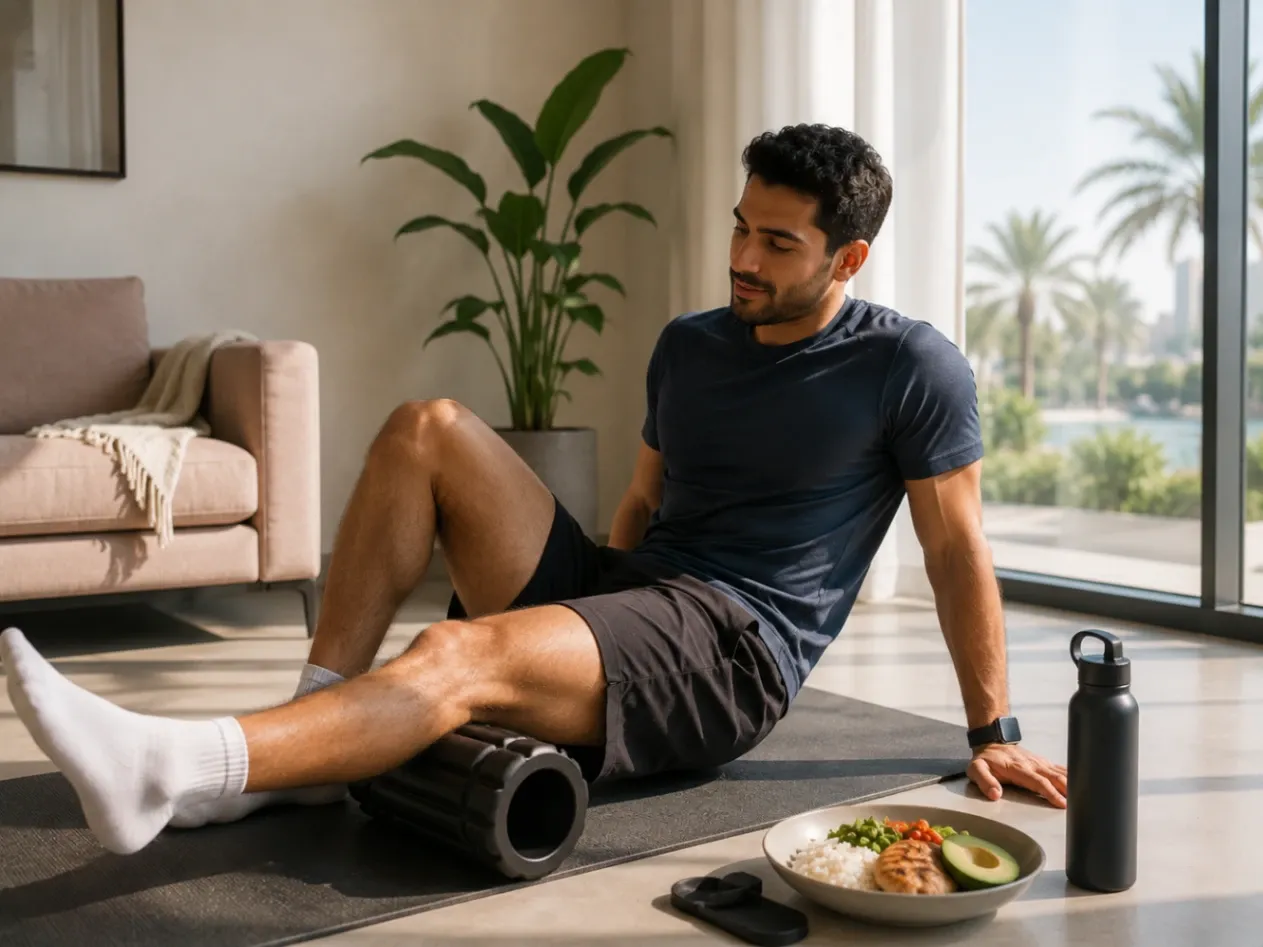
Research by Cheatham et al. (2015, IJSPT) meta-analysis found foam rolling significantly reduces DOMS and improves range of motion recovery when performed post-training and on recovery days. 60–90 seconds per target muscle group, focusing on areas of tension rather than painful rolling for its own sake.
Cold Water Immersion (UAE Accessible)
Cold water immersion (10–15°C, 10–15 minutes) is consistently supported by research for reducing acute DOMS and perceived recovery (Bleakley & Davison 2010, British Journal of Sports Medicine). In UAE, practical options: cold pool (most UAE residences), ice bath (advanced), or cold shower for 3–5 minutes post-training. Note: avoid very cold water immediately after strength training as it may blunt acute anabolic signalling — save it for 4+ hours post-session or after cardiovascular training.
Heart Rate Variability (HRV) — Recovery Monitoring in UAE
HRV (Heart Rate Variability) measures the variation in time between heartbeats — a reliable indicator of autonomic nervous system recovery status. Research by Plews et al. (2013, IJSPP) shows HRV monitoring allows athletes to adjust training based on real-time recovery status, significantly improving performance outcomes compared to fixed training schedules.
UAE athletes can monitor HRV with: Polar H10 + HRV4Training app, WHOOP (popular among UAE fitness professionals), Garmin HRV Status (built into modern Garmin watches). Measure immediately upon waking, before any caffeine or movement, for 3–5 minutes in a consistent position.
Practical Recovery Schedule for UAE Athletes
- Post-training (0–30 min): Protein + carbs, cool down, light stretch or mobility
- Evening: Foam rolling key muscle groups, 10 min mobility, blue light avoidance from 9pm
- Sleep: 7.5–9 hours, cool dark room (UAE AC advantage)
- Next day (recovery day): Active recovery (20–30 min easy swim or walk), HRV monitoring, full nutrition focus
- Weekly: 1–2 complete rest or very light days per week regardless of training cycle
Ready to Train with a Certified Coach?
Get a free consultation and a training plan built specifically for your goals, level, and schedule.
Find Your Coach →Frequently Asked Questions
Q: How many rest days do athletes need per week in Dubai?
A: Research supports 1–2 complete rest or very easy days per week for most athletes. UAE's heat adds an additional recovery demand — the body expends more energy managing thermoregulation, meaning recovery capacity is slightly reduced compared to training in temperate climates. This makes adequate rest even more important for UAE athletes training year-round.
Q: Is sleeping in air conditioning in Dubai bad for athletic recovery?
A: No — sleeping in a cool, climate-controlled room (16–19°C) is physiologically optimal for sleep quality. UAE's AC-cooled bedrooms are actually ideal sleep environments from a temperature perspective. The main concern is dehydration from dry AC air — ensure you're well-hydrated before sleep and use a glass of water on your bedside table.
Q: Does massage help recovery in Abu Dhabi?
A: Research shows sports massage modestly reduces DOMS and improves perceived recovery — primarily through psychological relaxation rather than specific physiological mechanisms. The benefit is real but modest compared to sleep and nutrition. Abu Dhabi has excellent sports massage facilities, and for high-volume athletes, regular massage (once weekly) is a reasonable recovery investment when fundamentals are in place.
Q: What supplements help with recovery in UAE?
A: Evidence-supported recovery supplements: protein powder (practical protein delivery), creatine monohydrate (reduces muscle damage markers), omega-3 fish oil (anti-inflammatory), tart cherry extract (DOMS reduction), and magnesium (sleep quality). Everything else in UAE's supplement market is marketing. Sleep and nutrition remain more impactful than any supplement.
Q: How do I know if I'm overtrained as a UAE athlete?
A: Key overtraining indicators: persistent performance decline despite maintained training, elevated resting heart rate, chronic fatigue not resolved by rest, mood disturbance (irritability, anxiety, depression), frequent illness, persistent muscle soreness, and declining HRV. If you experience multiple of these simultaneously for 2+ weeks, a 1–2 week training reduction or rest period is appropriate. If symptoms persist, consult a UAE sports medicine physician.
آمادهاید این را عملی کنید؟
با یک مربی معتبر 369MMAFIT در دبی مچ شوید — تمرین شخصی، MMA و تغذیه، حضوری یا آنلاین.