این مقاله فعلاً فقط به انگلیسی موجود است — ترجمهی فارسی بهزودی اضافه میشود.
MMA Training Injuries: Prevention, Treatment, and Return to Training
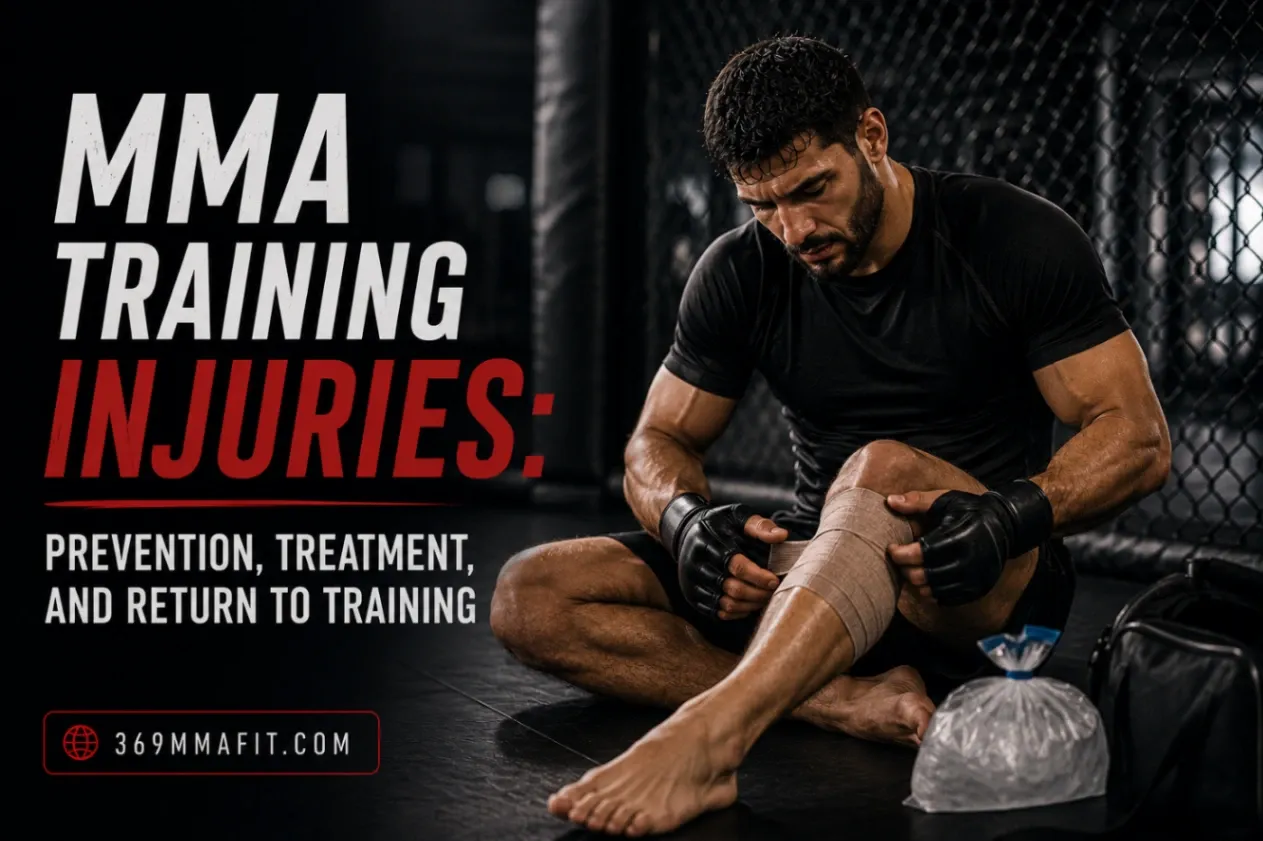
MMA training training carries inherent injury risk — but the evidence consistently shows that the majority of training injuries are preventable. Understanding which injuries occur most frequently, why they happen, and how to structure training to minimize them is one of the highest-leverage investments a fighter can make in their longevity and performance.
Injury Rates in MMA: What the Research Shows
Rainey (2009) documented injury rates in amateur MMA competition at approximately 228 injuries per 1,000 athlete-exposures — among the highest of any combat sport. Bledsoe et al. (2006) found that in professional MMA events, 23.6% of fighters sustained injuries during bouts, with the most common mechanism being strikes to the head followed by grappling-related joint and limb injuries.
Training injuries — which occur far more frequently than competition injuries simply due to the greater time exposure — are less well studied but estimated to run at 5–10 injuries per 1,000 training hours in regular practitioners. The critical observation is that the majority of training injuries involve overuse mechanisms (tendinopathies, stress fractures, muscular strains from inadequate preparation) rather than acute traumatic events.
The 6 Most Common MMA Training Injuries
1. Knee Ligament Sprains (MCL, ACL)
The medial collateral ligament (MCL) is the most frequently sprained knee ligament in grappling sports, typically injured when the knee is loaded in a valgus position (forced inward) during wrestling scrambles or leg lock defense. ACL injuries, while less common in training, carry significant recovery time (9–12 months post-surgery). Preventive strengthening of the hip abductors and quadriceps-to-hamstring strength ratio significantly reduces valgus collapse risk.
2. Shoulder Injuries (Labrum, Rotator Cuff)
The glenohumeral joint's extreme range of motion required for striking and grappling makes it inherently vulnerable. SLAP labral tears (superior labrum, anterior to posterior) are common in overhead throwing athletes and fighters who take armbar or shoulder lock submissions. Rotator cuff tendinopathy — particularly supraspinatus — results from high volumes of overhead pressing and shoulder-intensive sparring without adequate recovery.
3. Cauliflower Ear (Auricular Hematoma)
Repeated blunt trauma to the outer ear causes subperichondrial hematoma formation. Without drainage within 24–48 hours, the cartilage undergoes fibrous organization, creating permanent deformity. Prevention: wear wrestling headgear during grappling practice. Treatment: immediate aspiration by a medical professional within 24 hours of formation.
4. Rib Fractures and Bruising
Rib injuries range from stress fractures (accumulation of repeated impact) to acute fractures from single significant impacts. Clinically, distinguishing fracture from severe bruising requires imaging. Management is primarily supportive — adequate pain management to maintain breathing mechanics, with return-to-sparring typically 6–8 weeks for fracture and 2–4 weeks for bruising.
5. Cervical Spine Strain
Neck pain and cervical strain are common among grapplers due to the isometric loads placed on the neck during underhooks, collar ties, and guard passing. Chronic cervical strain often reflects inadequate neck strengthening rather than traumatic injury. Include neck strengthening (manual resistance, neck harness, wrestler's bridge progressions) 2–3 times per week.
6. Wrist and Hand Injuries
Scaphoid fractures (wrist, often misdiagnosed as sprains — always image a "wrist sprain" that does not resolve within 1–2 weeks), metacarpal fractures from bag and pad work, and thumb UCL sprains (from falling on outstretched hand or submission escapes) are the most common hand and wrist injuries. Use properly fitting boxing gloves for all striking work and wrist wraps for heavy bag sessions.
Why Training Injuries Happen: The Workload Ratio
Gabbett (2016) introduced the acute:chronic workload ratio (ACWR) as the most evidence-based framework for understanding training injury risk. The ratio compares the current week's training load (acute) to the average of the previous 4 weeks (chronic). A ratio below 0.8 indicates undertraining risk; above 1.5 indicates substantially elevated injury risk. The mechanism is straightforward: connective tissue (tendons, ligaments, bone) adapts more slowly than muscle and cardiovascular fitness. Spikes in training load outpace the capacity of slower-adapting tissues to handle the stress.
For MMA fighters, this typically manifests as the "overenthusiastic beginner spike" (doubling training load in the first weeks of a new program) or the "fight camp crunch" (rapidly increasing volume and intensity 8 weeks out after a low-training off-season).
Evidence-Based Prevention Strategies
Warm-Up Protocol
A proper warm-up increases tissue temperature (improving elasticity and reducing injury risk), activates neuromuscular pathways, and prepares the cardiovascular system. For MMA training: 5 minutes light aerobic activity → 5 minutes dynamic mobility (leg swings, arm circles, hip rotations, thoracic rotations) → 5 minutes movement-specific activation (sprawl practice, hip escapes at low intensity, footwork drills). Static stretching before training reduces force production — save it for post-session cool-down.
Prehabilitation Strength Work
Targeted strengthening of the muscle groups most commonly injured in MMA reduces injury incidence. Key prehabilitation exercises: Copenhagen adductor strengthening (MCL and groin injury prevention), external shoulder rotation with band (rotator cuff), neck isometrics (cervical spine), single-leg balance and hip abductor work (ACL risk reduction). 10–15 minutes, 3 sessions per week. For the full strength and conditioning system this integrates with, see our article on Strength and Conditioning for MMA.
Progressive Load Management
Never increase total training load (volume + intensity combined) by more than 10–15% per week. If coming back from a deload period or off-season, start at 60–70% of previous maximum load and build progressively. Use a simple weekly load monitoring system: rate each training session from 1–10 for effort, multiply by duration in minutes (session RPE × duration = arbitrary units of load).
RICE vs. PEACE & LOVE: Updated Acute Injury Management
The traditional RICE protocol (Rest, Ice, Compression, Elevation) has been superseded in sports medicine literature. Dubois and Esculier (2020) proposed the PEACE & LOVE framework: Protection (avoid aggravating activities 1–3 days), Elevation, Avoid anti-inflammatory modalities (NSAIDs and ice impair healing signaling), Compression, Education (understand natural healing trajectory), then Load (controlled early loading promotes recovery), Optimism (positive psychology reduces pain perception), Vascularization (early aerobic movement increases blood flow), Exercise (progressive loading restores function).
Return to Training Framework
A staged return-to-training framework after injury: (1) Pain-free range of motion, (2) Pain-free strength training (bodyweight → resistance), (3) Sport-specific movement patterns without contact, (4) Light contact drills, (5) Full sparring. Advance only when the current stage is pain-free and the injured structure shows no swelling or acute tenderness.
References
- Rainey, C.E. (2009). Determining the prevalence and assessing the severity of injuries in mixed martial arts competition. Journal of Sports Science & Medicine, 8(CSSI3), 45–52.
- Bledsoe, G.H. et al. (2006). Incidence of injury in professional mixed martial arts competitions. Journal of Sports Science & Medicine, 5(CSSI), 136–142.
- Gabbett, T.J. (2016). The training-injury prevention paradox: should athletes be training smarter and harder? British Journal of Sports Medicine, 50(5), 273–280.
- Dubois, B., & Esculier, J.F. (2020). Soft-tissue injuries simply need PEACE and LOVE. British Journal of Sports Medicine, 54(2), 72–73.
Frequently Asked Questions
Q: How long does it take to recover from a common MMA training injury?
A: Recovery time varies widely: mild muscle strains (grade 1) typically resolve in 1–2 weeks; moderate ligament sprains (grade 2) require 3–6 weeks; severe sprains or fractures require 6–12 weeks; surgical repairs (ACL, labrum) require 6–12 months. The single most important factor in recovery time is early appropriate loading — complete rest beyond the acute phase (3–5 days) consistently prolongs recovery.
Q: Should I train through pain in MMA?
A: Distinguish between discomfort (normal training stimulus — proceed) and pain (abnormal signal indicating tissue damage — modify or stop). Sharp, stabbing, or joint pain that worsens during training requires rest and professional assessment. Muscular soreness 24–48 hours after training (DOMS) is normal and not a reason to rest.
Q: Do I need to see a doctor for every MMA training injury?
A: Not every injury. Mild muscle strains and bruises are manageable with self-care. However, consult a sports medicine physician for: any joint injury with significant swelling, loss of range of motion, or instability; wrist injuries (rule out scaphoid fracture); head injuries with any loss of consciousness, confusion, or persistent headache; and any injury that does not improve within 1–2 weeks of appropriate management.
Q: Can strength training prevent MMA injuries?
A: Yes. A comprehensive meta-analysis found that strength training reduces sports injuries by approximately 33% and overuse injuries by up to 50%. The protective mechanisms include increased tendon and ligament stiffness and strength, improved neuromuscular control (reducing valgus collapse and other injury-prone movement patterns), and greater capacity to absorb and dissipate external forces.
Q: Is sparring safe for beginners?
A: Yes, with appropriate supervision and intensity management. Beginners should start with light technical sparring (25–30% effort, drilling-focused) rather than competitive sparring. Headgear, mouthguard, and shin guards are mandatory. Ensure your training partners understand your experience level. Injury risk in supervised beginner sparring is very low and significantly lower than in unsupervised or ego-driven sessions.
Ready to Train with a Certified Coach?
Get a free consultation and a training plan built specifically for your goals, level, and schedule.
Find Your Coach →آمادهاید این را عملی کنید؟
با یک مربی معتبر 369MMAFIT در دبی مچ شوید — تمرین شخصی، MMA و تغذیه، حضوری یا آنلاین.