این مقاله فعلاً فقط به انگلیسی موجود است — ترجمهی فارسی بهزودی اضافه میشود.
How to Improve Your Running Speed in Dubai and Abu Dhabi: Science-Based Training Guide
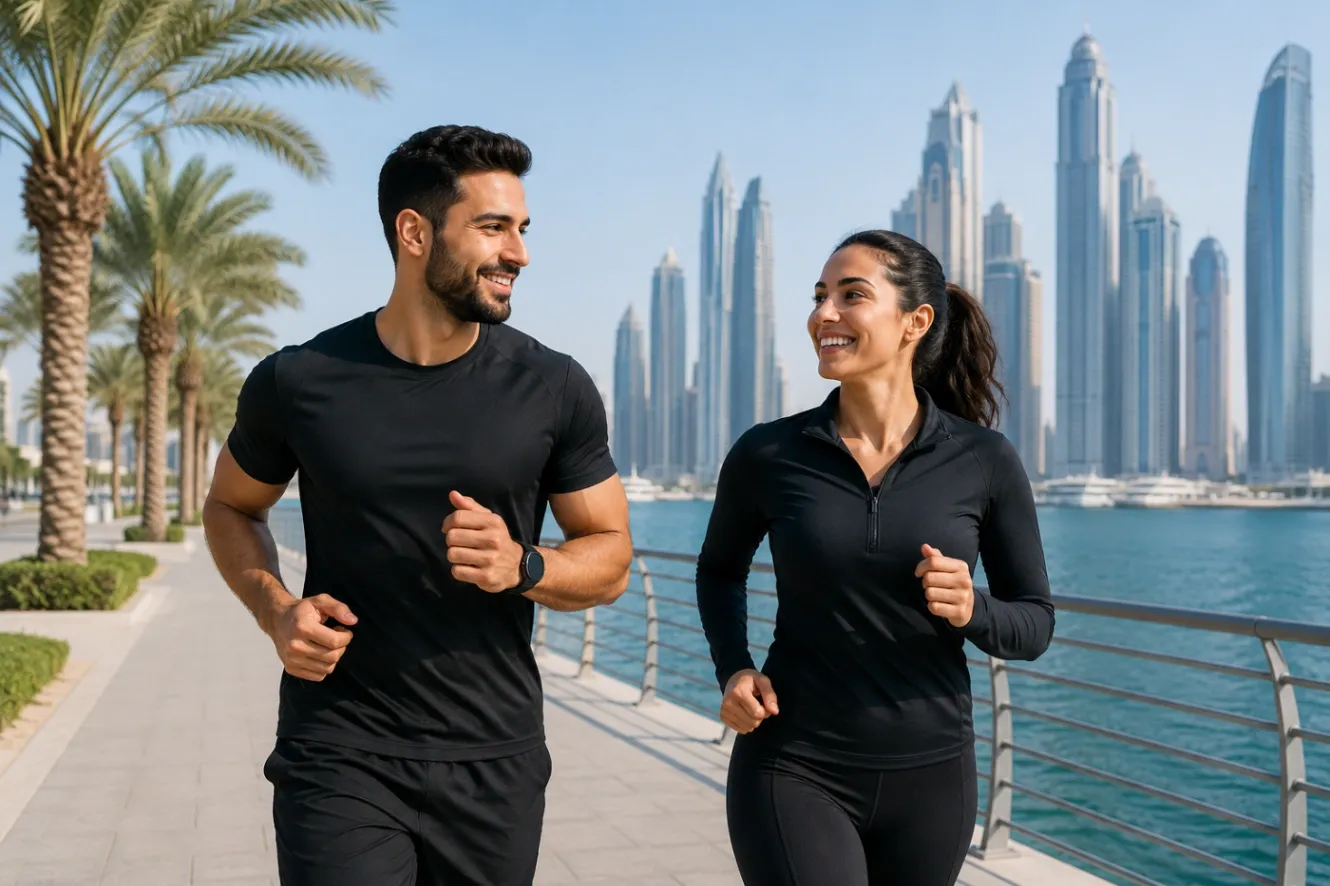
How to Improve Your Running Speed in Dubai and Abu Dhabi: Science-Based Training Guide
Whether you're training for a Dubai Running Festival 10km, preparing for the Abu Dhabi Marathon, or simply want to feel faster and stronger on your regular runs along the Corniche or JBR, improving running speed requires a systematic approach grounded in exercise physiology. This guide provides exactly that — science-based methods to run faster, tailored for UAE conditions.
The Physiology of Running Speed
Running speed is determined by two variables: stride length and stride frequency (cadence). Research by Weyand et al. (2010) shows these are both trainable — but through different mechanisms:
- Stride length is primarily limited by hip extension range and posterior chain power (glutes, hamstrings). Improving these increases how far each stride carries you.
- Stride frequency is determined by neuromuscular coordination and leg turnover — how quickly you can cycle your legs.
- Both are also influenced by running economy — how efficiently you use oxygen at a given speed. Better economy means the same speed costs less effort.
Method 1: Interval Training — The Fastest Route to Speed Improvement
Research by Laursen & Jenkins (2002, Sports Medicine) and Ingham et al. shows interval training at 90–100% of VO2max pace is the most effective method for improving running speed and VO2max simultaneously.
Types of Intervals for UAE Runners
Short intervals (400m repeats):
- Protocol: 6–10 × 400m at your target 1km race pace
- Recovery: Walk or very easy jog for 90–120 seconds between
- Frequency: 1× per week maximum
- Best done: Track or Al Qudra flat sections; early morning Oct–Apr or evening/treadmill in summer
1km intervals:
- Protocol: 4–6 × 1km at 5km race pace
- Recovery: 2–3 minutes easy jog between
- Highly effective for 5km and 10km improvement
Tempo runs (threshold training):
- Protocol: 20–40 minutes continuous running at "comfortably hard" pace (can speak only in short phrases)
- Builds lactate threshold — the pace you can sustain in longer races
- 1× per week alongside short intervals
Method 2: Strength Training for Faster Running
Strength training improves running speed through multiple mechanisms — greater force production per stride, improved neuromuscular coordination, and reduced energy waste from weak stabilising muscles. Research by Beattie et al. (2017, IJSPP) found heavy strength training improved 1500m performance by 3.8% in trained runners — without changing training volume.
Key Strength Exercises for UAE Runners
- Heavy barbell squat: 3 sets × 4–6 reps at 80%+ 1RM. Research consistently shows heavy lower body training improves running economy.
- Romanian deadlift: Targets hamstrings and glutes — primary force producers in running
- Single-leg exercises: Running is a single-leg sport. Bulgarian split squats, single-leg deadlifts, and step-ups build functional running strength
- Hip flexor strengthening: Often neglected but critical for fast stride rate. Hanging leg raises, cable hip flexion
- Plyometrics (1× per week): Box jumps, broad jumps, single-leg hops — develop reactive force that directly improves stride power
Method 3: Running Form Improvements
Poor running mechanics waste energy and limit speed. Common form issues among Dubai and Abu Dhabi recreational runners:
- Overstriding: Landing heel-first in front of your centre of mass creates a braking force with every step. Fix: Focus on landing foot under your hips, not in front.
- Cadence too low: The optimal running cadence is approximately 170–180 steps per minute. Count your steps for 30 seconds × 2 — many recreational runners are at 150–160. Increase cadence by 5% and your speed will increase without more effort.
- Cross-body arm swing: Arms crossing the midline creates rotation that costs energy. Keep elbows bent at ~90°, hands relaxed, arms swinging forward-backward not across the body.
- Forward head posture: Common in UAE office workers who bring desk posture into running. Keep ears over shoulders, slight forward lean from the ankles (not the waist).
Method 4: Aerobic Base — The Foundation Under Everything
Interval training only produces improvements on top of an adequate aerobic foundation. Without sufficient easy running volume, interval training yields diminishing returns and injury risk. Research by Seiler (2010) shows that 80% of total running training volume should be at easy pace (conversational effort).
For Dubai and Abu Dhabi runners:
- Build weekly easy running to 30–50km before adding significant interval work
- Easy runs should be genuinely easy — most recreational UAE runners run their easy days too hard, accumulating fatigue that limits quality of hard sessions
- Use heart rate: easy running is approximately 65–72% of maximum HR
8-Week Speed Improvement Programme for UAE Runners
Weekly Structure
- Monday: Easy run 40–50 min
- Tuesday: Strength training (squat, deadlift, plyometrics)
- Wednesday: Interval session (alternate between 400m repeats and 1km repeats)
- Thursday: Easy run 30–40 min OR rest
- Friday: Tempo run 25–35 min
- Saturday: Long easy run (60–90 min, conversational pace)
- Sunday: Rest or easy walk
Running in UAE Heat: Speed Implications
Heat is the most significant external factor affecting running performance in Dubai and Abu Dhabi. Research shows running performance decreases approximately 5–8% per 5°C above 18°C. On a Dubai summer evening (35°C), performance is theoretically reduced by 15–20% versus equivalent effort in optimal conditions.
Practical heat management for faster UAE running:
- Train in the heat for UAE racing: Heat acclimatisation over 7–14 days of consistent heat exposure genuinely improves performance in those conditions. If racing in UAE, training in UAE heat is advantageous.
- Use heat as altitude substitute: The physiological adaptations from heat training (plasma volume expansion, improved thermoregulation) mimic some altitude training benefits. Deliberate heat training is a legitimate performance strategy.
- Don't compare winter and summer times: Your summer pace doesn't represent fitness — it represents fitness + heat challenge. Use effort and heart rate as metrics, not pace, during UAE summer.
Dubai and Abu Dhabi Running Races and Events
Target events provide focus and motivation for UAE runners:
- Dubai Fitness Challenge (October–November): Annual city-wide fitness event with mass participation runs
- Standard Chartered Dubai Marathon (January): Full and half marathon, one of the Middle East's premier road races
- Abu Dhabi Marathon (December): Full, half, 10km options
- Dubai Run: Mass participation 5km and 10km events
- Wadi runs and trail events: Off-road running growing rapidly in UAE, with events at Hatta and various desert locations
Ready to Train with a Certified Coach?
Get a free consultation and a training plan built specifically for your goals, level, and schedule.
Find Your Coach →Frequently Asked Questions
Q: How long does it take to improve running speed in Dubai?
A: Measurable speed improvement from a structured programme is typically evident within 6–8 weeks. Significant performance improvements (5–10% in race times) generally take 12–16 weeks of consistent training. The rate of improvement is fastest for runners who are relatively new to structured training — experienced runners see improvements more gradually.
Q: Should I run in the morning or evening in Abu Dhabi for best performance?
A: October–April: early morning (6–8am) and evening (6–8pm) are both excellent. May–September: run before 7am or after 8pm to avoid dangerous heat. Research shows afternoon/early evening training produces marginally better performance in most people due to higher core temperature, but the practical UAE summer constraint makes morning training optimal for most residents.
Q: How many times per week should I run to improve speed in UAE?
A: 4–5 runs per week is optimal for most recreational UAE runners wanting significant speed improvement. The structure should be: 1 interval session, 1 tempo run, 1 long easy run, 1–2 easy recovery runs. Running only 2–3 times per week limits the aerobic adaptations that underpin speed improvement.
Q: Will heat training in Dubai make me faster in cool conditions?
A: Yes. Research confirms deliberate heat acclimatisation increases plasma volume, improves cardiac output, and reduces cardiovascular strain — adaptations that transfer to cooler conditions. Training in UAE summer heat and then racing in cooler winter conditions can provide a performance advantage, similar in mechanism (though different in magnitude) to altitude training.
Q: Should I hire a running coach or personal trainer in Dubai to improve speed?
A: A running coach or S&C personal trainer in Dubai with running expertise can significantly accelerate speed development through personalised programming, gait analysis, and progressive overload management. For runners targeting specific race time goals, structured coaching is far more efficient than self-directed training. Many UAE-based coaches offer both in-person and online programmes.
آمادهاید این را عملی کنید؟
با یک مربی معتبر 369MMAFIT در دبی مچ شوید — تمرین شخصی، MMA و تغذیه، حضوری یا آنلاین.