این مقاله فعلاً فقط به انگلیسی موجود است — ترجمهی فارسی بهزودی اضافه میشود.
Flexibility and Mobility Training in Dubai and Abu Dhabi: The Complete Science-Based Guide
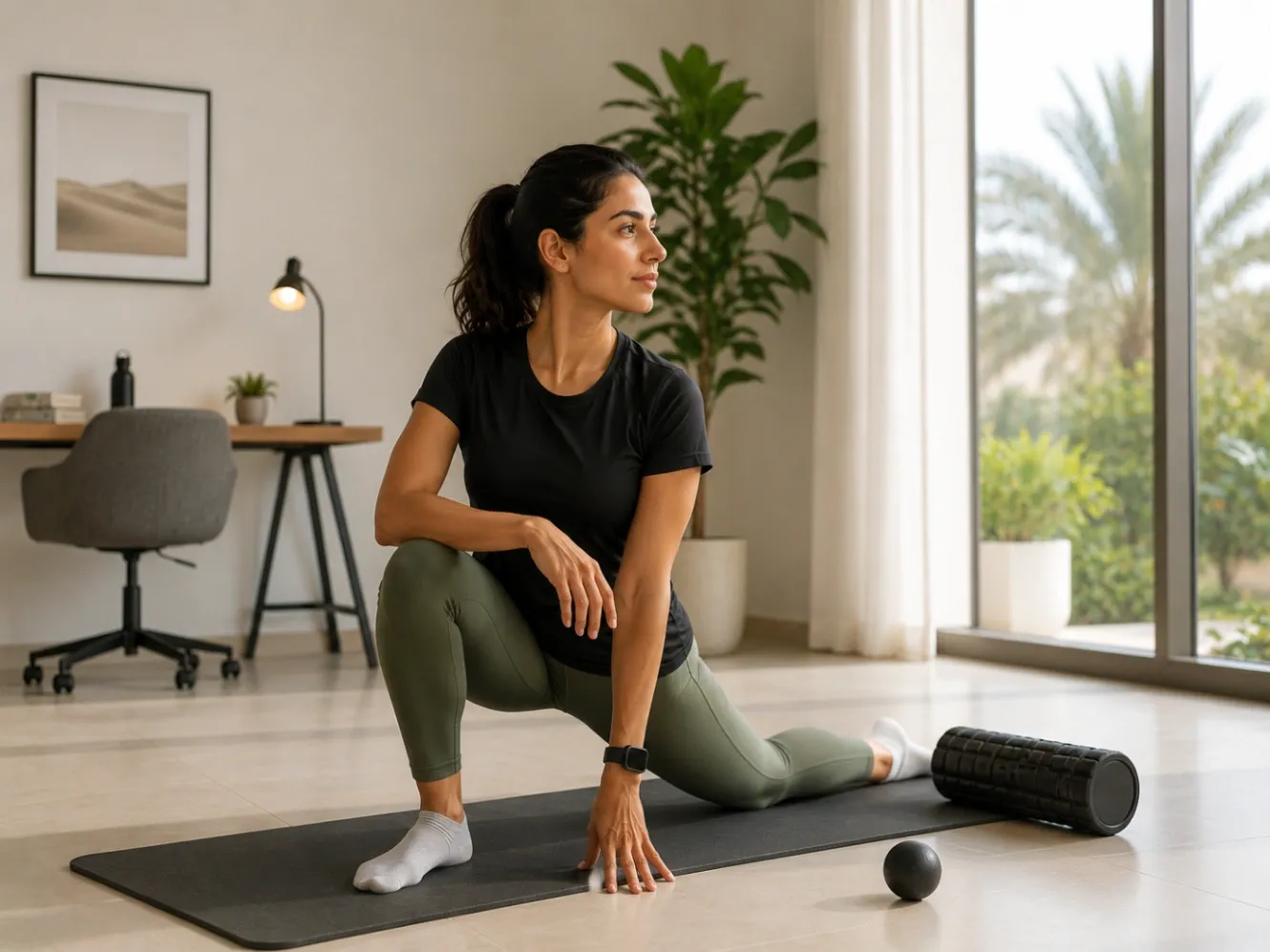
Flexibility and Mobility Training in Dubai and Abu Dhabi: The Complete Science-Based Guide
Poor flexibility and mobility is one of the most prevalent but most correctable fitness limitations among UAE residents. Dubai and Abu Dhabi's desk-work culture, car-centric lifestyle, and limited natural walking creates a population with chronically shortened hip flexors, tight thoracic spines, and restricted shoulder mobility. This guide provides a science-based approach to reversing these patterns.
Flexibility vs. Mobility: An Important Distinction
These terms are often used interchangeably but represent different physical qualities:
- Flexibility: The passive range of motion available in a joint — how far you can stretch a muscle when an external force is applied (gravity, body weight, another person)
- Mobility: The active range of motion you can control — how far you can move a joint through its range using your own muscular strength and neural coordination
Mobility is the more functionally relevant quality. A person can have good passive hip flexibility but poor active hip mobility if they lack the muscular strength and neural control to use that range actively. Research by Behm & Chaouachi (2011) shows active mobility training produces more functional improvements than passive flexibility training for most athletic and daily life applications.
Why UAE Residents Need Mobility Work
The Dubai and Abu Dhabi lifestyle systematically creates specific mobility restrictions:
Hip Flexor Tightness
Prolonged sitting (8–10+ hours daily in UAE office environments) places hip flexors (particularly iliopsoas) in a shortened position. Over months and years, this creates both structural and neural shortening. Consequences: anterior pelvic tilt, lower back pain, limited hip extension in running and squatting, and reduced stride length.
Thoracic Spine Restriction
Forward head posture from screen use combined with seat-back support eliminates the natural thoracic mobility requirement. Loss of T-spine mobility forces excessive compensatory movement at the lumbar spine (injury risk) and limits rotation for golf, tennis, swimming, and MMA — sports popular in UAE.
Ankle Mobility
Closed-toe shoes worn in air-conditioned UAE environments, combined with minimal walking on uneven surfaces, reduces ankle dorsiflexion mobility. Limited ankle mobility restricts deep squatting and stair performance, and increases knee and lower back injury risk.
Shoulder Mobility
Forward shoulder posture from screen work limits overhead mobility — relevant for swimming, tennis, weightlifting, and simply reaching overhead comfortably.
Evidence-Based Mobility Improvement Methods
Method 1: Controlled Articular Rotations (CARs)
CARs, developed by Dr. Andreo Spina's Functional Range Conditioning system, involve taking joints through their maximum active range of motion under voluntary muscular control. Research shows CARs maintain and improve joint capsule health and neurological control of joint range. The approach: slowly take the joint to the end of its comfortable active range in all directions, 3–5 repetitions per joint.
Daily CAR routine (7 minutes): Neck CARs, shoulder CARs, hip CARs, and ankle CARs — one joint at a time, maximum active control, minimal compensation.
Method 2: Contract-Relax (PNF) Stretching
Proprioceptive Neuromuscular Facilitation stretching involves contracting the muscle being stretched for 6–8 seconds, then relaxing into a deeper stretch. Research by Sharman et al. (2006) shows PNF produces significantly greater flexibility gains than static stretching alone — 30–40% greater improvement in hamstring flexibility in one study.
Protocol: Reach your passive end range, contract the target muscle at ~30% effort for 6–8 seconds, release and breathe, then move deeper into the new range. 3–4 repetitions per muscle.
Method 3: Static Stretching (Correctly Timed)
Static stretching is effective for improving passive flexibility but research confirms it should NOT be performed before training — it reduces power output and strength by 5–8% for up to 60 minutes post-stretching (Behm & Chaouachi 2011). Best timing: post-training or during dedicated flexibility sessions separate from training.
Effective static stretch parameters: 30–60 seconds per stretch, at a mild tension (not pain), for 2–3 repetitions per muscle. 4–5 sessions per week produces meaningful flexibility gains within 4–6 weeks.
Method 4: Foam Rolling and Myofascial Release
Foam rolling before stretching has been shown to improve subsequent flexibility gains by mechanically reducing tissue stiffness. Research by MacDonald et al. (2014) found 2 minutes of foam rolling increased joint range of motion by 4–8° without reducing force production — making it ideal as a pre-exercise warm-up tool unlike static stretching.
4-Week UAE Mobility Programme
Target areas most relevant to Dubai and Abu Dhabi office workers and athletes. Perform daily (15 minutes) — any time of day except immediately before intense training:
Hip Flexor and Hip Mobility (5 minutes)
- Half-kneeling hip flexor stretch: 60 seconds each side
- 90/90 hip stretch: 60 seconds each position (internal and external rotation)
- Hip CARs: 5 repetitions each hip (slow, maximum active control)
Thoracic Spine (4 minutes)
- T-spine rotation in quadruped: 10 reps each side
- Open book stretch: 10 reps each side
- Foam roller thoracic extension: 60 seconds over roller at mid-back
Shoulder and Neck (3 minutes)
- Shoulder CARs: 5 reps each shoulder
- Doorway chest stretch: 60 seconds (counters forward shoulder posture)
- Neck side stretch: 30 seconds each side
Ankles (3 minutes)
- Ankle CARs: 5 reps each ankle
- Knee-to-wall ankle dorsiflexion: 10 reps each side
- Calf foam rolling: 60 seconds each leg
Yoga and Pilates for UAE Mobility
Yoga and Pilates are both excellent supplementary mobility tools widely available in Dubai and Abu Dhabi. Research by Cramer et al. (2013, Clinical Journal of Pain) shows yoga significantly improves flexibility and mobility compared to control groups — with the social and mindfulness benefits being additionally valuable for UAE residents managing high stress loads.
UAE yoga coaching and Pilates studios in Dubai (Exhale, Pure Yoga, The Hundred) and Abu Dhabi (Yogathletica, Reform Pilates Abu Dhabi) offer both in-person and online classes, making regular practice highly accessible.
Ready to Train with a Certified Coach?
Get a free consultation and a training plan built specifically for your goals, level, and schedule.
Find Your Coach →Frequently Asked Questions
Q: How long does it take to improve flexibility in Dubai with daily stretching?
A: Research shows measurable flexibility improvements within 4–6 weeks of consistent daily stretching (5–7 days/week). Significant transformation — where previously restricted movements become comfortable — typically takes 8–12 weeks of consistent practice. Consistency is far more important than session duration; 10–15 minutes daily outperforms 60-minute weekly sessions.
Q: Is it too late to improve flexibility at 50 in Abu Dhabi?
A: No — research confirms flexibility improvements from stretching training occur at all ages, including in adults over 60 and 70. Older adults may progress slightly more slowly but consistently achieve meaningful gains. Age-related connective tissue changes make mobility work even more important after 50, not less.
Q: Should I stretch before or after gym in Dubai?
A: Dynamic stretching (leg swings, hip circles, arm circles) and mobility warm-up exercises: before training. Static stretching (holding positions for 30–60 seconds): after training only, or in a separate session. Pre-training static stretching reduces strength and power output and should be avoided before resistance training or athletic performance.
Q: Can flexibility training help lower back pain in UAE office workers?
A: Yes — hip flexor stretching, thoracic mobility work, and hamstring flexibility training address three of the most common physical contributors to lower back pain in Dubai and Abu Dhabi office workers. Combined with core stability training (dead bugs, bird dogs, Pallof press), a targeted mobility programme is one of the most effective interventions for chronic lower back pain from sedentary work.
Q: How does the UAE climate affect flexibility training?
A: Warm muscles are more flexible — UAE's ambient temperature means muscles are naturally more pliable than in cold climates, which is a slight flexibility advantage. However, dehydration (common in UAE heat) reduces tissue pliability. Ensure adequate hydration before flexibility sessions. In air-conditioned gyms or home environments, a brief warm-up before stretching remains important even in UAE's warm climate.
آمادهاید این را عملی کنید؟
با یک مربی معتبر 369MMAFIT در دبی مچ شوید — تمرین شخصی، MMA و تغذیه، حضوری یا آنلاین.