این مقاله فعلاً فقط به انگلیسی موجود است — ترجمهی فارسی بهزودی اضافه میشود.
Core Exercises for Seniors in the UAE: Safe and Effective Training Over 60
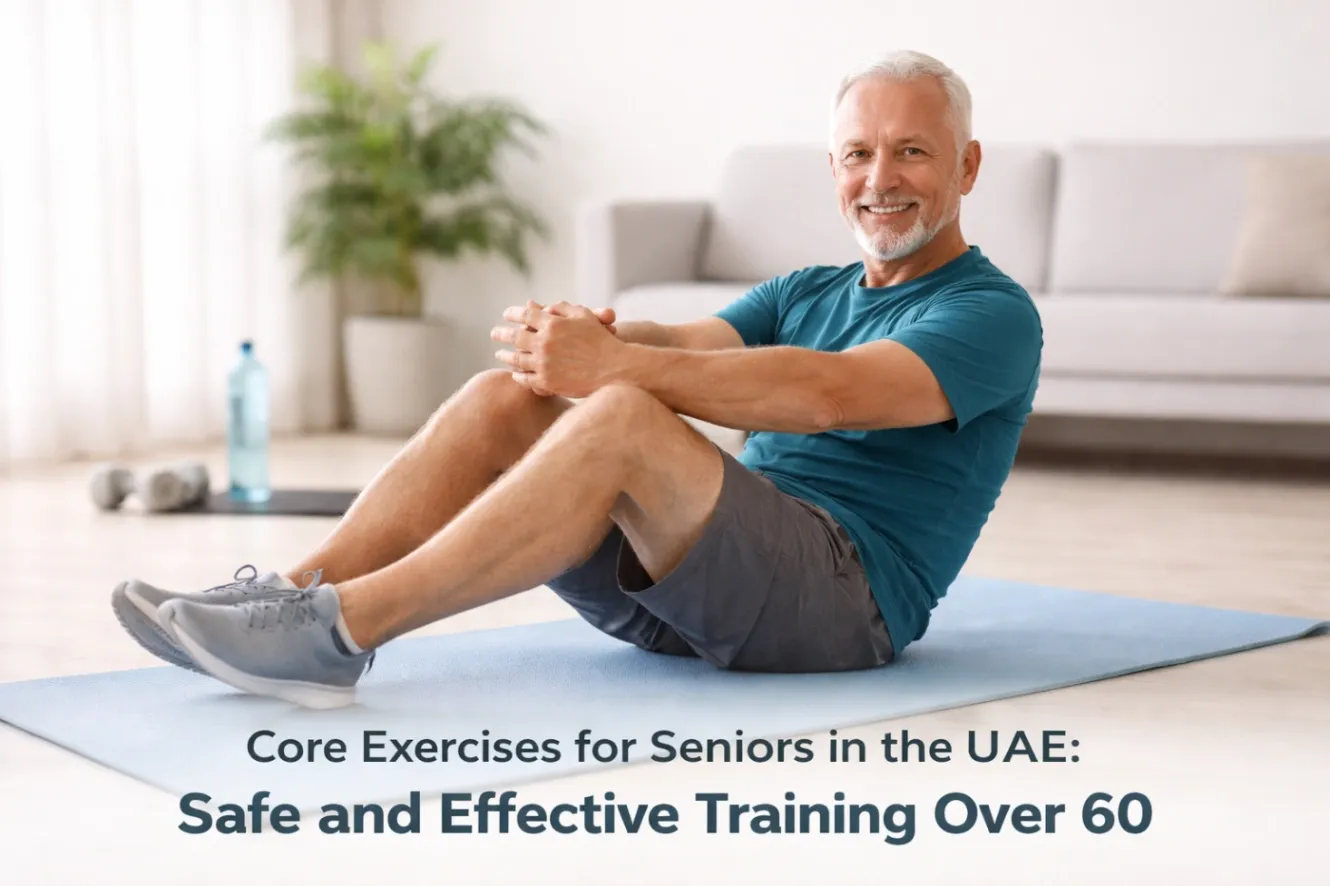
Core Exercises for Seniors in the UAE: Safe and Effective Training Over 60
Core training for seniors in Abu Dhabi and Dubai is one of the most important and most misunderstood areas of fitness for older adults. The "core" is not about six-pack aesthetics — it is the functional system that keeps you upright, prevents falls, enables pain-free daily movement, and maintains your independence as you age. Research is unambiguous: maintaining core strength and function is among the highest-impact health investments available to people over 60 in the UAE.
Why Core Strength Matters More as You Age
Three evidence-based reasons why core training should be a priority for UAE seniors:
1. Fall Prevention — The Most Critical Benefit
Falls are the leading cause of injury-related death and disability in adults over 65 globally. In the UAE, where floor surfaces (marble tiles in homes, polished stone in malls, uneven outdoor surfaces) create significant fall hazards, this is acutely relevant. Research by Gillespie et al. (2012, Cochrane Review) found that exercise programmes targeting strength and balance (the key outputs of core training) reduced fall incidence by 23% and fall-related injuries by 37% in older adults.
2. Back Pain Management
Chronic low back pain affects an estimated 65–80% of adults over 60. Weak deep core muscles (multifidus, transversus abdominis) fail to adequately stabilise the lumbar spine under daily loading — sitting, standing, walking, lifting. Strengthening these muscles reduces compressive joint load and improves pain in the majority of cases. Research by Hicks et al. (2005, Spine) showed core stabilisation exercise programmes produced superior pain and disability outcomes compared to general exercise in older adults with chronic low back pain.
3. Functional Independence
Core strength is the foundation of virtually every activity of daily life: getting up from chairs, climbing stairs, bending to pick up objects, carrying shopping at Abu Dhabi markets, maintaining balance while reaching overhead. The ACSM's Position Stand on physical activity for older adults identifies core and balance training as priority components of senior fitness programmes for this reason.
What NOT to Do: Core Exercises Seniors Should Avoid
Several commonly seen core exercises in UAE gyms are inappropriate or higher-risk for seniors:
- Traditional sit-ups and crunches: Place excessive flexion force on lumbar discs and cervical spine; risk of vertebral fracture in those with osteoporosis; negligible functional benefit compared to safer alternatives
- Double leg raises (both legs simultaneously): Creates large lumbar flexion moment; inappropriate for most seniors and those with any disc pathology
- Heavy loaded spinal flexion/extension machines: High compressive loads on already age-compromised spinal structures
- Fast, ballistic movement-based core exercises: Reaction time slows with age; explosive movements increase fall and strain risk
Safe and Effective Core Exercises for UAE Seniors
Level 1: Foundation (for those new to exercise or very deconditioned)
Diaphragmatic Breathing + TVA Activation
Lie on your back, knees bent. Breathe deeply into your belly (not chest). On exhale, gently draw the belly button toward the spine without holding your breath. This activates the transversus abdominis — the deepest core muscle and primary spinal stabiliser. Hold 5 seconds, 10 repetitions. This is the foundation of all core training.
Heel Slides
Lying on back, knees bent. Maintaining gentle TVA activation, slowly slide one heel away from you until the leg is flat, then return. Alternate sides. 10 repetitions each side. Trains lumbar stabilisation during limb movement — the most functional core demand in daily life.
Seated Core Engagement (Chair Exercise)
Seated in a firm chair, feet flat on floor. Sit tall (not using chair back for support), hold this position for 30 seconds. This trains the postural endurance of spinal extensors and deep core — the muscles that keep you upright throughout the day.
Level 2: Progressive (for those with some movement foundation)
Glute Bridge
Lying on back, knees bent. Press through heels to lift hips off floor until shoulders, hips, and knees form a straight line. Hold 5 seconds, lower slowly. 3 × 10. Strengthens glutes and posterior chain — critical for walking, stair climbing, and sitting-to-standing in Abu Dhabi and Dubai.
Bird-Dog
On hands and knees (or modified on seated position for those with wrist issues). Extend one arm forward and opposite leg back simultaneously, hold 5 seconds, return. Alternate. 3 × 8 each side. This is among the most evidence-supported exercises for lumbar stabilisation (McGill 2007, Low Back Disorders).
Modified Side Plank (on knee)
Lying on side, lower knee bent for support, upper leg extended. Lift hips from floor. Hold 15–20 seconds each side. Trains the lateral stabilisers (quadratus lumborum, obliques) essential for sideways balance and hip stability.
Level 3: Advanced (for active seniors with good movement foundation)
Full Plank (Modified)
Forearm plank (elbows under shoulders) with knees on mat for modification or full plank on toes. Hold 20–30 seconds, rest, repeat 3 times. Progress toward 60-second holds over weeks.
Standing Single-Leg Stance
Stand on one foot for 20–30 seconds, eyes open. Progress to eyes closed. This directly trains balance — the integrated output of core and hip stability in the most functional position. Near a wall for safety until confident.
Romanian Deadlift (Light Dumbbells)
Hip hinge movement with 2–5kg dumbbells. Stand feet hip-width, soft knees, hinge at hips (not waist) to lower dumbbells along thighs, feeling hamstring stretch, then drive hips forward to return. 3 × 12. The most functional posterior chain exercise for seniors — trains the hip hinge pattern used to pick up objects safely.
Sample Weekly Core Programme for UAE Seniors
- Monday: Level 1–2 exercises (20 minutes)
- Wednesday: Level 2–3 exercises + 20 minutes walking (outdoors in winter, mall-walking in summer)
- Friday: Level 1–2 exercises + balance training (standing single-leg)
- Daily: Seated core engagement at desk/dining table — posture training costs no extra time
Frequently Asked Questions
Q: Is it safe for seniors over 70 in Dubai to do core exercises?
A: Yes — with appropriate exercise selection. The Level 1 exercises (diaphragmatic breathing, heel slides, seated engagement) are safe for virtually all older adults including those over 80. More advanced exercises should be introduced gradually and ideally with supervision from a qualified personal trainer in Dubai or Abu Dhabi experienced with senior populations. Any exercise causing sharp pain should be stopped and reviewed.
Q: Will core exercises help my lower back pain in Abu Dhabi?
A: For most non-specific chronic low back pain in seniors, yes — core stabilisation exercises are among the most evidence-supported interventions. However, acute or severe back pain, back pain with leg symptoms (sciatica), or back pain following injury should be assessed by a doctor or physiotherapist in Abu Dhabi before starting exercise. Exercise is a key part of back pain management, but the type and starting intensity should be guided by your specific diagnosis.
Q: How often should seniors over 60 do core exercises in the UAE?
A: 3–4 times per week is ideal, with rest days between sessions. The muscles involved in core training (particularly the slow-twitch postural stabilisers) recover relatively quickly and can be trained more frequently than power-focused muscles. However, consistent quality over time matters more than frequency — 3 well-executed sessions weekly for months produces better outcomes than intense daily sessions done for 2 weeks then abandoned.
Q: What equipment do I need for senior core exercises in my Abu Dhabi apartment?
A: A yoga mat or exercise mat (AED 50–150 at most UAE sports stores) is the only equipment needed for all Level 1 and 2 exercises. Level 3 exercises benefit from light dumbbells (1–3kg). A sturdy chair is useful for seated exercises and near-wall balance practice. No gym membership is required — the most effective senior core programme can be done entirely at home.
Q: My doctor told me to exercise but I'm afraid of hurting myself in Dubai. How do I start safely?
A: Begin with Level 1 exercises only for 2–3 weeks before progressing. If you have any existing medical conditions (osteoporosis, recent surgery, cardiovascular conditions), work with a certified personal trainer in Dubai or Abu Dhabi experienced with seniors — preferably one who can liaise with your physician. Progress should be gradual: if any exercise causes pain beyond mild muscular effort, stop that exercise, rest for a day, and try a modified version or seek professional guidance.
Ready to Train with a Certified Coach?
Get a free consultation and a training plan built specifically for your goals, level, and schedule.
Find Your Coach →References: Gillespie et al. 2012, Cochrane Review — fall prevention | Hicks et al. 2005, Spine | McGill 2007, Low Back Disorders 2nd Ed | ACSM Position Stand — Physical Activity and Public Health in Older Adults
آمادهاید این را عملی کنید؟
با یک مربی معتبر 369MMAFIT در دبی مچ شوید — تمرین شخصی، MMA و تغذیه، حضوری یا آنلاین.