این مقاله فعلاً فقط به انگلیسی موجود است — ترجمهی فارسی بهزودی اضافه میشود.
Battle Rope Training in the UAE: Is It Good for Muscle Gain?
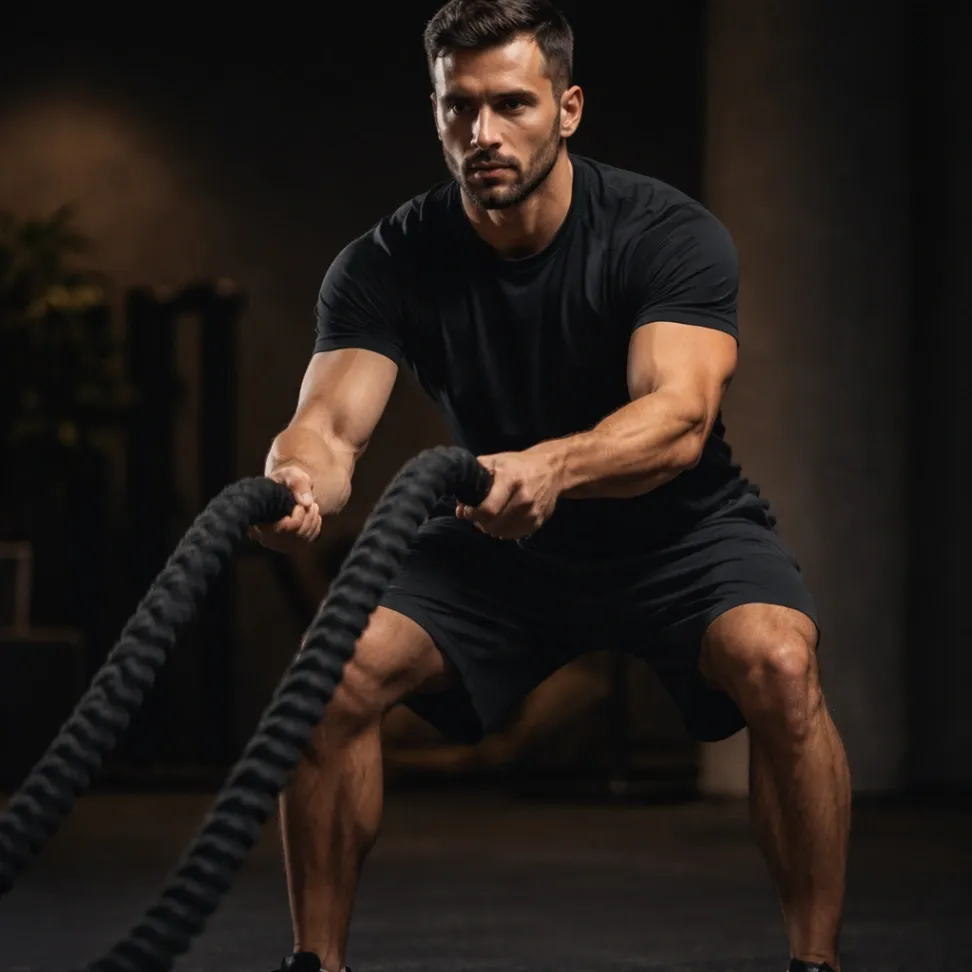
Battle Rope Training in the UAE: Is It Good for Muscle Gain?
Walk into any well-equipped gym in Abu Dhabi or Dubai and you will almost certainly find a set of battle ropes anchored to a wall or pillar — thick, heavy ropes used in wave, slam, and rotation patterns that leave even fit athletes breathless within 30 seconds. Battle rope training has exploded in popularity at UAE fitness facilities, CrossFit boxes, and outdoor boot camps. But beyond the spectacle of the exercise, many gym-goers have a specific question: does it actually build muscle?
The answer, like most questions in exercise science, is nuanced — and worth understanding properly.
What Are Battle Ropes? Equipment Overview
Battle ropes (also called battling ropes) are typically 9–15 metres long, 3–5 cm in diameter, made from polyester or manila, and weigh 9–20 kg. One end is anchored; the user holds the free ends and creates wave, slam, or rotational patterns.
The weight of the rope, the length from the anchor point, and the pattern performed determine the intensity. Shorter distance from the anchor = easier (less rope mass to move). Common movements include:
- Alternating waves: Alternating arm motion creating undulating waves
- Double waves: Both arms simultaneously, greater upper body demand
- Slams: Overhead lift and slam of both ends simultaneously
- Circles: Both arms rotating in vertical or horizontal circles
- Lateral shuffles + waves: Combining footwork with wave patterns
Muscle Activation in Battle Rope Training
Electromyography (EMG) research by Calatayud et al. (2015 — Journal of Human Kinetics) measured muscle activation during common battle rope movements and found significant engagement of:
- Anterior deltoids and lateral deltoids: Primary movers in wave patterns
- Biceps brachii and brachialis: Significant activation in alternating wave and slam variations
- Trapezius (upper and middle): Stabilisation and wave-generation
- Latissimus dorsi: Active in slam and downward drive phases
- Rectus abdominis and obliques: Continuous core stabilisation throughout all movements
- Quadriceps and glutes: Hip hinge and squat-stance variations increase lower body activation substantially
This is genuinely impressive muscle activation coverage — battle ropes are a legitimate whole-body exercise.
Can Battle Ropes Build Muscle?
This is where the honest answer matters. Battle rope training can contribute to muscle development, but with important qualifications:
Where Battle Ropes Excel
- Muscular endurance: The typical 20–40 second high-intensity intervals develop the oxidative capacity of recruited muscles — improving their ability to sustain work over time. This is a form of muscular development, though distinct from hypertrophy.
- Hypertrophy for untrained individuals: Beginners achieve muscle gain from almost any resistance stimulus. For untrained individuals, the novel loading of battle rope training will produce some hypertrophic response in the shoulders, arms, and core.
- Metabolic conditioning: A 2015 study by Fountaine & Schmidt (Journal of Strength & Conditioning Research) found 10 minutes of battle rope training burned 112 kcal and produced peak heart rate responses of 94% max HR — comparable to high-intensity interval running. For fat loss alongside muscle maintenance, this is highly effective.
Where Battle Ropes Are Limited for Muscle Gain
- Insufficient mechanical tension for hypertrophy: The primary driver of muscle hypertrophy is mechanical tension — the amount of force applied to a muscle fibre under load. Battle ropes produce high metabolic stress and muscle damage but relatively low mechanical tension compared to progressive barbell or dumbbell training.
- No progressive overload mechanism: Hypertrophy requires progressively increasing resistance over time. Battle ropes offer limited progression options — you can increase time or wave speed, but load increases are minimal compared to adding plates to a bar.
- Lower body underutilisation: Standard battle rope movements primarily load the upper body. Leg-heavy variations exist (squat waves, lunge slams) but are rarely programmed.
The evidence verdict: Battle ropes are an excellent conditioning tool and provide secondary muscle development benefits — but should not be the primary tool for individuals whose main goal is muscle hypertrophy. That goal is best served by progressive resistance training (Schoenfeld, 2010 — JSCR).
How to Integrate Battle Ropes Effectively in UAE Gym Programming
As a Conditioning Finisher (Most Common and Effective)
After a strength training session, 10–15 minutes of battle rope intervals deliver cardiovascular and metabolic conditioning without compromising the primary strength stimulus. Example protocol:
- 30 seconds alternating waves | 30 seconds rest × 8 rounds
- Total work time: 4 minutes. Total session add-on: ~12 minutes including setup
As Standalone Conditioning (HIIT Format)
On rest days from heavy lifting, a 20-minute battle rope HIIT session provides excellent cardiovascular work while keeping muscular fatigue lower than running or cycling (less lower body involvement):
- Exercise 1: Alternating waves (30s) | Rest (30s)
- Exercise 2: Double waves (30s) | Rest (30s)
- Exercise 3: Squat + slam (30s) | Rest (30s)
- Exercise 4: Lateral shuffle + waves (30s) | Rest (30s)
- Repeat × 3–4 rounds
For Combat Sports Athletes
Battle ropes closely mimic the muscular endurance demands of MMA training, boxing, and grappling — short, maximal-intensity bursts with incomplete recovery. UAE combat sports athletes increasingly use battle ropes as sport-specific conditioning, particularly during fight camp phases.
Choosing the Right Battle Rope in UAE Gyms
Most UAE gyms stock 12–15 metre, 4 cm diameter ropes weighing 12–16 kg. For beginners:
- Start 4–5 metres from the anchor (less rope mass in motion)
- Use the thinner available rope if options exist
- Focus on maintaining wave consistency rather than maximum speed
Frequently Asked Questions
Q: Are battle ropes good for weight loss in the UAE?
A: Yes — battle rope HIIT is one of the highest calorie-burning exercises per minute available. Combined with appropriate nutrition, regular battle rope sessions contribute significantly to the caloric deficit required for fat loss.
Q: Can beginners use battle ropes?
A: Yes, with appropriate modifications. Begin close to the anchor, use lighter movements (alternating waves at moderate pace), and start with 10–15 second intervals. Build duration and intensity progressively. Shoulder warm-up is essential before battle rope work.
Q: Do battle ropes build a strong core?
A: Battle ropes are excellent for core endurance — the continuous wave and rotation patterns require sustained anti-rotation and stabilisation effort. For maximum core strength, combine battle ropes with dedicated loaded core exercises (cable woodchops, deadlifts, carries).
Q: Should women use battle ropes?
A: Absolutely. Battle ropes are highly effective for women seeking cardiovascular conditioning, shoulder development, and full-body metabolic training. They do not build bulk — the metabolic demand of the exercise is far too high for that outcome.
Q: How long should a battle rope session be?
A: As a standalone session: 15–25 minutes of work using interval formats. As a finisher after strength training: 10–12 minutes maximum to avoid excessive fatigue accumulation. Longer sessions rarely add value — quality of effort over each interval matters far more than duration.
Build a Complete Conditioning Program in the UAE
Our certified coaches integrate battle ropes, strength training, and sport-specific conditioning into programmes that actually produce results — for Abu Dhabi and Dubai clients at every fitness level.
Find Your Coach →آمادهاید این را عملی کنید؟
با یک مربی معتبر 369MMAFIT در دبی مچ شوید — تمرین شخصی، MMA و تغذیه، حضوری یا آنلاین.