Judo Classes in Dubai: Adult Beginner's Complete Guide to Throws, Fitness & Mental Discipline (2026)
Judo Classes in Dubai: Adult Beginner's Complete Guide to Throws, Fitness & Mental Discipline (2026)
Judo is one of Dubai's most under-rated combat sports. While MMA, Boxing, and Brazilian Jiu-Jitsu dominate the conversation in UAE fitness circles, Judo offers a unique combination of Olympic-recognised athletic credentials, exceptional cardiovascular conditioning, throw-based self-defence, and the kind of mental discipline that translates into every other domain of an adult professional's life.
This guide is built for the Dubai adult — typically 28–55, often in a desk-bound profession, looking for a martial art that delivers fitness, stress relief, real-world capability, and a meaningful community. By the end you will know exactly what to expect from your first lesson, what to wear, what costs to budget for, how to assess a coach in the UAE regulatory context, and how to integrate Judo into a broader Dubai fitness lifestyle.
What Is Judo (And Why It Suits Dubai Adults)
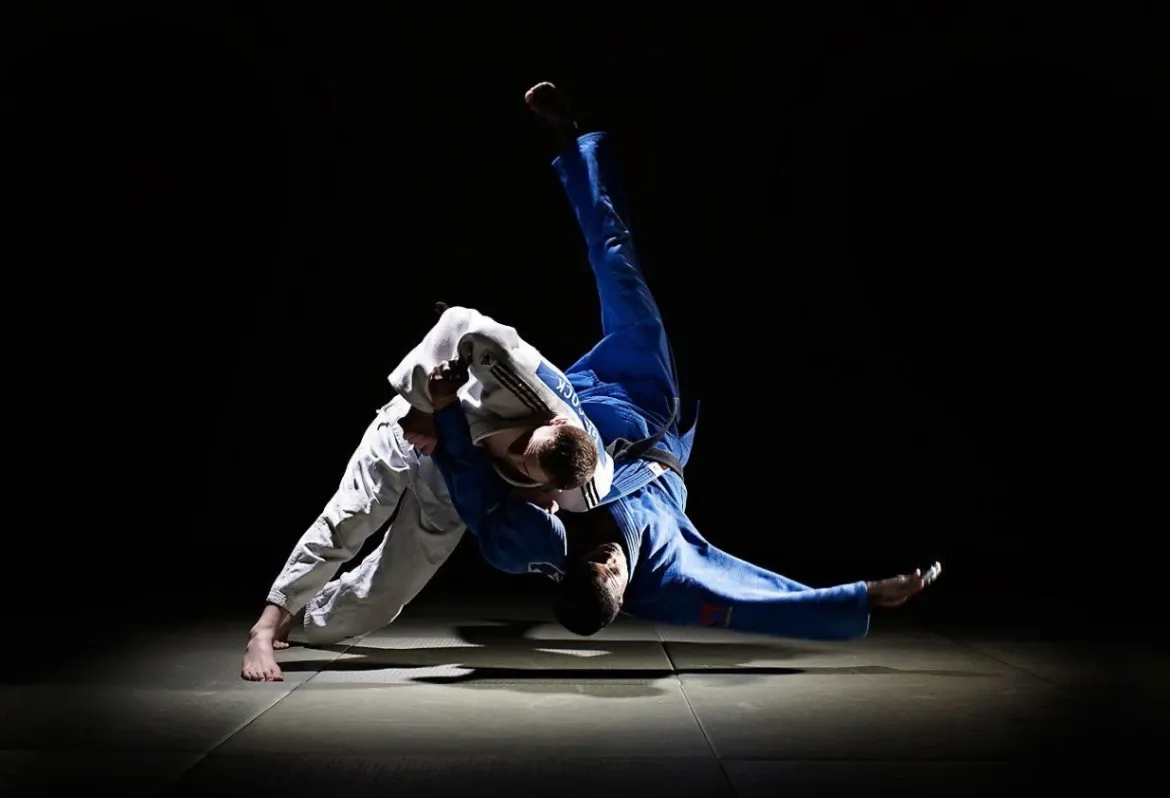
Judo — literally "the gentle way" — was developed in Japan in 1882 by Jigoro Kano and became an Olympic sport in 1964. The technical curriculum centres on throws (nage-waza), ground control (katame-waza), and submission holds, with traditional Judo eliminating the strikes used in older jiu-jitsu systems. The result is a martial art designed to be practised at full intensity against a resisting partner without producing the chronic head trauma associated with striking arts (Kuroki et al., 2017 — British Journal of Sports Medicine).
For the typical Dubai adult, this matters for three reasons:
- Joint-friendlier than striking: No accumulated head impact, no knuckle damage, no shin conditioning required.
- Full-resistance training without injury inflation: Unlike striking, you can train Judo against fully resisting opponents almost from day one — the breakfall (ukemi) curriculum makes this safe.
- Olympic-grade conditioning: A 5-minute Judo match (shiai) elicits cardiac demands equivalent to elite middle-distance running (Franchini et al., 2011 — Sports Medicine).
What to Expect in Your First Judo Class in Dubai
Most Dubai dojos and certified private coaches structure the first three sessions around the same skill: ukemi. Before you throw, before you grip, before you spar — you learn to fall safely. This sounds basic but is the single biggest determinant of injury rate in adult-onset Judo. Ukemi is taught from a kneeling position first (back falls, side falls), then standing (forward and rear rolling falls).
After ukemi, beginner curriculum typically introduces:
- Standing grip work (kumi-kata): How to grip the lapel and sleeve of your training partner's gi (uniform) — the foundation for all throws.
- Foot sweeps (de-ashi-barai, okuri-ashi-barai): Low-risk, high-reward beginner throws.
- Hip throws (o-goshi, uki-goshi): Classic Judo throws that teach hip drive and rotation.
- Newaza basics: Pin escapes, the four classical pins, and one or two beginner submissions (juji-gatame, kesa-gatame-jime).
A typical 60–90 minute beginner class is structured: 10–15 min warm-up and ukemi drills → 25–30 min technical instruction → 20–30 min controlled drilling or light randori (free practice) → 5 min cool-down and bowing out. You will sweat heavily. You will be tired the next day. You will not be injured if the dojo is well-run.
Fitness Benefits — What the Research Actually Shows
Cardiovascular Conditioning
Competitive Judo elicits heart rates of 85–95% of maximum during randori, with blood lactate concentrations of 8–14 mmol/L — values comparable to elite 800m runners (Franchini et al., 2011). Even recreational adult practitioners training 2–3 times per week show meaningful VO2max improvements over 12-week programmes.
Strength and Body Composition
A randomised trial in Journal of Strength and Conditioning Research (Drid et al., 2017) found that 12 weeks of adult-onset Judo training produced grip strength increases of 18–24%, lean mass gains of 1.8–2.6 kg, and fat mass reductions of 2.1–3.4 kg in previously untrained adults aged 30–50 — outcomes typically requiring dedicated weight training plus separate cardio in conventional fitness programmes.
Bone Density
The high-impact nature of repeated ukemi and ground transitions generates skeletal loading that increases bone mineral density at hip and lumbar spine. This is particularly valuable for adults over 35, who otherwise lose 0.5–1% bone density annually (NIH, 2023).
Mental Health
A 2022 systematic review in Frontiers in Psychology documented Judo training's effects on anxiety reduction (effect size d = 0.71), self-efficacy improvement, and reduced rumination — comparable to first-line cognitive behavioural therapy outcomes. The mechanism appears multimodal: the physical exertion suppresses sympathetic over-activation, the focused attention disrupts rumination loops, and the supportive dojo community provides social buffering.
Where to Train Judo in Dubai (2026)
Dubai's Judo scene is led by the UAE Judo Federation (UAEJF) and a network of private dojos and certified personal coaches. Options include:
- Federation-affiliated dojos: Typically larger, group-class focused, well-suited to adults who thrive on community energy and lower per-session cost (150–250 AED group rate).
- Private Judo coaches: One-on-one or 2:1 instruction at your home, private studio, or a mat-equipped facility. Costs typically 280–450 AED per session, but skill acquisition is dramatically faster (Schmidt & Lee, 2011 — Motor Control and Learning documents 40–60% faster motor-skill acquisition with immediate expert feedback).
- Hybrid: 1 private session per week + 1–2 group sessions — favoured by adults who want fast technical progression without isolating themselves from the dojo community.
Costs in Dubai (2026)
Adult Judo training in Dubai typically falls in the following bands:
- Group dojo membership: 800–1,800 AED/month for 2–4 weekly classes.
- Private 1:1 coaching: 280–450 AED/session, with packages of 8–12 sessions reducing the per-session cost by 10–20%.
- Equipment: Judogi (uniform): 200–600 AED for a beginner gi, lasting 1–2 years.
- Federation registration: If you intend to compete, UAEJF licensing is approximately 250–400 AED annually.
For broader context on personal training pricing in the UAE, see our comprehensive 2026 Personal Trainer Cost Guide.
How to Evaluate a Judo Coach in the UAE
Adult Judo carries genuine injury risk if taught poorly. Before committing to a coach, verify:
- REPS UAE registration: The Register of Exercise Professionals UAE is the recognised body for personal trainer credentialing. While Judo coaches may also hold federation-issued ranks, REPS UAE registration confirms broader exercise-professional credentials.
- Judo grade: Minimum Shodan (1st-degree black belt) for adult beginner instruction; ideally Sandan (3rd dan) for adult mixed-level groups.
- Coaching certification: International Judo Federation (IJF) coaching course completion or equivalent (e.g., USJA, Kodokan-affiliated training).
- Adult-onset specialism: Coaches who primarily teach children require different drill design and pacing for adults. Ask explicitly about their adult beginner intake history.
- Insurance: Reputable Dubai coaches carry professional indemnity and public liability insurance.
Common Adult Beginner Mistakes (and How to Avoid Them)
- Skipping ukemi to "get to the throws": The single biggest predictor of adult Judo injury. Resist this impulse.
- Training through tiredness: Judo's lactate demands are extreme. A coach should regulate intensity for adult beginners — if your dojo doesn't, raise it.
- Inadequate hydration for the UAE climate: Hot dojos and 60–90 min intense sessions produce significant fluid loss. See our Dubai Hydration Guide.
- Ignoring strength training: Judo grip and core demands are unforgiving for sedentary adults. Add 2 supplementary strength sessions per week — see Strength Training Tips for Dubai.
Integrating Judo Into a Dubai Fitness Lifestyle
For a working Dubai adult training 2 Judo sessions per week, the optimal supplementary structure is:
- 2× strength training (45–60 min, full-body, focus on posterior chain and grip)
- 1× mobility/yoga session — see our Yoga services for private and group options
- 1× active recovery (walking, swimming, or light cycling)
- 7–9 hours sleep per night (lactate clearance and adaptation occur in deep sleep stages)
Sleep is non-negotiable for Judo adaptation. Our Sleep & Fitness Guide covers this in depth.
Frequently Asked Questions
Q: Can I start Judo as an adult beginner in my 40s or 50s?
A: Yes — provided you have no major joint pathology and you commit to thorough ukemi training in the first 4–6 weeks. Many UAE Judo competitors began as adults; the sport has well-developed Masters categories for athletes 30+.
Q: How long until I can train safely with the gi (randori)?
A: 4–8 weeks of consistent attendance is typical before light randori begins. Coaches who throw you into randori in week 1 are not running a safe programme.
Q: Is Judo good for self-defence in Dubai?
A: Outstanding. Throw-based self-defence is among the most reliable real-world skills because it neutralises an attacker on hard ground in a single technique. Combined with basic Brazilian Jiu-Jitsu (often cross-trained at the same dojos), it is among the most practical self-defence systems available. See also our Women's Self-Defence in Dubai guide.
Q: Will I lose weight doing Judo?
A: Yes — moderately active adults training 2–3 times weekly typically lose 0.4–0.8 kg of fat mass per week in the first 8–12 weeks, provided nutrition supports a moderate caloric deficit.
Q: How does Judo compare to BJJ for an adult in Dubai?
A: Judo emphasises standing throws with secondary ground work; BJJ emphasises ground submissions with secondary standing work. Most experienced grapplers in Dubai eventually train both. For a comparison see BJJ Classes in Dubai.
Ready to Try Your First Judo Class in Dubai?
Our certified Judo coaches across Dubai and the wider UAE offer beginner-friendly intake sessions. No experience required — just bring water and a willingness to learn ukemi properly.
Request a Judo Coach →Ready to put this into action?
Get matched with a certified 369MMAFIT coach in Dubai — personal training, MMA, and nutrition, in-person or online.