Helping Children Overcome Fear of Water in the UAE: A Parent's Guide
Helping Children Overcome Fear of Water in the UAE: A Parent's Guide
In a country where swimming coaching pools are ubiquitous, the Arabian Gulf provides a stunning natural playground, and water parks are among the most popular family destinations in Dubai and Abu Dhabi, childhood water fear is both common and consequential. An estimated 35–40% of children experience meaningful water anxiety at some stage — and in the UAE's water-rich environment, this fear limits participation, reduces safety, and creates stress for both children and parents. The good news: childhood water fear responds well to the right approach.
Understanding Why Children Fear Water
Water fear in UAE children arises from several distinct sources, and identifying the cause helps determine the most effective response:
- Normal developmental water caution: Between ages 2–4, stranger anxiety and sensory sensitivity peak — the unfamiliar sensory experience of water (cold, splashing, getting face wet) naturally triggers caution. This is developmentally normal and resolves with gentle, positive exposure.
- Traumatic experience: A sudden submersion, a scary pool incident, or being pushed into water creates a conditioned fear response. The amygdala encodes the experience as threatening, and future water exposure triggers the same anxiety response even without danger.
- Cultural transmission: Parents who are themselves afraid of water unintentionally communicate anxiety to children through body language, verbal expressions of concern, and avoidance behaviours. UAE families from backgrounds without swimming traditions may transmit water caution across generations.
- Negative early swim instruction: Coercive instruction methods — dunking children without consent, "throwing in the deep end," forcing submersion before readiness — are unfortunately still practised in some UAE settings and reliably create or entrench water fear.
- Sensory processing differences: Children with sensory processing sensitivities may have heightened responses to the tactile, auditory (echoing pool sounds), and proprioceptive (buoyancy) aspects of water environments.
The Psychological Framework: Graduated Exposure
The most evidence-supported approach for childhood specific phobias is graduated exposure — systematic, controlled introduction to feared stimuli at increasing intensity while maintaining positive emotional state (Öst 2012, Acta Psychiatrica Scandinavica). For water fear, this means a carefully sequenced progression from least to most challenging water experiences, always at the child's own pace:
Stage 1: Water Familiarity Without Pressure
- Water play away from the pool first: water table, sprinklers, water balloons, playing with water in a bowl or bathtub
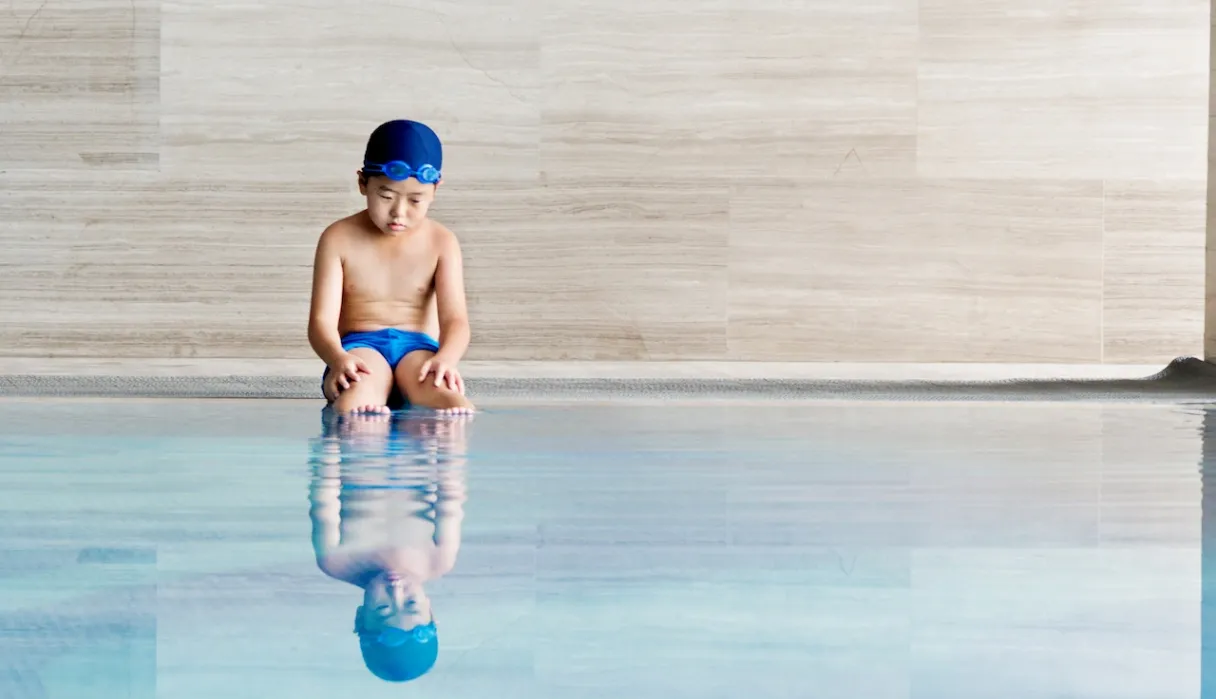
- Visit the pool environment without entering: sit at pool edge, observe other children swimming, positive associations with the pool space
- Pool-adjacent activities: paddle feet while sitting on steps, dangle legs from the edge
- Praise engagement at every level — never trivialise the fear or create pressure
Stage 2: Shallow Water Comfort
- Enter very shallow water with parent physically present and holding throughout
- Water games in shallow water: pouring water, floating toys, bubbles
- Face-splashing: beginning with letting child splash their own face voluntarily, building comfort with water on face at their pace
Stage 3: Face Submersion
This is typically the largest psychological hurdle. Approaches:
- Blowing bubbles into the water — child controls the breath, parent models it first
- "Chin in the water" progression before full face submersion
- Use of goggles — seeing underwater removes the disorientation that makes submersion frightening for many children
- Always with a consistent verbal cue ("1, 2, 3") so child knows exactly when submersion will happen — unpredictability is a major amplifier of water fear
Stage 4: Floating and Independent Movement
- Back float with full parent support, gradually reducing
- Front glide with wall push-off
- Introduction of kick with parent support
What NOT to Do: Common Mistakes UAE Parents Make
- Forcing submersion before readiness: The most common mistake — and the most damaging. Forced submersion creates traumatic memories that can set back progress by months.
- Saying "There's nothing to be afraid of": This invalidates the child's emotional experience. The fear is real to them. Acknowledge it: "I know this feels scary. We'll take it slowly."
- Comparing to other children: "Your friend swims just fine" creates shame and increases anxiety. Every child's developmental timeline is different.
- Abandoning the process after one difficult session: Progress in overcoming water fear is not linear — difficult sessions followed by good ones are normal. Consistency and patience over weeks and months are essential.
- Enlisting unqualified instruction: A swimming teacher who uses coercive methods, dunks children, or creates a negative experience will set back progress significantly. Vet instructors carefully.
Choosing the Right Swim Instructor for a Fearful Child in the UAE
For children with significant water fear, standard group swim lessons are rarely appropriate initially. Look for:
- Specific experience with fearful or anxious children — ask directly: "How do you work with children who are afraid of water?"
- Child-centred, play-based approach — sessions should feel like fun, not swimming drills
- Never uses coercion, force, or peer pressure
- Small group (maximum 4:1 ratio) or private 1:1 instruction
- STA (Swimming Teachers' Association) or RLSS qualification with infant/child swimming endorsement
- Warm water pool (32–34°C reduces sensory sensitivity and makes the experience more comfortable)
Frequently Asked Questions
Q: My 6-year-old has been afraid of water for 2 years in Dubai. Is it too late to help them?
A: Absolutely not — water fear responds to the right approach at any age. A 6-year-old has greater cognitive capacity than a toddler to understand what is happening, communicate their feelings, and actively participate in overcoming their fear. With a patient, child-centred swim instructor in Dubai or Abu Dhabi and consistent graduated exposure over 3–6 months, the majority of children this age overcome water fear and develop genuine swimming competence. The most important factor is the right instructor — one session with a coercive teacher can undo months of progress.
Q: Should I use floaties or water wings for a fearful child in UAE pools?
A: Water wings and floaties can be useful for initial pool confidence-building but should be transitioned away from progressively. They create a false body position (too upright) and a dependence that must be unlearned when actual swimming begins. Structured float aids (swim noodles, kickboards, SwimFin) used by a qualified instructor are more appropriate for fearful children as they can be progressively reduced. Never use floaties as a substitute for supervision — they are not safety devices.
Q: My child panics as soon as their face gets wet. What can I do at home in Abu Dhabi?
A: The bath is the ideal starting place for face water desensitisation. Use bath time to very gradually introduce face water — starting with voluntary splashing by the child, then gentle pouring with warning ("I'm going to pour a little water over your face now — ready?"), progressing to goggles during bathtub play which removes the disorientation of water in the eyes. Praising each small step generously. This home-based desensitisation can significantly accelerate readiness for pool-based instruction.
Q: Are there specialist water-fear programmes in Abu Dhabi or Dubai?
A: Yes — several UAE swimming academies and instructors specialise in fearful swimmers. Advantage Sports in Abu Dhabi and various independent swim schools in Dubai offer programmes specifically designed for water-anxious children. British Swim School's curriculum is explicitly designed around fear-free, positive water introduction. Ask specifically about water-fear specific programmes when researching — not all general children's swimming academies have trained instructors in this area.
Q: My child was fine in water and then suddenly became scared at age 5. Why?
A: Sudden onset water fear in a previously water-comfortable child is common and usually attributable to one of: a scary pool incident (going underwater accidentally, seeing another child struggle), a developmental cognitive jump (around ages 4–6, children develop more sophisticated understanding of risk and danger, making previously comfortable activities suddenly frightening), or an unobserved negative experience. The approach is the same: return to foundations with graduated positive exposure. Because the child has positive water memories from before the fear onset, progress is typically faster than for children who have never been comfortable in water.
Ready to Train with a Certified Coach?
Get a free consultation and a training plan built specifically for your goals, level, and schedule.
Find Your Coach →References: Öst 2012, Acta Psychiatr Scand — one-session treatment specific phobias | Muris et al. 2000, J Child Psychol Psychiatry — water fear in children | Royal Life Saving Society — childhood water safety guidelines | Swim England — teaching fearful swimmers guidelines
Ready to put this into action?
Get matched with a certified 369MMAFIT coach in Dubai — personal training, MMA, and nutrition, in-person or online.