هذه المقالة متاحة باللغة الإنجليزية فقط حالياً — الترجمة العربية قيد الإعداد.
Sleep and Fitness in Dubai and Abu Dhabi: How Sleep Quality Affects Your Training
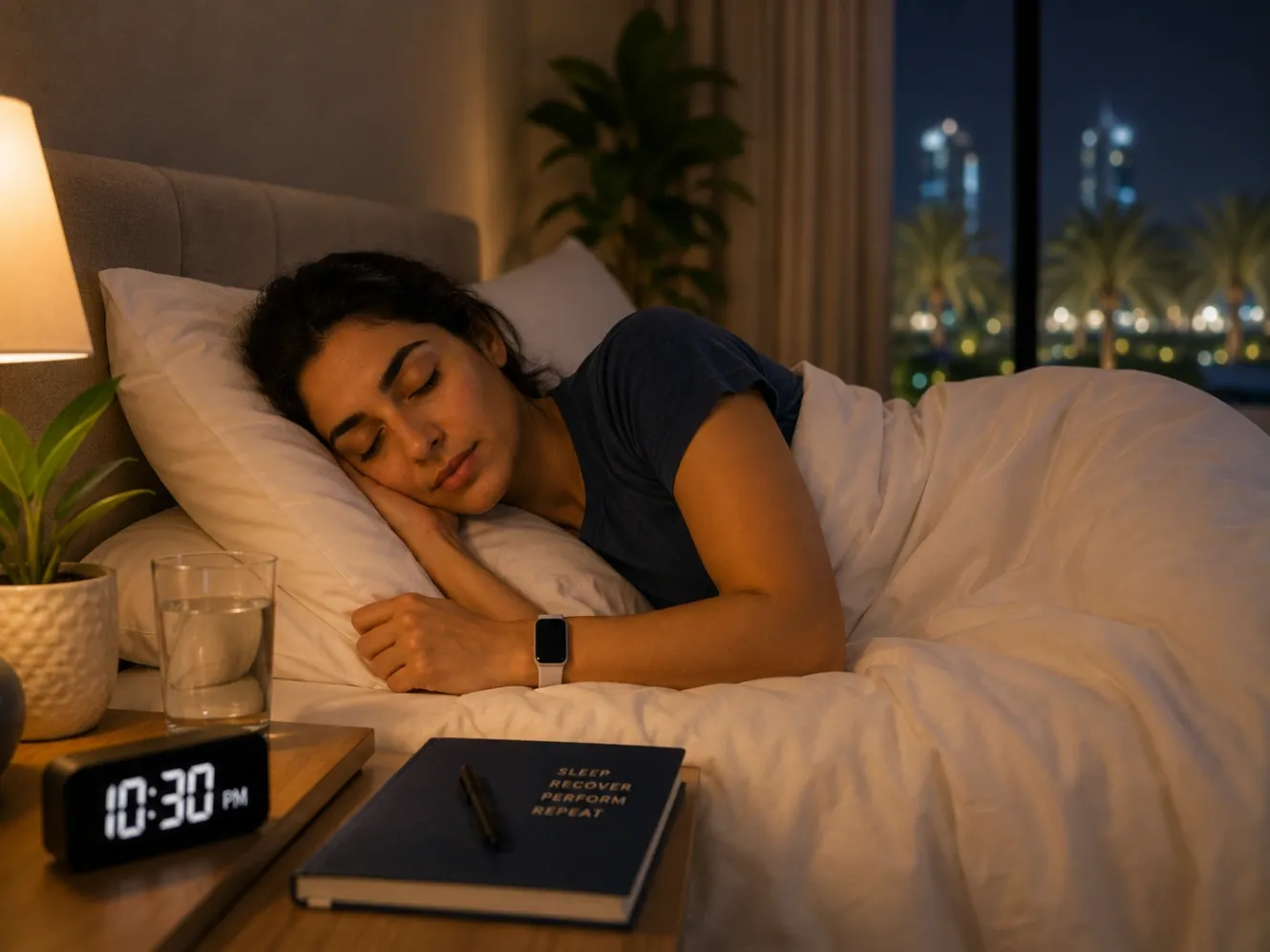
Sleep and Fitness in Dubai and Abu Dhabi: How Sleep Quality Affects Your Training
You can have the best training programme and the most perfectly structured nutrition plan in Dubai or Abu Dhabi — but if your sleep is compromised, you are leaving the majority of your potential results on the table. Research has established sleep as the most powerful recovery and adaptation tool available, yet UAE's lifestyle consistently undermines it. This guide explains the science and gives you practical solutions.
The Evidence: Sleep's Impact on Fitness Outcomes
Muscle Building and Strength
Growth hormone — the primary anabolic hormone for muscle tissue repair and growth — is secreted in pulses predominantly during slow-wave (deep) sleep stages 3 and 4. Research by Van Cauter et al. (2000) shows that sleep deprivation reduces GH secretion by up to 70% in one night. This means:
- Even perfect post-workout nutrition cannot compensate for sleep-deprived GH suppression
- Muscle protein synthesis during sleep accounts for approximately 40% of daily muscle repair
- Sleep restriction below 6 hours reduces testosterone levels by 10–15% (Leproult & Van Cauter 2011, JAMA) — further impairing muscle development
Fat Loss and Metabolism
Sleep restriction profoundly disrupts fat loss. Research by Spiegel et al. (2004, PLOS Medicine) found just two days of sleep restriction (4 hours/night) increased ghrelin (hunger hormone) by 28% and decreased leptin (satiety hormone) by 18% — creating a powerful neurochemical drive toward overeating. Subsequent studies confirmed:
- Sleep-restricted people consume an average 385 extra calories daily (St-Onge et al. 2011, AJCN)
- Sleep restriction preferentially causes fat mass gain and muscle mass loss during caloric restriction (Nedeltcheva et al. 2010, Annals of Internal Medicine)
- Insulin sensitivity decreases significantly after just one night of partial sleep deprivation
Athletic Performance
Research by Mah et al. (2011) at Stanford extended NCAA athletes' sleep to 10 hours per night for 5–7 weeks. Results: sprint times improved 5%, shooting accuracy improved 9%, reaction time improved, and mood and vigour scores increased significantly. Conversely, sleep restriction to 5 hours for one week reduced maximal strength output by 20% in resistance training (Knowles et al. 2018, IJSPP).
UAE Sleep Challenges and Their Fitness Impact
Late Night Culture
Dubai and Abu Dhabi social life frequently extends past midnight — Friday brunches transition to evening outings, and weeknight restaurant culture is active until 11pm or later. Each hour of lost sleep meaningfully compromises the following day's training quality and adaptation.
Shift Work and Variable Schedules
UAE has a large proportion of shift workers (hospitality, healthcare, aviation, security) and professionals working across time zones (managing European or Asian markets from Dubai). Circadian disruption from irregular schedules impairs sleep quality even when sleep duration is adequate.
Ramadan Sleep Disruption
Ramadan in UAE involves significant sleep pattern alteration — late Iftar, Tarawih prayers, and Suhoor meals disrupt normal sleep architecture. Research shows Ramadan sleep restriction can reduce athletic performance by 5–8% and increase perceived fatigue significantly. Strategic Ramadan sleep management (napping, earlier bedtimes, consolidated night sleep) can significantly mitigate these effects.
Science-Based Sleep Optimisation for UAE Residents
1. Consistent Sleep Schedule — The Most Important Factor
Research by Sehgal & Bhaskaran (2017) confirms that consistent sleep timing — same bedtime and wake time daily including weekends — is the single most effective sleep quality intervention. Irregular schedules (common in UAE social culture) disrupt circadian rhythm even if total sleep hours are maintained. This creates "social jet lag" — the same physiological stress as actual jet lag but occurring every week.
Practical UAE approach: Set a non-negotiable wake time (e.g., 6am). Bedtime follows naturally from working backward 7.5–8.5 hours. Protect this schedule even on weekends and UAE national holidays — the social cost is real but the fitness and health benefit is substantial.
2. Sleep Environment Optimisation
The UAE climate creates unique sleep environment challenges and opportunities:
- Temperature: Air conditioning is standard in UAE — use it. The optimal sleep temperature (18–20°C) is easily achievable year-round. This is a genuine sleep advantage of UAE living.
- Light: Dubai's extensive nighttime lighting requires blackout curtains. Complete darkness is important for melatonin production.
- Noise: Urban UAE environments (Dubai Marina, Downtown, Deira) have significant noise — quality earplugs or white noise are worth using
3. Caffeine Management
UAE's café culture and high coffee/energy drink consumption is a significant sleep quality disruptor. Caffeine's half-life is 5–7 hours — an Arabic coffee at 4pm is still 50% active at 10pm, meaningfully disrupting sleep onset. Rule: No caffeine after 1–2pm for those targeting 10–11pm sleep.
4. Light Exposure Management
Melatonin (sleep hormone) production is suppressed by blue light — prevalent in phone, laptop, and TV screens. In UAE where evening screen use is extremely high, blue light exposure after 9pm significantly delays sleep onset. Solutions: blue light blocking glasses, phone night mode (automatic red shift), or simply avoiding screens in the final 60–90 minutes before sleep.
5. Exercise Timing in UAE
Vigorous exercise within 2–3 hours of bedtime can delay sleep onset in some individuals by elevating core temperature and adrenaline. Many UAE residents train in the evenings (6–8pm) — if you find post-evening-training sleep difficult, consider: earlier training if possible, or a cool shower post-workout to reduce core temperature more rapidly.
Sleep Supplements: What Works and What Doesn't
UAE supplement shops in Dubai and Abu Dhabi sell numerous sleep products. Evidence-based perspective:
- Melatonin (0.5–3mg): Supported by evidence for circadian rhythm regulation (jet lag, shift work) but not a sedative — doesn't increase sleep duration significantly in most people. Useful for resetting timing, not for inducing sleep.
- Magnesium glycinate (200–400mg before bed): Research supports magnesium's role in GABA pathway function and relaxation. Common deficiency in UAE populations.
- Ashwagandha (300–600mg): Research shows cortisol-reducing effects that can improve sleep quality, particularly for stressed UAE professionals
- Avoid: OTC sleep aids (antihistamine-based), alcohol as sleep aid (reduces sleep quality significantly despite feeling sedating)
How Much Sleep Do UAE Fitness Enthusiasts Need?
Research consensus: 7–9 hours for most adults. For UAE athletes in hard training phases or periods of high life stress:
- 8–9 hours is optimal for performance maximisation
- 7–7.5 hours maintains performance for most people
- Below 6 hours consistently produces measurable performance decline
Note: many UAE residents believe they "function fine" on 5–6 hours due to caffeine and habit. Research shows these individuals consistently underperform on objective measures compared to well-rested peers — but lose the ability to perceive their own deficit (Walker 2017, Why We Sleep).
Ready to Train with a Certified Coach?
Get a free consultation and a training plan built specifically for your goals, level, and schedule.
Find Your Coach →Frequently Asked Questions
Q: Does sleeping in air conditioning in Dubai affect fitness results?
A: Sleeping in air-conditioned comfort (18–20°C) actually improves sleep quality compared to sleeping in heat. The cool, consistent temperature that UAE AC provides is physiologically optimal for deep sleep and growth hormone secretion. There is no negative fitness impact from UAE air conditioning sleep — quite the opposite.
Q: Can napping in UAE replace lost night sleep for fitness?
A: Short naps (20–30 min) provide meaningful benefits for alertness and performance but do not fully replace lost night sleep. Deep, restorative sleep cycles (stages 3–4) are primarily concentrated in early night sleep — missed night sleep cannot be fully compensated by daytime napping. A 20-minute nap is valuable as a supplement, not a substitute.
Q: How does Ramadan sleep disruption affect my gym progress in UAE?
A: Ramadan sleep disruption (typically 1–2 hours less sleep than normal) reduces muscle protein synthesis and increases perceived fatigue, potentially slowing strength and muscle gains. Research by Trabelsi et al. (2013) shows athletes who manage sleep strategically during Ramadan (earlier bedtimes, strategic napping) maintain performance better than those who don't. Focus on maintenance rather than ambitious new PBs during Ramadan.
Q: Is it okay to train in the evening in Abu Dhabi if it disrupts my sleep?
A: If evening training consistently disrupts your sleep (evidenced by difficulty falling asleep after workouts), experiment with moving training earlier or reducing pre-sleep intensity. For some people, evening exercise doesn't disrupt sleep at all — individual variation is significant. If you sleep well post-evening training, the benefit of training outweighs any theoretical disruption.
Q: What's the best sleep tracker for UAE fitness enthusiasts?
A: WHOOP (popular with UAE fitness professionals) provides excellent sleep staging and recovery data. Garmin Fenix/Forerunner series, Apple Watch Series 8+, and Oura Ring all offer solid sleep tracking. The data is most useful for identifying sleep patterns over weeks rather than optimising individual nights. All are available in UAE through Sharaf DG, Apple Store UAE, and online retailers.
جاهز لتطبيق ذلك؟
احصل على مدرب 369MMAFIT معتمد في دبي — تدريب شخصي وMMA وتغذية، حضوريًا أو عبر الإنترنت.