هذه المقالة متاحة باللغة الإنجليزية فقط حالياً — الترجمة العربية قيد الإعداد.
The Benefits of Dryland Training for Swimmers in the UAE
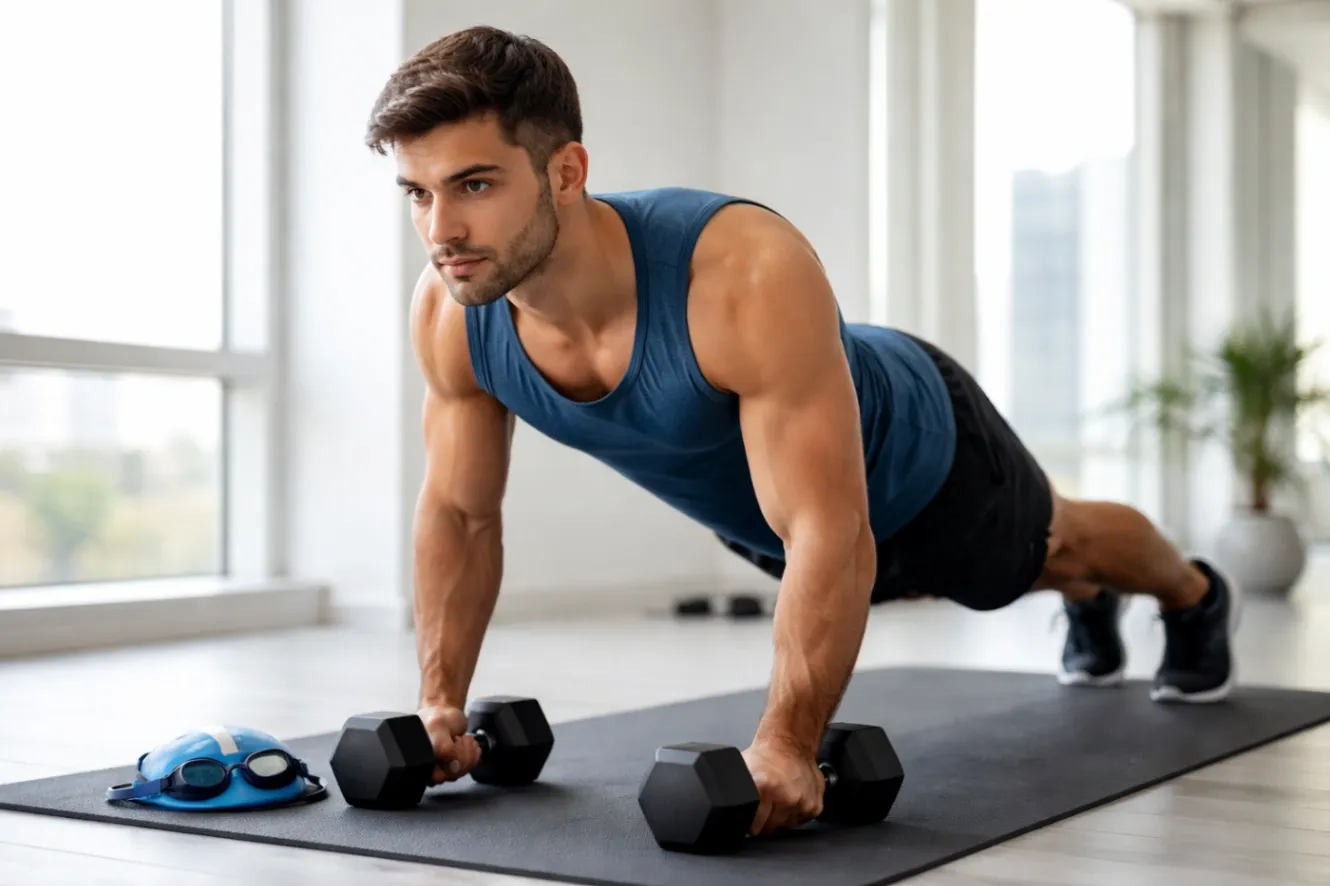
The Benefits of Dryland Training for Swimmers in the UAE
Dryland training — strength, conditioning, and mobility work performed outside the pool — is consistently one of the most underleveraged tools available to swimmers in Abu Dhabi and Dubai. Many UAE swimmers spend their entire training time in the water, overlooking the substantial evidence that targeted dryland work produces swimming coaching performance gains that pool training alone cannot achieve. This guide explains why, and gives you a practical programme.
What Is Dryland Training for Swimmers?
Dryland training for swimmers encompasses any land-based training that complements pool work. It includes:
- Resistance training (free weights, cables, resistance bands) targeting swim-specific musculature
- Plyometric and power development training
- Core stability and anti-rotation training
- Flexibility and mobility work
- Sprint and agility work (for competitive swimmers)
It is not generic gym training — effective dryland work is designed around the movement patterns, energy demands, and injury risks specific to swimming.
The Evidence Base for Dryland Training
The research supporting dryland training for swimmers is compelling:
- Girold et al. (2007, Journal of Strength and Conditioning Research) found that swimmers who added 8 weeks of resistance training to pool training improved 50m freestyle performance by 3.2% compared to 0.4% in the pool-only group
- Tanaka & Costill (1998, Sports Medicine) demonstrated that strength training increased swimming economy — the energy cost per stroke — by improving propulsive force generation and reducing drag-producing errors
- Conflicting early research suggested strength training impaired flexibility; more recent work (Stager & Tanner 2005, Swimming: Handbook of Sports Medicine) demonstrated no flexibility loss when resistance training is combined with mobility work
Key Benefits for UAE Swimmers
1. Improved Propulsive Force and Speed
Swimming speed is primarily determined by propulsive force (what your arms and legs generate) minus drag. Dryland pulling exercises (lat pulldowns, cable pulls, band pulls) directly overload the latissimus dorsi, pectoralis major, and triceps — the primary muscles of the freestyle pull phase — with resistance far greater than water provides. This strength transfers to faster swim times.
2. Injury Prevention
Swimmer's shoulder (subacromial impingement, rotator cuff tendinopathy) is the most common injury in competitive and fitness swimming in UAE pools. The repetitive overhead motion of swimming, performed hundreds of times per session, stresses the rotator cuff and shoulder stabilisers. Dryland exercises specifically targeting the rotator cuff, lower trapezius, and serratus anterior significantly reduce shoulder injury risk (Heinlein & Cosgarea 2010, Sports Health).
3. Improved Core Stability
Swimming requires a rigid core that transfers force between the upper and lower body. A swimmer with a weak or unstable core "leaks" energy with every stroke — the hips wiggle, the kick is misaligned, and the pull loses power. Dryland core exercises (plank variations, anti-rotation press, dead bug) build the stability that technique alone cannot provide.
4. Enhanced Starts and Turns
For competitive swimmers in Abu Dhabi and Dubai Master's swimming and club competitions: starts and turns are entirely dryland-derived force expressions. The jump/dive start and the pushoff-from-wall rely on leg power (squat and hip hinge strength) that pool training cannot effectively develop.
Dryland Programme for UAE Swimmers
This programme is designed for 2 sessions per week, approximately 35–40 minutes each, and can be performed at any gym in Abu Dhabi or Dubai.
Session A: Upper Body and Core
- Band pull-aparts — 3 × 20 (shoulder health prehabilitation)
- Lat pulldown or pull-up — 3 × 8–10 (swim-specific pulling strength)
- Cable or band pull-through (swimming motion) — 3 × 12
- Dumbbell external rotation — 3 × 15 each side (rotator cuff)
- Dead bug — 3 × 8 each side (core anti-extension)
- Plank — 3 × 30–45 seconds
Session B: Lower Body, Power, and Mobility
- Goblet squat — 3 × 10 (leg drive foundation)
- Romanian deadlift — 3 × 10 (posterior chain for kick and body position)
- Jump squat — 3 × 6 (start and turn power)
- Hip flexor stretch — 2 × 60 seconds each side (essential for a high, horizontal body position)
- Thoracic rotation stretch — 2 × 10 each side (improves freestyle shoulder roll)
- Ankle mobility (ankle circles, calf stretches) — 2 minutes total (important for butterfly and breaststroke kick)
Frequently Asked Questions
Q: Will dryland weight training make me too muscular to swim fast in Dubai?
A: No — this is a persistent myth. Moderate resistance training (the volumes described above) does not produce large muscle bulk, particularly in swimmers who are simultaneously doing high volumes of aerobic pool work. Elite swimmers — including Olympic-level athletes — all incorporate significant dryland strength training. The concern about muscle bulk applies to very high-volume, high-calorie bodybuilding programmes — not swim-specific strength training.
Q: When should I do dryland training relative to pool sessions in Abu Dhabi?
A: For optimal adaptation, avoid performing dryland resistance training immediately before a high-intensity pool session — fatigue impairs swim technique. The best scheduling for UAE swimmers is: dryland training after an easy or moderate pool session, or on a separate day. Performing dryland in the morning and swimming in the evening (or vice versa) is common practice among Abu Dhabi and Dubai club swimmers.
Q: Can I do dryland training at home without gym equipment in the UAE?
A: Partially. Resistance bands (AED 30–100, available at Decathlon and most UAE sports stores) replicate many cable and band exercises effectively. Bodyweight exercises (push-ups, pull-ups if you have a bar, squats, lunges) provide useful stimulus. A pull-up bar (AED 50–150) and a set of resistance bands provide 80% of the dryland exercises in the above programme. For meaningful strength gains in the pulling muscles (the primary swimmers' dryland need), access to a cable machine or lat pulldown at a Dubai or Abu Dhabi gym is beneficial.
Q: Is dryland training useful for non-competitive adult swimmers in Dubai?
A: Yes — perhaps even more so than for competitive swimmers, because recreational adult swimmers in Dubai and Abu Dhabi typically have greater relative strength deficits and technique inefficiencies that dryland work directly addresses. Shoulder injury prevention is particularly relevant for adult recreational swimmers who are increasing volume without the technique foundation that prevents impingement. Two weekly dryland sessions will meaningfully improve your pool experience within 6–8 weeks.
Q: What stretches should I prioritise for swimming in the UAE?
A: Hip flexors (shortened by UAE desk-based lifestyle — restricts high body position in water), thoracic spine rotation (shoulder roll in freestyle), ankle flexibility (important for breaststroke and butterfly kick), and shoulder internal/external rotation range (prevents impingement). These four mobility targets address the most common movement restrictions seen in adult swimmers in Abu Dhabi and Dubai and most significantly impact swim technique and injury risk.
Ready to Train with a Certified Coach?
Get a free consultation and a training plan built specifically for your goals, level, and schedule.
Find Your Coach →References: Girold et al. 2007, JSCR | Tanaka & Costill 1998, Sports Medicine | Heinlein & Cosgarea 2010, Sports Health | Stager & Tanner 2005, Swimming: Handbook of Sports Medicine
جاهز لتطبيق ذلك؟
احصل على مدرب 369MMAFIT معتمد في دبي — تدريب شخصي وMMA وتغذية، حضوريًا أو عبر الإنترنت.