TRX Suspension Training: Complete Guide for All Fitness Levels (2026)
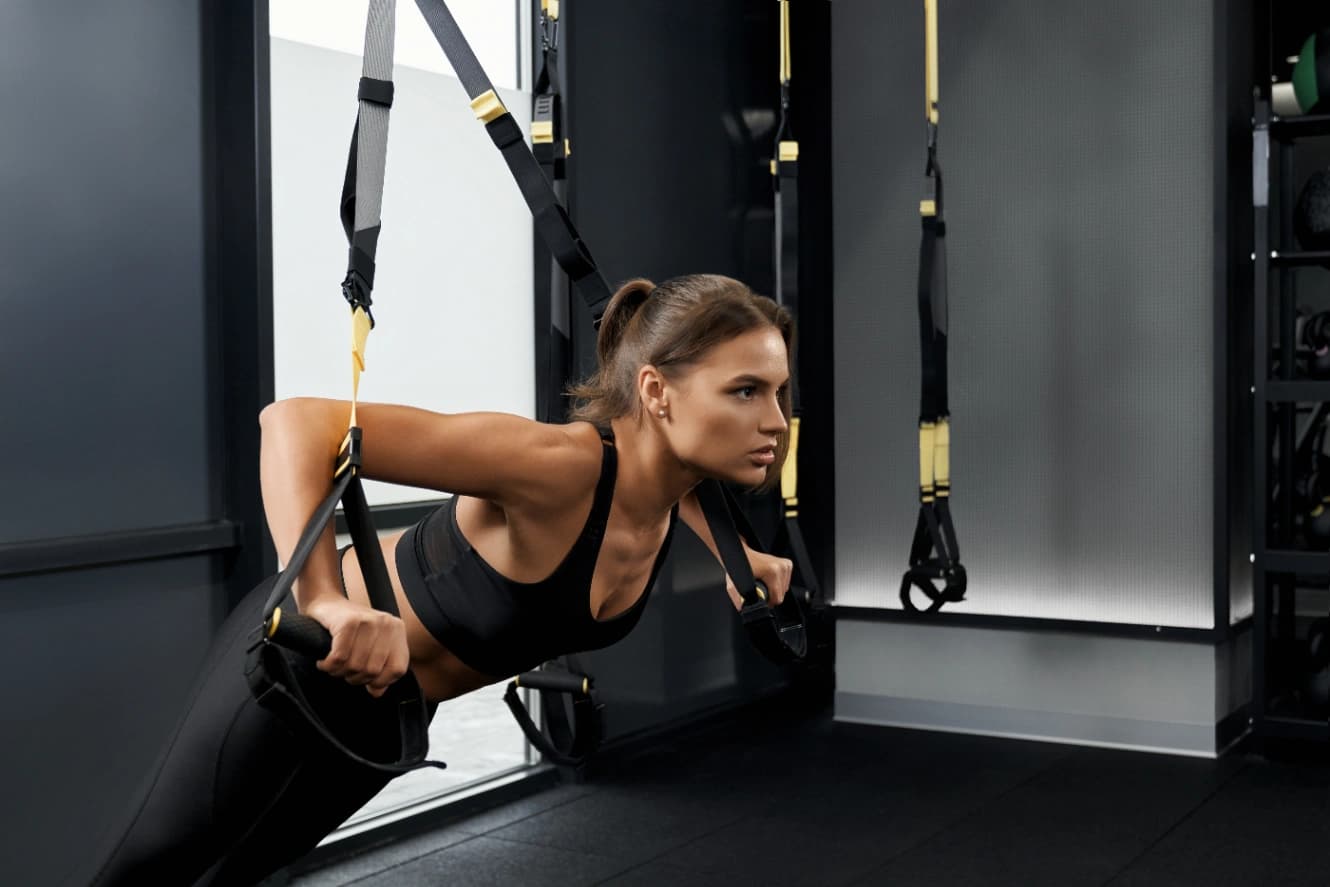
TRX Suspension Training: Complete Guide for All Fitness Levels (2026)
If you have ever watched someone train on a pair of yellow-and-black straps anchored to a door frame or pull-up bar and wondered what all the fuss was about, this guide is for you. TRX suspension training is one of the most versatile, portable, and effective training systems ever developed, and in 2026 it remains a cornerstone of functional fitness worldwide — including right here in Dubai.
The Navy SEAL Origin Story
TRX was born out of necessity. In the late 1990s, Randy Hetrick was a Navy SEAL squadron commander deployed in Southeast Asia. Between missions, he needed a way to keep his team in peak physical condition with minimal equipment. Using a jiu-jitsu belt and parachute webbing, Hetrick improvised a suspension device that allowed his operators to perform hundreds of bodyweight exercises from a single anchor point.
After leaving the military, Hetrick refined his prototype into the TRX Suspension Trainer that hit the commercial market in 2005. Within a decade the system had been adopted by professional sports teams, military units on every continent, and tens of thousands of personal trainers. What makes the story relevant today is the core principle behind it: you do not need a room full of machines to build real-world strength, stability, and endurance.
The Science of Instability Training
Why Suspended Bodyweight Work Is Different
When you perform a push-up on the floor, the ground provides a stable surface. Your prime movers — the pectorals, anterior deltoids, and triceps — do the vast majority of the work. Replace that stable surface with TRX handles and everything changes.
Research published in the *Journal of Strength and Conditioning Research* has shown that suspension-based exercises increase activation of stabilizer muscles by 20 to 45 percent compared to their stable counterparts. A 2024 meta-analysis in *Sports Medicine* confirmed that instability training produces superior improvements in core endurance and proprioception without significantly reducing maximal force output — provided the exercises are programmed correctly.
The Pendulum Effect
Every TRX exercise creates a pendulum. Your body hangs from or leans into the straps, and any deviation from the ideal line of pull forces your core and joint stabilizers to fire correctively. This constant micro-correction is what makes a simple TRX row feel so much more demanding than a cable row at the same relative load.
Neuromuscular Adaptation
Because instability demands rapid motor-unit recruitment cycles, TRX training is exceptionally effective at improving intermuscular coordination — the ability of multiple muscle groups to work together in real time. For athletes in combat sports, tennis, football, or any discipline that requires reactive stability, this is a game-changer.
12+ TRX Exercises Organized by Body Part
Upper Body — Push
Upper Body — Pull
Core
Lower Body
Angle Manipulation: The Key to Progressive Overload
Unlike traditional weight training where you add plates to a barbell, TRX uses angle of body lean as its primary resistance variable. This is called the Vector Resistance Principle.
How It Works
For pulling exercises like the TRX Row, standing nearly upright might produce an effort equivalent to pulling 30 percent of your body weight. Walking your feet forward until your body is at 45 degrees can double that. At near-horizontal, you are pulling close to your full body weight.
Micro-Progressions
One of the underappreciated advantages of TRX is the ability to make very small progressions. Moving your feet one inch closer to the anchor might add only two to three percent more load. In contrast, the smallest barbell increment at most gyms is 2.5 kg, which can represent a five to ten percent jump for isolation exercises. For shoulder rehabilitation or return-to-sport protocols, this granularity is invaluable.
Offset Loading
By using a single handle or staggering your foot position, you can create asymmetric demands that challenge rotational stability. Single-arm TRX rows, for example, force the obliques and quadratus lumborum to resist rotation — a critical capacity for boxers and MMA fighters.
Three Complete TRX Programs
Program 1 — Beginner (Weeks 1 to 6)
Frequency: 3 days per week (Monday, Wednesday, Friday)
| Exercise | Sets x Reps | Rest |
|---|---|---|
| TRX Squat | 3 x 12 | 60s |
| TRX Row (steep angle) | 3 x 10 | 60s |
| TRX Chest Press (steep angle) | 3 x 10 | 60s |
| TRX Plank | 3 x 20s | 45s |
| TRX Hamstring Curl | 2 x 10 | 60s |
| TRX Y-Fly | 2 x 8 | 60s |
Progression: Each week, either add one rep per set or adjust the angle by one small step toward horizontal.
Program 2 — Intermediate (Weeks 7 to 14)
Frequency: 4 days per week (Upper/Lower split)
Upper Day:
| Exercise | Sets x Reps | Rest |
|---|---|---|
| TRX Row (moderate angle) | 4 x 10 | 60s |
| TRX Chest Press (moderate angle) | 4 x 10 | 60s |
| TRX Bicep Curl | 3 x 10 | 45s |
| TRX Tricep Extension | 3 x 10 | 45s |
| TRX Y-Fly | 3 x 10 | 45s |
Lower Day:
| Exercise | Sets x Reps | Rest |
|---|---|---|
| TRX Single-Leg Squat | 4 x 8/side | 60s |
| TRX Lunge | 3 x 10/side | 60s |
| TRX Hamstring Curl | 4 x 10 | 60s |
| TRX Pike | 3 x 8 | 60s |
| TRX Mountain Climber | 3 x 30s | 45s |
Program 3 — Advanced (Weeks 15+)
Frequency: 5 days per week (Push/Pull/Legs/Upper Power/Conditioning)
This program layers TRX exercises with tempo manipulations (3-second eccentrics), single-arm variations, and combination movements such as the TRX Atomic Push-Up (push-up into knee tuck). Rest periods drop to 30 to 45 seconds, and total training volume increases by roughly 40 percent compared to the intermediate phase.
Sample Advanced Day — Push:
| Exercise | Sets x Reps | Tempo | Rest |
|---|---|---|---|
| TRX Atomic Push-Up | 4 x 8 | 3-0-1-0 | 45s |
| TRX Single-Arm Chest Press | 3 x 8/side | 2-0-1-0 | 45s |
| TRX Tricep Extension | 4 x 10 | 3-0-1-0 | 30s |
| TRX Body Saw | 3 x 12 | controlled | 30s |
| TRX Pike to Push-Up | 3 x 6 | controlled | 60s |
Setting Up TRX in Dubai: Practical Tips
Indoor Training
Dubai summers regularly exceed 45 degrees Celsius, making indoor training essential for four to five months of the year. A TRX Suspension Trainer can be set up in any room with a sturdy door, an exposed beam, or a pull-up bar. Many residential towers in Dubai Marina, JBR, and Downtown have well-equipped gyms that already include TRX anchor points. If yours does not, a simple door anchor costs under 100 AED and installs in seconds.
Outdoor Training
From October through April, Dubai offers some of the best outdoor training conditions on the planet. Parks such as Al Barsha Pond Park, Safa Park, and Kite Beach have pull-up bars and frame structures that serve as ideal TRX anchor points. Training outdoors provides natural sunlight for vitamin D synthesis, varied terrain for footwork drills, and a mental health boost that no air-conditioned gym can replicate.
Hiring a Personal Trainer for TRX in Dubai
If you are new to suspension training, working with a certified personal trainer can accelerate your learning curve dramatically. A good TRX coach will assess your baseline stability, select appropriate angles, correct your body alignment in real time, and build a periodized program that progresses safely. At 369MMAFIT, our trainers are experienced in integrating TRX into broader programs that include combat sports, strength training, and mobility work.
Common Mistakes to Avoid
Final Thoughts
TRX suspension training is not a trend — it is a proven, science-backed training methodology that has stood the test of time since its battlefield origins. Whether you are a complete beginner looking for a safe entry point to fitness, an intermediate trainee seeking variety, or an advanced athlete chasing functional performance, the TRX system delivers. Its portability makes it ideal for the Dubai lifestyle, whether you are training in a high-rise apartment, a park by the beach, or a fully equipped gym. Start with the beginner program, respect the angles, and progress patiently. Your body will thank you.
Ready to put this into action?
Get matched with a certified 369MMAFIT coach in Dubai — personal training, MMA, and nutrition, in-person or online.